You’ve seen the before-and-afters. You’ve fallen down the TikTok rabbit hole. You know veneers can transform a smile — but the more you research, the more confused you get.
The same veneers cost up to 70% less in Colombia.
See if you qualify Free video call in English · on WhatsAppIndividual patient experience. Results and pricing are confirmed after a clinical evaluation.
Porcelain or composite? Prep or no-prep? Is dental tourism in Colombia a smart move or a one-way ticket to corrective surgery? And most importantly: will they look natural on your face?
You’re not overthinking it. This decision is genuinely complex — it’s irreversible, expensive, and deeply personal. This guide cuts through the noise with real clinical data, official guidelines from the American Academy of Cosmetic Dentistry (AACD) and the American Dental Association (ADA), and peer-reviewed studies covering over 6,500 veneers. No marketing fluff. Just the truth.
What Are Dental Veneers, Really? A Simple Explanation
Think of a veneer as a custom-fitted contact lens for your tooth. It’s an ultra-thin shell — typically between 0.3 and 0.8 mm thick — bonded permanently to the front surface of your tooth to change its color, shape, size, or length.
The AACD officially defines dental veneers as restorations that allow natural teeth to “remain largely intact, with only a minimal amount being altered.” The ADA draws a critical distinction: “Unlike a crown, which covers the entire tooth, a veneer is a thin covering placed over the front (visible) part of the tooth.
This distinction matters enormously. Veneers are additive or minimally reductive — crowns are destructive. Anyone trying to sell you a “veneer” that requires filing your teeth down to small pegs is actually selling you crowns. That’s the infamous “Turkey Teeth” phenomenon, and it’s a fundamentally different (and far more aggressive) procedure.
Get your veneers in Colombia for up to 70% less.
In the US, 20 porcelain veneers run $30,000–$50,000. With Dr. Yazmin in Medellin, it's $6,900, all-inclusive.
Individual patient experience. Prices, inclusions and results are confirmed after a clinical evaluation. A full evaluation is required before any treatment.
The 5 Main Types of Dental Veneers
- Feldspathic porcelain: The aesthetic gold standard. Hand-layered by a dental technician, just 0.3–0.5 mm thick, with unmatched translucency that mimics natural enamel. Clinical survival: ~87–92% at 10 years. Cost: $900–$2,500 per tooth.
- Lithium disilicate / IPS e.max: The current workhorse of cosmetic dentistry. Six to eight times stronger than feldspathic porcelain (470–530 MPa flexural strength), with 10-year survival rates of 95–98%. This is what most skilled cosmetic dentists place today. Cost: $900–$2,500 per tooth.
- Composite resin (direct): Sculpted chairside in a single appointment, no lab required. Lowest cost ($250–$1,500 per tooth) and the only truly reversible option. The catch: composite stains within 2–5 years and fails at 4–5× the rate of ceramic.
- No-prep veneers (Lumineers, DURAthin): Contact-lens-thin shells (0.2–0.3 mm) requiring zero or minimal enamel removal. Ideal for patients with naturally small teeth. Cannot mask deep discoloration. Independent clinical data suggests 5–15 years, shorter than traditional veneers.
- Zirconia veneers: The newcomer. Extraordinarily strong (500–800 MPa for translucent cubic varieties), increasingly aesthetic, and a strong option for patients with bruxism or heavy biting forces. Bonding requires specialized adhesives. Long-term data still limited.
The Main Showdown: Porcelain vs. Composite Veneers
This is the question every veneer patient faces. Here is what the actual clinical evidence says — based on the landmark 10-year study by Mazzetti et al. (2022) tracking 1,459 veneers in 341 patients, and the systematic review by Alenezi et al. (2021) analyzing 6,500 porcelain veneers across 25 studies.
| Feature | Porcelain Veneers | Composite Veneers |
| Material | Ceramic (feldspathic or e.max) | Resin polymer |
| 10-Year Survival Rate | 93–98% | ~60–75% |
| Annual Failure Rate | 1.2–2.8% | 3.9–10% |
| Stain Resistance | Excellent — glazed surface resists pigment | Moderate — absorbs coffee, wine within 2–5 years |
| Aesthetics / Brightness | Superior translucency, closest to natural enamel | Good at first; yellows and dullens over time |
| Tooth Preparation | 0.3–0.8 mm enamel reduction (usually) | Minimal to none |
| Repairability | Difficult — typically requires full replacement | Easy — repolishable or patchable chairside |
| Appointments | 2–3 visits (impressions + placement) | 1 visit (direct) or 2–3 visits (indirect lab) |
| Cost per Tooth (US) | $900–$2,500 | $250–$1,500 |
| Cost per Tooth (Colombia) | $300–$700 | $100–$350 |
| Real Failure Risk vs. Ceramic | Baseline | 4× higher (HR 4.00; 95% CI: 2.74–5.83) |
| Best For | Anyone wanting long-term, optimal aesthetics | Budget-constrained patients; teens; trial runs |
| Risk Level | Low (with enamel bonding) | Medium (staining, chipping, color mismatch over time) |
Bottom line: A porcelain veneer averaging $1,765 lasting 15 years costs ~$118/year. A composite veneer at $800 replaced every 5–7 years costs $114–$160/year — comparable cost, with far more appointments, and consistently inferior aesthetics after year three.
The Million-Dollar Question: Are Dental Veneers Permanent?
This is the most common and most misunderstood question in cosmetic dentistry.
Short Answer
Traditional veneers are irreversible, not permanent. You cannot un-remove the enamel shaved away during preparation. But the veneers themselves will eventually need replacing — typically after 10–20 years.
Nuanced Answer — It Depends on Three Factors
1. How much enamel was removed during preparation. The single most powerful predictor of long-term veneer success is bonding substrate. Alghauli et al. (2024, Journal of Prosthetic Dentistry) — a systematic review of 6,500+ veneers — found that veneers bonded entirely to enamel achieve 99% survival and 99% success. When significant dentin is exposed, success drops to 74%. This means a conservative preparation by a skilled dentist protects you far more than any brand or material choice.
2. Whether you have bruxism (teeth grinding). Granell-Ruiz et al. (2014) followed 323 veneers and found that more than half of all fractures occurred in the subset of bruxist patients. However — and this is crucial — patients who wore a nightguard had a failure rate of just 1.1%. Bruxism is a manageable contraindication, not an absolute barrier.
3. The material and skill level of your provider. Lithium disilicate (e.max) at 95–98% survival over 10 years is not the same as direct composite at 60–75%. And the most technically perfect material fails faster in the hands of an undertrained clinician. Accreditation by the AACD is a reliable proxy for competency.
Your Customization Guide: Choosing the Right Veneer for Your Face
Smile design is not one-size-fits-all. The right veneer shape, shade, and proportion depends on your face shape, skin tone, age, and bite type. Here’s what the clinical science says.
Skin Tone and Veneer Shade
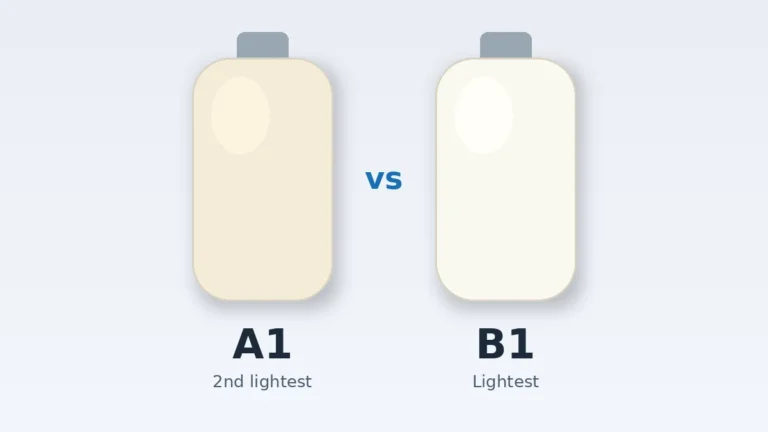
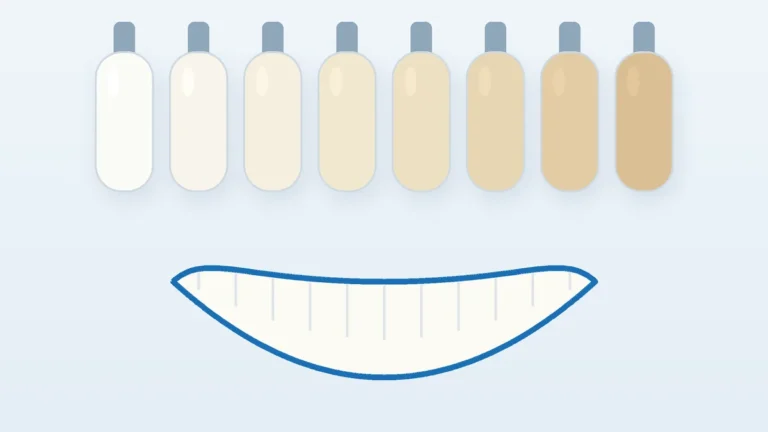
The landmark Jahangiri et al. (2002) study of 119 individuals found a counterintuitive inverse relationship between skin tone and natural tooth shade. A key practical guideline that has emerged across multiple studies: your veneer shade should never exceed the brightness of the whites of your eyes (sclera). Teeth brighter than the sclera read as artificial on any skin tone.
- Fair/cool skin tones: B-range shades (slightly yellowish-white) often look most natural. Stark blue-white shades (BL1, BL2) can look harsh and “removable.”
- Medium/olive skin tones: A-range or B-range shades. The contrast between your skin and your teeth is naturally higher, so you can go slightly brighter without looking artificial.
- Deep/warm skin tones: Benefit most from brighter shades — the higher contrast is actually beautiful and reads as healthy. Avoid muted, gray-toned whites.
Face Shape and Tooth Form
The Recurring Esthetic Dental (RED) proportion — proposed by Dr. David H. Ward in 2001 and preferred by 75% of North American cosmetic dentists over the Golden Proportion — dictates that each tooth should appear narrower than the previous one at a consistent ratio moving away from the midline. Ward’s research found that the Golden Proportion (the famous 1.618 ratio) was actually rated the least pleasing for normal-length teeth by most practitioners.
Beyond proportions, tooth shape is customized by face form:
- Oval/round faces: Slightly squared central incisors add definition. Avoid overly round, baby-tooth shapes.
- Square/angular faces: Rounded or tapered tooth edges soften the jawline. Avoid sharp, geometric veneer forms.
- Long/narrow faces: Wider-appearing teeth (horizontal emphasis) create balance. Avoid very narrow, elongated veneers.
- Heart-shaped faces: Moderate proportions work best — neither too broad nor too narrow.
Age Considerations
A 2025 study published in BMC Oral Health confirmed what experienced cosmetic dentists have observed for decades: tooth length and shade preferences shift with age. Younger patients tend to prefer slightly longer, brighter teeth; more mature patients favor naturalistic wear patterns (slightly shorter centrals, natural-looking incisal texture) that don’t clash with other visible signs of aging. A 60-year-old with BL1 veneers and deep perioral wrinkles looks incongruous. A skilled smile designer accounts for this.
3 Self-Tests to Do Before Your Consultation
These practical tests help you walk into any dental consultation with clarity — and protect you from being upsold on a look that doesn’t suit you.
Test 1: The Sclera Brightness Check Look in a mirror in natural daylight. Note the brightness of the whites of your eyes. Now look at your teeth. The target zone for your veneers is at or slightly below sclera brightness. If a dentist shows you shade samples brighter than your eye whites, ask them to go one or two shades warmer. If they resist, go elsewhere.
Test 2: The Selfie Smile Test Take 10 candid photos of yourself smiling naturally — not a posed camera-ready grin. Look for: which teeth show the most (usually the 6–8 front teeth are the “social six” or “smile eight”), whether your gum line is symmetrical, and how your current tooth shape relates to your lip line. This is exactly what your dentist will do during Digital Smile Design. Arriving with this analysis makes you a far more empowered patient.
Test 3: The Lifestyle Fit Test Answer honestly: Do you grind or clench at night? Do you bite your nails or chew ice? Do you play contact sports without a mouthguard? Are you a daily coffee, tea, or red wine drinker? If the answers skew toward yes, you need a dentist who explicitly discusses bruxism management and nightguard protocols — and you likely want lithium disilicate (e.max) over feldspathic porcelain. Composite is a poor choice if you’re a heavy stainer.
What Patients Are Choosing in 2025 (And Why)
A clear aesthetic and material shift is reshaping the veneer market. The ultra-white, hyper-uniform “Hollywood smile” of the 2010s is giving way to what industry insiders call the “quiet glow-up” — natural-looking, character-preserving enhancement over dramatic transformation.
Key numbers: ultra-thin veneers (≤0.5 mm) now represent ~45% of new placements globally. No-prep and ultra-thin combined account for 37% of all veneer procedures. Digital Smile Design adoption rose from 34% to 42% among AACD practitioners between 2019 and 2022. CAD/CAM technology now supports 58% of all veneer procedures worldwide.
| Desired Look | Most Popular Option | Why Patients Choose It |
| Natural upgrade — whiter but “still me” | Ultra-thin lithium disilicate (e.max) | Preserves enamel; looks real under all lighting |
| Full smile makeover — confidence transformation | Traditional porcelain (feldspathic or e.max) | Maximum aesthetic control; longest-lasting |
| Trial run / budget-first | Direct composite resin | Reversible; single visit; lowest upfront cost |
| Teeth grinding / active lifestyle | Zirconia veneers | Extreme strength; withstands clenching forces |
| Minimal prep / slightly misaligned teeth | Lumineers / no-prep ceramic | Zero enamel removal; gentle entry to veneers |
| Dental tourism + natural result | e.max in Colombia or Mexico | Clinical quality at 50–70% US cost savings |
The Step Before the Decision: What to Demand From Your Dentist
Never allow a dentist to begin irreversible enamel preparation without completing these three steps first. The AACD’s clinical guidelines are unambiguous on this — skipping any of these is a red flag.
Step 1: The Diagnostic Wax-Up
A dental laboratory builds a physical prototype of your proposed smile in wax, mounted on articulated study models. This blueprint allows the clinician to assess whether minimally invasive preparation is possible — and is the foundation for everything that follows. Ask to see it. Touch it. Ask what it tells them about how much tooth needs to be removed.
Step 2: The Intraoral Mock-Up
From the wax-up, a silicone matrix is made. The dentist uses this to fabricate a temporary “trial smile” placed directly in your mouth using bisacryl resin — no drilling involved. You wear it, speak with it, smile in it, and critically evaluate it under different lighting (daylight, office light, evening light). Most patients change their minds about shade, length, or shape at this stage. This is the entire point. If a clinic skips the mock-up and goes straight to preparation, walk out.
The AACD’s LeSage Classification formalizes how aggressively your teeth need to be prepared:
- Class I (no-prep): 95–100% of enamel remains intact
- Class II (minimal): 80–95% enamel, less than 0.5 mm reduction
- Class III (conservative): 50–80% enamel, 0.5–1.0 mm reduction
- Class IV (conventional): ~50% enamel remaining, ≥1.0 mm reduction
Demand to know which class you’re in before you agree to preparation.
Step 3: Try-In Paste Shade Verification
After your veneers are fabricated in the lab, before permanent bonding, your dentist should test multiple try-in pastes (water-soluble glycerin gels simulating different cement shades) to verify the final color. Research by Preston et al. (2018, European Journal of Prosthodontic and Restorative Dentistry) found that cement shade meaningfully affects final aesthetics — especially for thin veneers under 0.5 mm. Evaluate under natural light, not just the dental chair lamp. Go outside if necessary. This is your last chance to adjust before bonding is permanent.
Bonus: The Colombia Advantage in Dental Tourism
If cost is a genuine barrier, Colombia has emerged as the most credible dental tourism destination in Latin America — and arguably globally — for high-quality veneer work. Here’s why it stands apart from the “Turkey Teeth” risk:
- Medellín and Bogotá are home to internationally accredited cosmetic dental clinics staffed by dentists who trained at Colombiaʼs top universities (Universidad de Antioquia, Pontificia Universidad Javeriana) and frequently completed postgraduate training in the United States, Spain, or Brazil.
- Price gap is substantial without sacrificing materials. Porcelain veneers in Colombia range from $300–$700 per tooth (vs. $900–$2,500 in the US). A full 10-veneer smile makeover with e.max costs approximately $3,500–$6,000 all-inclusive — often including hotel and coordination. The same treatment in the US runs $15,000–$25,000.
- Regulatory framework. Colombia’s dental profession is regulated by Law 35 of 1989 and overseen by the Colombian Dental Federation (COf). Unlike the unregulated “veneer tech” trend the ADA warned about in 2024, licensed Colombian dentists operate under formal professional accountability.
- The key due-diligence checklist for Colombia dental tourism: Verify your dentist’s registration with the COf, request before-and-after cases of their actual patients, confirm the lab they use (ask whether e.max or zirconia is imported or locally manufactured), and plan a 5–7 day stay to allow for try-in, any adjustments, and a post-bonding review before flying home.
A 2025 British Dental Journal analysis noted that complications in dental tourism are concentrated in clinics with no quality framework — not in destinations broadly. Colombia’s leading cosmetic clinics have invested precisely in those frameworks. The risk is manageable when you do your homework.
Conclusion and Action Plan
Dental veneers are not impulse purchases. They are long-term investments in your confidence, your face, and your dental health — and the evidence is clear on what makes them succeed or fail.
Here are your next steps:
- Identify your primary goal: Stain correction, shape improvement, or full smile transformation? Each has an optimal material and approach.
- Choose your material: For most patients, lithium disilicate (e.max) offers the best balance of aesthetics, strength, and longevity. Composite if you need reversibility or have a tight budget. Zirconia if you grind at night.
- Insist on the three-step pre-treatment protocol: Wax-up → intraoral mock-up → try-in paste. No shortcuts.
- Assess the bonding substrate: Ask your dentist what percentage of each veneer will bond to enamel vs. dentin. The closer to 100% enamel, the closer to 99% long-term success.
- Evaluate dental tourism seriously if cost is a barrier — especially Colombia, where quality and cost align uniquely well. Do your due diligence on the specific clinic, not the country.
- Book a consultation with a specialist — ideally an AACD-accredited cosmetic dentist or an equivalent specialist in your country — and arrive with your mock-up demand ready.
The best veneer is the one that disappears — that makes people say “you look great” without knowing why. That outcome is absolutely achievable. Now you know exactly how to make it happen.
Consulted Sources
Dental Veneers: The Complete Evidence-Based Guide · Updated March 2026