
Veneers in Colombia

The Ultimate Guide to Teeth Whitening Shades and Color Scales

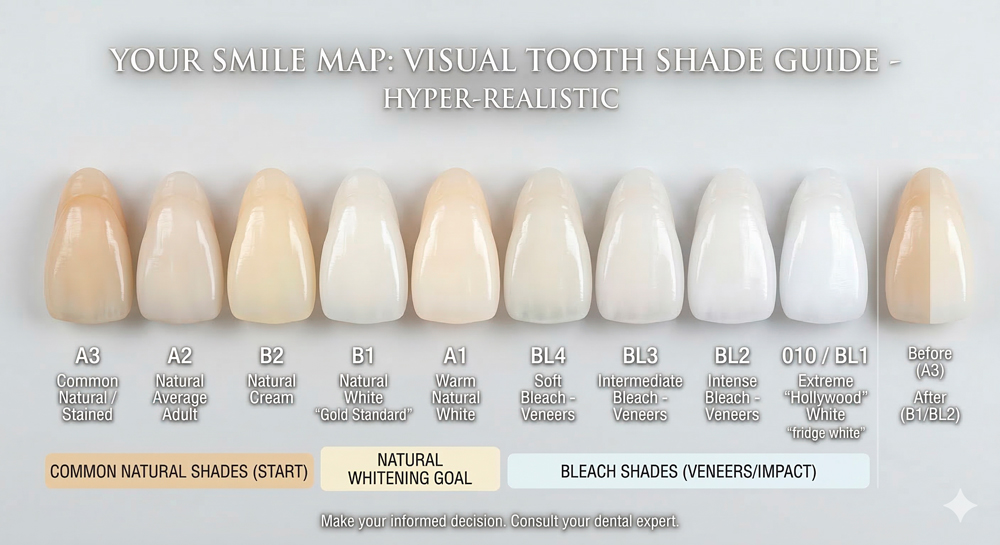
Hyper-realistic dental shade guide comparing VITA natural shades A3 to B1 and Hollywood Bleach shades BL1 to BL4 for veneers and whitening.

How shade guides work, what A3 and B1 actually mean, how many shades whiter you can realistically expect — and how veneers compare to bleaching. Clinically grounded, patient-friendly.

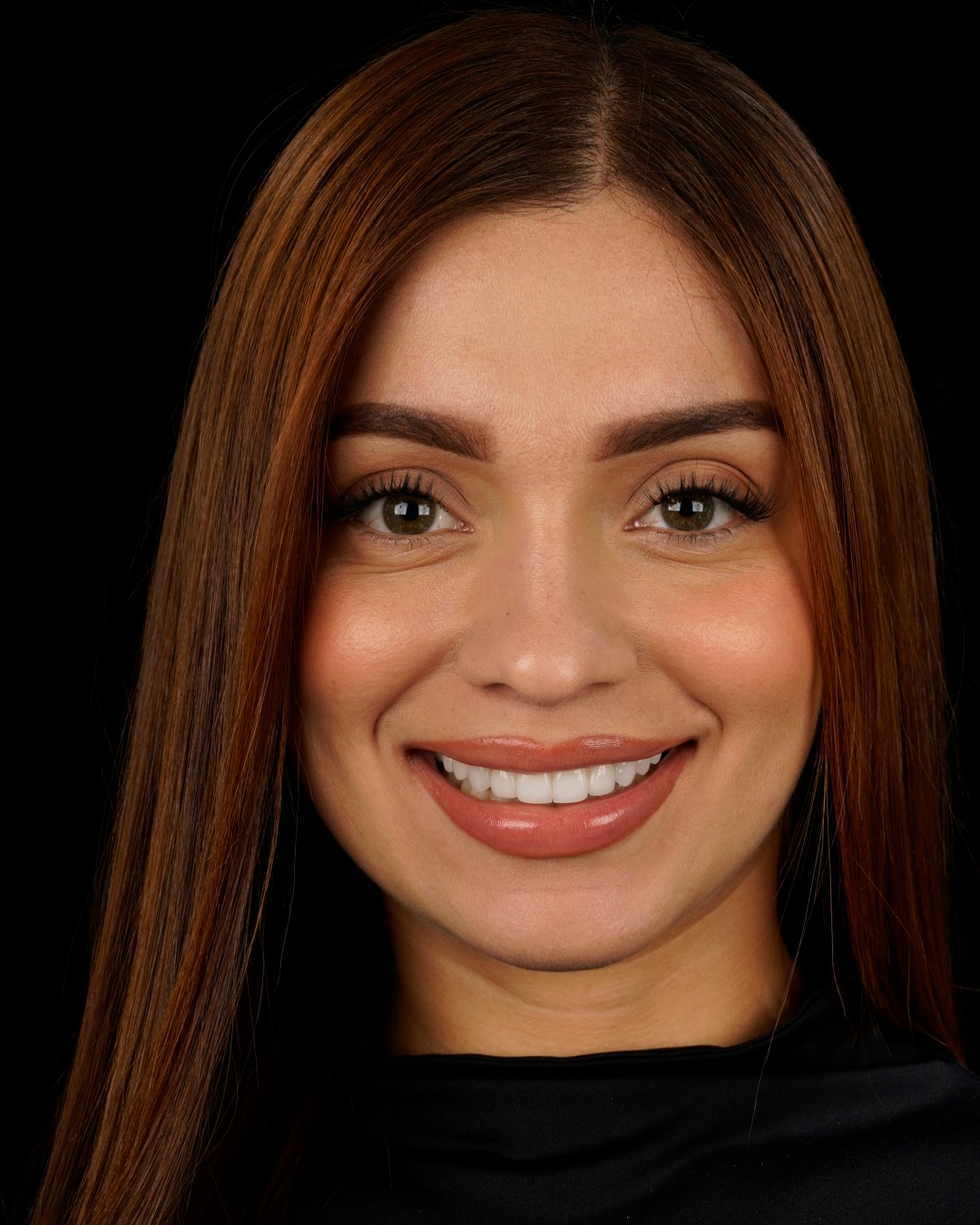
Verified Patient
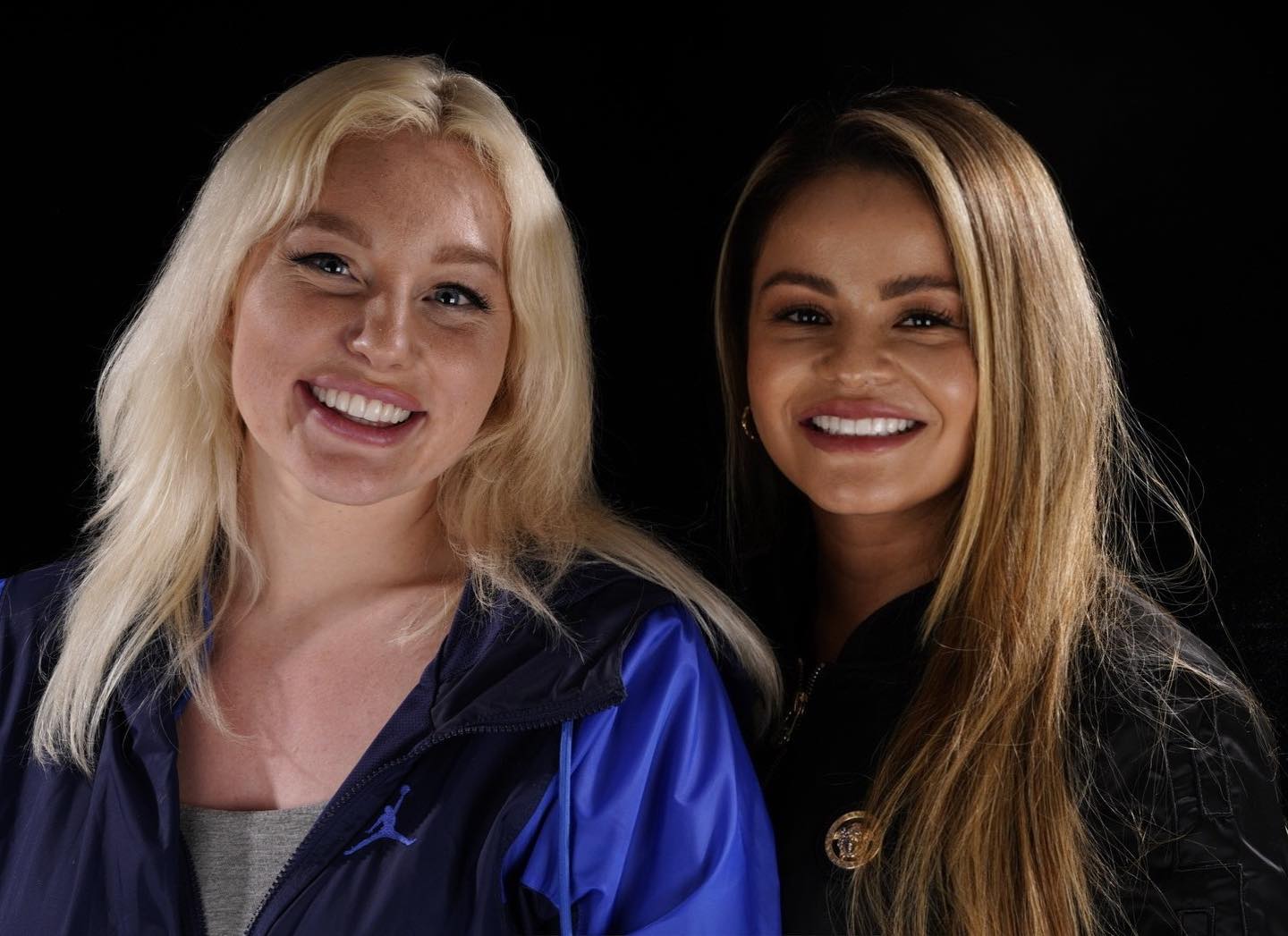
Real patient. Real results.

The same veneers cost up to 70% less in Colombia.

See if you qualify Free video call in English · on WhatsApp

Individual patient experience. Results and pricing are confirmed after a clinical evaluation.


Why tooth color varies

Tooth color comes from the interplay between translucent enamel and the naturally yellowish dentin beneath it. When enamel is thin or worn, more dentin shows through — and teeth appear darker or more yellow.

Key factors that influence tooth color include:

  • Genetics — baseline dentin color and enamel thickness
  • Age — enamel wear and cumulative staining over time
  • Diet — coffee, tea, red wine, and deeply pigmented foods
  • Smoking or vaping — nicotine and tar deposits
  • Oral hygiene and tartar build-up
  • Medications during tooth development (e.g. tetracyclines)
  • Trauma or root canal-treated teeth, which may darken from the inside

Because of this natural variation, dentists rely on a standardized shade guide rather than guessing “white” or “yellow.

Curious about pricing? See our breakdown of veneer costs in Colombia.

Still choosing a destination? Compare Colombia vs. Mexico for veneers.

Verified Patient
Real patient. Real results.

The same veneers in Colombia cost up to 70% less.

In the US, 20 porcelain veneers run $30,000–$50,000. With Dr. Yazmin in Medellin, it's $8,000, all-inclusive.

$8,000 All-Inclusive
20 HD Porcelain Veneers in just 3 days
Our own in-house lab, few clinics have one
4-Star Hotel for your 3-day stay
Private Driver throughout your trip
100% Bilingual Translator by your side
Free video consultation in English first
How it works. Only $500 to start.
Free Video Call In English with our translator, no obligation.
Today $500 Reserves your spot. That's all you pay now.
When you land $7,500 You pay the rest once you're in Medellin.

Individual patient experience. Prices, inclusions and results are confirmed after a clinical evaluation. A full evaluation is required before any treatment.


How professional shade guides work

A tooth shade guide is a fan or strip of artificial tooth tabs, each labeled with a code that corresponds to a precise combination of hue, chroma, and brightness. Clinically, a dentist will hold tabs next to your front teeth under calibrated lighting, record your starting shade, agree on a realistic target, and document the change after treatment.

Clinical uses: Most chairside and spa-style guides have 16–25 shades grouped into four families that mirror the VITA A1–D4 standard. They document starting baselines, set whitening goals, track progress session by session, and help match new restorations to neighboring natural teeth.

For a full transformation beyond whitening, see our affordable veneers in Colombia packages.

Compare the top porcelain veneer clinics in Colombia.

For professional whitening abroad, see our guide to teeth whitening in Medellín, Colombia{‘id’: 4467, ‘date’: ‘2026-03-16T21:09:41’, ‘date_gmt’: ‘2026-03-16T21:09:41’, ‘guid’: {‘rendered’: ‘https://doctoryazmin.com/?p=4467’, ‘raw’: ‘https://doctoryazmin.com/?p=4467’}, ‘modified’: ‘2026-07-13T03:55:59’, ‘modified_gmt’: ‘2026-07-13T03:55:59’, ‘password’: ”, ‘slug’: ‘teeth-whitening-shade-guide’, ‘status’: ‘publish’, ‘type’: ‘post’, ‘link’: ‘https://doctoryazmin.com/teeth-whitening-shade-guide/’, ‘title’: {‘raw’: ‘The Ultimate Guide to Teeth Whitening Shades and Color Scales’, ‘rendered’: ‘The Ultimate Guide to Teeth Whitening Shades and Color Scales’}, ‘content’: {‘raw’: ‘\n\n\n

\n\n

How shade guides work, what A3 and B1 actually mean, how many shades whiter you can realistically expect — and how veneers compare to bleaching. Clinically grounded, patient-friendly.

\n\n \n\n
\n

Why tooth color varies

\n

Tooth color comes from the interplay between translucent enamel and the naturally yellowish dentin beneath it. When enamel is thin or worn, more dentin shows through — and teeth appear darker or more yellow.

\n

Key factors that influence tooth color include:

\n
    \n
  • Genetics — baseline dentin color and enamel thickness
  • \n
  • Age — enamel wear and cumulative staining over time
  • \n
  • Diet — coffee, tea, red wine, and deeply pigmented foods
  • \n
  • Smoking or vaping — nicotine and tar deposits
  • \n
  • Oral hygiene and tartar build-up
  • \n
  • Medications during tooth development (e.g. tetracyclines)
  • \n
  • Trauma or root canal-treated teeth, which may darken from the inside
  • \n
\n

Because of this natural variation, dentists rely on a standardized shade guide rather than guessing “white” or “yellow.

\n\n
\n

How professional shade guides work

\n

A tooth shade guide is a fan or strip of artificial tooth tabs, each labeled with a code that corresponds to a precise combination of hue, chroma, and brightness. Clinically, a dentist will hold tabs next to your front teeth under calibrated lighting, record your starting shade, agree on a realistic target, and document the change after treatment.

\n\n
\n

Clinical uses: Most chairside and spa-style guides have 16–25 shades grouped into four families that mirror the VITA A1–D4 standard. They document starting baselines, set whitening goals, track progress session by session, and help match new restorations to neighboring natural teeth.

\n
\n\n
\n

The VITA classical shade guide (A1–D4)

\n

The most widely taught standard in restorative dentistry. It organizes natural tooth color into four hue families, each numbered from light (1) to dark (4).

\n\n
\n
\n
\n
A group
\n
Reddish-brown
A1 – A4
\n
\n
\n
\n
B group
\n
Reddish-yellow
B1 – B4
\n
\n
\n
\n
C group
\n
Gray tones
C1 – C4
\n
\n
\n
\n
D group
\n
Reddish-gray
D2 – D4
\n
\n
\n\n
\n
\n

B1 shade Brightest natural

\n

B1 is the whitest shade within the classical VITA system — bright and clean, yet still within the range of realistic, non-bleached tooth color. Going noticeably beyond B1 can start to look artificial unless the full smile design is carefully planned around face shape, skin tone, and lip support.

\n
\n
\n

A3 shade Most common

\n

A3 is one of the most common natural tooth shades in adults — mid-range in brightness and chroma. Most whitening consultations start around A2–A3. Moving to A1 or B1 is often perceived as a dramatic improvement, even if it represents only 2–4 positions on the professional scale.

\n
\n
\n\n
\n

The VITA Toothguide 3D-Master system

\n

A more modern system that maps tooth color across three dimensions simultaneously: brightness (value), chroma (intensity), and hue. It covers nearly all naturally occurring tooth shades — not just the 16 in the classical set.

\n\n
\n

Reading a 3D-Master code: Take 2M2 as an example. The first number (2) is the brightness group on a 1–5 scale, where 1 is brightest. The letter (M = medium, L = light, R = reddish) is the hue. The last number (2) is the chroma intensity. Labs use conversion charts to translate between classical A1–D4 codes and 3D-Master, so dentists can keep using familiar labels while technicians work in the more systematic color space.

\n
\n\n

For patients, the key benefit is that 3D-Master helps the dental team reproduce subtle details — translucency, differences between the neck and incisal edge, and complex aging effects — and integrates bleach shades into one standardized system.

\n\n
\n

Bleach shades: BL1–BL4 and beyond

\n

The classical VITA guide was designed for natural teeth and does not cover the very bright cosmetic results achievable with modern whitening and veneers. Dedicated bleach shade guides fill that gap.

\n\n
\n
\n
\n
BL1
\n
Extremely bright — “Hollywood white”
\n
\n
\n
\n
BL2
\n \n
\n
\n
\n
BL3
\n
Bright but softer, more natural-looking
\n
\n
\n
\n
BL4
\n
Darkest bleach shade, still whiter than B1
\n
\n
\n\n

Some veneer and ceramic systems also use OM1–OM3 codes for ultra-bright whites beyond the natural range. These are mainly used in full smile makeovers rather than subtle touch-ups.

\n\n
\n

How many shades whiter can you realistically get?

\n

Marketing often promises “8 shades whiter” or more, but real-world outcomes depend heavily on your starting shade, stain type, and the system used. Even 2–3 shades is already clearly visible in photos and in person.

\n\n
\n
2–3 shadesVery common — clearly visible result
\n
\n
\n
\n
4–6 shadesIn-office or well-supervised take-home trays
\n
\n
\n
\n
7–8 shadesIntensive protocols in ideal cases
\n
\n
\n\n
\n

Why results vary: Intrinsic stains from medications or trauma, thin enamel, pre-existing crowns or fillings that won\’t lighten, and ongoing habits like smoking or heavy coffee drinking all limit how far whitening can go. Dentists use the shade guide at baseline to set realistic expectations — not arbitrary numbers.

\n
\n\n

Many people are discovering that getting cosmetic veneers in Colombia is a fantastic way to achieve a perfect smile without breaking the bank. The rise in dental tourism has made this beautiful country a top destination for cosmetic dentistry.

\n\n
\n

Veneers vs. natural whitening

\n\n
\n
\n

Professional whitening

\n
    \n
  • Uses hydrogen peroxide or carbamide peroxide gels to lighten existing enamel
  • \n
  • Typically achieves 2–8 shades lighter depending on protocol and starting shade
  • \n
  • Limited by the intrinsic color of dentin and enamel translucency
  • \n
  • Less effective on tetracycline stains or root canal-darkened teeth
  • \n
\n
\n
\n

Porcelain veneers / crowns

\n
    \n
  • Cover or replace the visible tooth surface entirely with custom ceramic
  • \n
  • Any shade is selectable — including BL1 and OM1, beyond what bleaching can reach
  • \n
  • Can mask intrinsic discoloration, fluorosis, or trauma-darkened teeth
  • \n
  • Treatment of choice when a uniform, very bright result is required
  • \n
\n
\n
\n\n

Shade selection for veneers: beyond the chart

\n

Choosing the right veneer shade is less about hitting the whitest possible color and more about achieving harmony with the rest of the face. Key considerations include:

\n
    \n
  • Age — very bright bleach shades can look artificial on older patients; A2–B2 often appears more natural
  • \n
  • Skin tone — cooler, brighter whites may suit lighter complexions; warmer, creamier whites often complement deeper or warmer tones
  • \n
  • Lip color — deeply pigmented or cool-toned lipsticks amplify brightness; warm tones can highlight yellowing
  • \n
  • Existing restorations — crowns or implants that can\’t be replaced may limit the shade range
  • \n
\n

A widely used clinical guideline is to avoid going whiter than the whites of the eyes to maintain a natural-looking result.

\n\n
\n

Lipstick shades that make teeth look whiter

\n

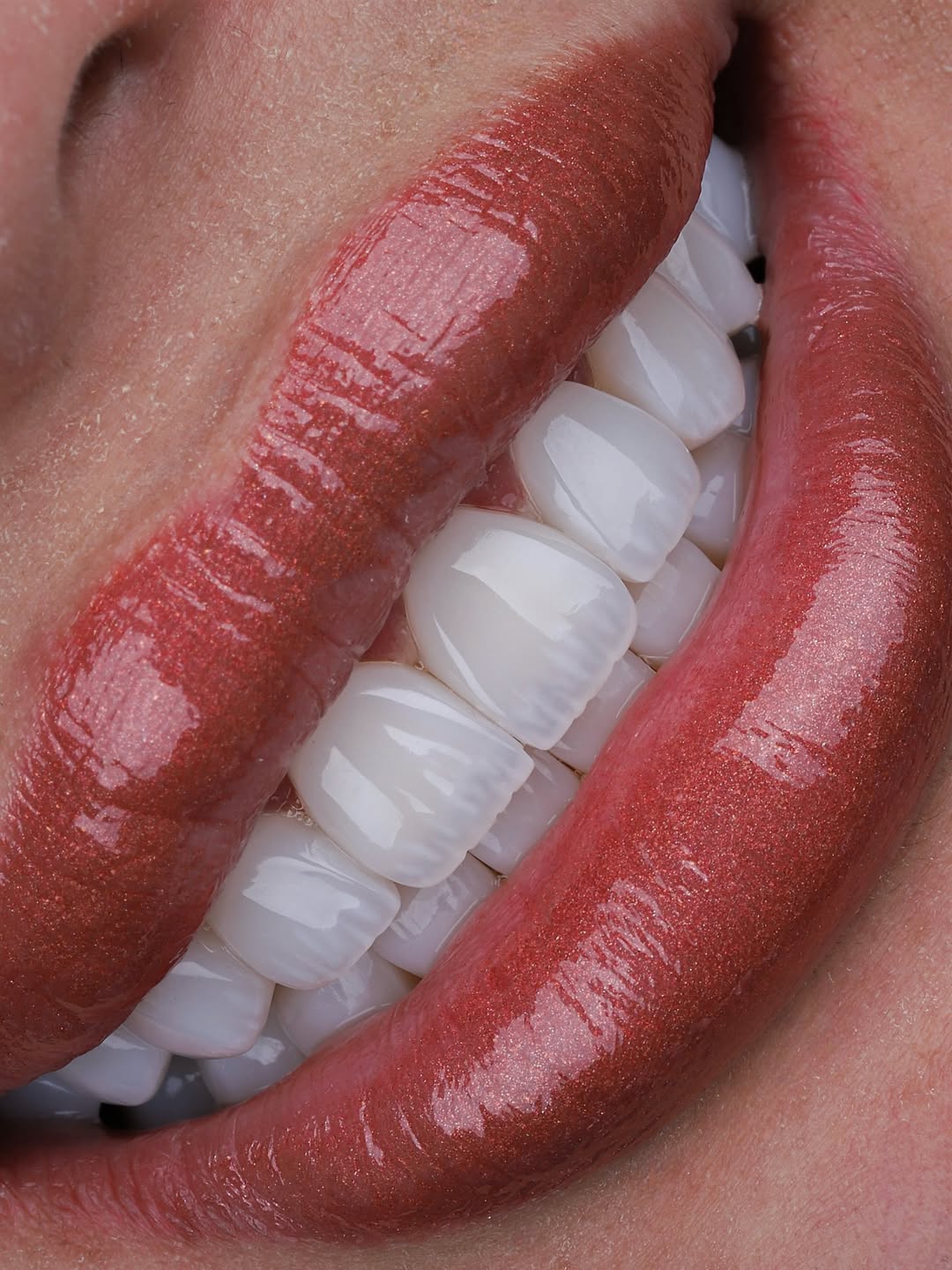
Color theory can make teeth appear noticeably whiter without any dental treatment at all. Cool-toned lipsticks with blue or berry undertones visually cancel yellow tones in teeth — a trick that costs nothing and works instantly.

\n\n
\n
\n

Works well

\n
Blue-based reds (cherry, garnet, apple)
\n
Berry and plum shades (raspberry, wine, blackberry)
\n
Cool pinks and fuchsias
\n
Cool-toned nudes (pink or mauve base)
\n
\n
\n

Use cautiously

\n
Warm orange-reds
\n
Brick reds with brown undertones
\n
Warm peach or coral nudes
\n
Dark warm browns
\n
\n
\n

Warmer tones sit closer to yellow-orange on the color wheel, which tends to highlight rather than mask tooth discoloration.

\n\n
\n

Frequently asked questions

\n\n
\n
\n
What is the whitest natural shade of teeth?
\n
Within the VITA classical A1–D4 system, B1 is widely recognized as the whitest natural tooth shade. Anything brighter — such as BL1 or OM1 — is considered a bleach or cosmetic shade, not a naturally occurring color.
\n
\n
\n
What shade are most people\’s teeth?
\n
Most adults fall around A2 or A3 on the VITA scale — warm, mid-brightness shades that are completely healthy and very common. These are the typical starting points recorded before professional whitening.
\n
\n
\n
Is B1 too white for teeth?
\n
For many patients, B1 provides a bright but still natural-looking result — especially in younger individuals or those with naturally lighter complexions. In older patients or those with warm skin tones, A1, A2, or B2 may look more harmonious than B1 or anything brighter.
\n
\n
\n
Can yellow teeth actually become white?
\n
Teeth that appear yellow mainly due to external stains — diet, smoking, plaque — often respond well to professional whitening and cleaning, sometimes reaching A1 or B1 brightness when enamel is healthy. Teeth discolored by intrinsic factors like medications, trauma, or developmental defects respond less predictably and often benefit more from veneers or crowns.
\n
\n
\n
How many shades whiter can professional whitening achieve?
\n
Professional whitening commonly delivers 2–3 shades of improvement, with 4–6 shades achievable through in-office systems or well-supervised take-home trays. Up to 7–8 shades is possible in selected cases with intensive protocols. Even a two-shade change is usually very noticeable to the naked eye.
\n
\n
\n
What veneer shade should I choose?
\n
Clinicians commonly recommend staying within A1–B1 for a natural but bright look. BL1 or OM1 brightness is best reserved for full smile makeovers or younger patients who explicitly want a dramatic, Hollywood-style result. Age, skin tone, lip color, and existing restorations all factor into the final selection.
\n
\n
\n
Does lighting affect how white teeth appear?
\n
Significantly. Cool, blue-white lighting makes teeth appear whiter; warm, yellow lighting emphasizes yellow or brown tones. This is why professional shade matching is always done under standardized or natural daylight-equivalent conditions.
\n
\n
\n
Do dentures and crowns use the same shade chart?
\n
Most modern denture and crown systems are mapped to the VITA classical and/or 3D-Master systems, even when they use proprietary codes. Labs provide conversion charts so clinicians can translate standard A1–D4 or 3D-Master selections into the manufacturer\’s naming system.
\n
\n
\n
Can I tell what shade my teeth are at home?
\n
Only a dentist or trained professional can reliably match shades using a calibrated guide and proper lighting. That said, printable shade guides and high-quality photos taken in natural light can give a rough indication of whether your teeth are in the A3 range, closer to A1/B1, or noticeably darker.
\n
\n
\n\n
\n

Key takeaways

\n
    \n
  • Tooth color is determined by enamel, dentin, and a range of lifestyle and genetic factors — “normal” spans a wide spectrum
  • \n
  • The VITA classical A1–D4 guide and the VITA 3D-Master are the two main standards for recording and communicating tooth shades
  • \n
  • B1 is the brightest common natural shade; A3 is the most frequent starting shade in adults
  • \n
  • Bleach guides (BL1–BL4, OM1–OM3) extend beyond natural white to meet cosmetic demands, especially for veneers
  • \n
  • Professional whitening typically delivers 2–6 shades of improvement — up to 7–8 in ideal cases — but expectations should be set individually using a standardized shade chart
  • \n
  • Lipstick undertones and overall facial aesthetics significantly influence how white teeth appear, making shade selection a blend of science and art
  • \n
\n
\n\n
\n\n\n\n\n\n
\n\n\n\n\n\n
\n\n

Here is the complete list of clinical references, official guidelines, and resources consulted to ensure the accuracy of the "Teeth Whitening Shades and Color Scales" guide.

\n\n
\n

References & Official Guidelines

\n\n
\n

Top VITA & Shade Guide Sources Clinical Standards

\n \n
\n\n
\n
\n

Teeth Whitening Guides Industry Data

\n \n
\n\n
\n
\n

Whitest Shades & Veneers Cosmetics

\n \n
\n\n
\n

Lipstick & Optical Enhancement Aesthetics

\n \n
\n
\n
\n\n
\n

Methodology Note: These sources represent the top-ranking results for "teeth whitening shade guide" and "teeth shades chart," encompassing official VITA documentation, supporting content on veneers, bleach shades (BL1-BL4), and optical enhancements. All data points in the guide map directly to these authoritative citations.
\n
\n\n
\n', 'rendered': '\n\n\n
\n\n

How shade guides work, what A3 and B1 actually mean, how many shades whiter you can realistically expect — and how veneers compare to bleaching. Clinically grounded, patient-friendly.

\n\n \n\n
\n

Why tooth color varies

\n

Tooth color comes from the interplay between translucent enamel and the naturally yellowish dentin beneath it. When enamel is thin or worn, more dentin shows through — and teeth appear darker or more yellow.

\n

Key factors that influence tooth color include:

\n
    \n
  • Genetics — baseline dentin color and enamel thickness
  • \n
  • Age — enamel wear and cumulative staining over time
  • \n
  • Diet — coffee, tea, red wine, and deeply pigmented foods
  • \n
  • Smoking or vaping — nicotine and tar deposits
  • \n
  • Oral hygiene and tartar build-up
  • \n
  • Medications during tooth development (e.g. tetracyclines)
  • \n
  • Trauma or root canal-treated teeth, which may darken from the inside
  • \n
\n

Because of this natural variation, dentists rely on a standardized shade guide rather than guessing “white” or “yellow.

\n\n
\n

How professional shade guides work

\n

A tooth shade guide is a fan or strip of artificial tooth tabs, each labeled with a code that corresponds to a precise combination of hue, chroma, and brightness. Clinically, a dentist will hold tabs next to your front teeth under calibrated lighting, record your starting shade, agree on a realistic target, and document the change after treatment.

\n\n
\n

Clinical uses: Most chairside and spa-style guides have 16–25 shades grouped into four families that mirror the VITA A1–D4 standard. They document starting baselines, set whitening goals, track progress session by session, and help match new restorations to neighboring natural teeth.

\n
\n\n
\n

The VITA classical shade guide (A1–D4)

\n

The most widely taught standard in restorative dentistry. It organizes natural tooth color into four hue families, each numbered from light (1) to dark (4).

\n\n
\n
\n
\n
A group
\n
Reddish-brown
A1 – A4
\n
\n
\n
\n
B group
\n
Reddish-yellow
B1 – B4
\n
\n
\n
\n
C group
\n
Gray tones
C1 – C4
\n
\n
\n
\n
D group
\n
Reddish-gray
D2 – D4
\n
\n
\n\n
\n
\n

B1 shade Brightest natural

\n

B1 is the whitest shade within the classical VITA system — bright and clean, yet still within the range of realistic, non-bleached tooth color. Going noticeably beyond B1 can start to look artificial unless the full smile design is carefully planned around face shape, skin tone, and lip support.

\n
\n
\n

A3 shade Most common

\n

A3 is one of the most common natural tooth shades in adults — mid-range in brightness and chroma. Most whitening consultations start around A2–A3. Moving to A1 or B1 is often perceived as a dramatic improvement, even if it represents only 2–4 positions on the professional scale.

\n
\n
\n\n
\n

The VITA Toothguide 3D-Master system

\n

A more modern system that maps tooth color across three dimensions simultaneously: brightness (value), chroma (intensity), and hue. It covers nearly all naturally occurring tooth shades — not just the 16 in the classical set.

\n\n
\n

Reading a 3D-Master code: Take 2M2 as an example. The first number (2) is the brightness group on a 1–5 scale, where 1 is brightest. The letter (M = medium, L = light, R = reddish) is the hue. The last number (2) is the chroma intensity. Labs use conversion charts to translate between classical A1–D4 codes and 3D-Master, so dentists can keep using familiar labels while technicians work in the more systematic color space.

\n
\n\n

For patients, the key benefit is that 3D-Master helps the dental team reproduce subtle details — translucency, differences between the neck and incisal edge, and complex aging effects — and integrates bleach shades into one standardized system.

\n\n
\n

Bleach shades: BL1–BL4 and beyond

\n

The classical VITA guide was designed for natural teeth and does not cover the very bright cosmetic results achievable with modern whitening and veneers. Dedicated bleach shade guides fill that gap.

\n\n
\n
\n
\n
BL1
\n
Extremely bright — “Hollywood white”
\n
\n
\n
\n
BL2
\n \n
\n
\n
\n
BL3
\n
Bright but softer, more natural-looking
\n
\n
\n
\n
BL4
\n
Darkest bleach shade, still whiter than B1
\n
\n
\n\n

Some veneer and ceramic systems also use OM1–OM3 codes for ultra-bright whites beyond the natural range. These are mainly used in full smile makeovers rather than subtle touch-ups.

\n\n
\n

How many shades whiter can you realistically get?

\n

Marketing often promises “8 shades whiter” or more, but real-world outcomes depend heavily on your starting shade, stain type, and the system used. Even 2–3 shades is already clearly visible in photos and in person.

\n\n
\n
2–3 shadesVery common — clearly visible result
\n
\n
\n
\n
4–6 shadesIn-office or well-supervised take-home trays
\n
\n
\n
\n
7–8 shadesIntensive protocols in ideal cases
\n
\n
\n\n
\n

Why results vary: Intrinsic stains from medications or trauma, thin enamel, pre-existing crowns or fillings that won’t lighten, and ongoing habits like smoking or heavy coffee drinking all limit how far whitening can go. Dentists use the shade guide at baseline to set realistic expectations — not arbitrary numbers.

\n
\n\n

Many people are discovering that getting veneers in Medellín is a fantastic way to achieve a perfect smile without breaking the bank. The rise in dental tourism has made this beautiful country a top destination for cosmetic dentistry.

\n\n
\n

Veneers vs. natural whitening

\n\n
\n
\n

Professional whitening

\n
    \n
  • Uses hydrogen peroxide or carbamide peroxide gels to lighten existing enamel
  • \n
  • Typically achieves 2–8 shades lighter depending on protocol and starting shade
  • \n
  • Limited by the intrinsic color of dentin and enamel translucency
  • \n
  • Less effective on tetracycline stains or root canal-darkened teeth
  • \n
\n
\n
\n

Porcelain veneers / crowns

\n
    \n
  • Cover or replace the visible tooth surface entirely with custom ceramic
  • \n
  • Any shade is selectable — including BL1 and OM1, beyond what bleaching can reach
  • \n
  • Can mask intrinsic discoloration, fluorosis, or trauma-darkened teeth
  • \n
  • Treatment of choice when a uniform, very bright result is required
  • \n
\n
\n
\n\n

Shade selection for veneers: beyond the chart

\n

Choosing the right veneer shade is less about hitting the whitest possible color and more about achieving harmony with the rest of the face. Key considerations include:

\n
    \n
  • Age — very bright bleach shades can look artificial on older patients; A2–B2 often appears more natural
  • \n
  • Skin tone — cooler, brighter whites may suit lighter complexions; warmer, creamier whites often complement deeper or warmer tones
  • \n
  • Lip color — deeply pigmented or cool-toned lipsticks amplify brightness; warm tones can highlight yellowing
  • \n
  • Existing restorations — crowns or implants that can’t be replaced may limit the shade range
  • \n
\n

A widely used clinical guideline is to avoid going whiter than the whites of the eyes to maintain a natural-looking result.

\n\n
\n

Lipstick shades that make teeth look whiter

\n

Color theory can make teeth appear noticeably whiter without any dental treatment at all. Cool-toned lipsticks with blue or berry undertones visually cancel yellow tones in teeth — a trick that costs nothing and works instantly.

\n\n
\n
\n

Works well

\n
Blue-based reds (cherry, garnet, apple)
\n
Berry and plum shades (raspberry, wine, blackberry)
\n
Cool pinks and fuchsias
\n
Cool-toned nudes (pink or mauve base)
\n
\n
\n

Use cautiously

\n
Warm orange-reds
\n
Brick reds with brown undertones
\n
Warm peach or coral nudes
\n
Dark warm browns
\n
\n
\n

Warmer tones sit closer to yellow-orange on the color wheel, which tends to highlight rather than mask tooth discoloration.

\n\n
\n

Frequently asked questions

\n\n
\n
\n
What is the whitest natural shade of teeth?
\n
Within the VITA classical A1–D4 system, B1 is widely recognized as the whitest natural tooth shade. Anything brighter — such as BL1 or OM1 — is considered a bleach or cosmetic shade, not a naturally occurring color.
\n
\n
\n
What shade are most people’s teeth?
\n
Most adults fall around A2 or A3 on the VITA scale — warm, mid-brightness shades that are completely healthy and very common. These are the typical starting points recorded before professional whitening.
\n
\n
\n
Is B1 too white for teeth?
\n
For many patients, B1 provides a bright but still natural-looking result — especially in younger individuals or those with naturally lighter complexions. In older patients or those with warm skin tones, A1, A2, or B2 may look more harmonious than B1 or anything brighter.
\n
\n
\n
Can yellow teeth actually become white?
\n
Teeth that appear yellow mainly due to external stains — diet, smoking, plaque — often respond well to professional whitening and cleaning, sometimes reaching A1 or B1 brightness when enamel is healthy. Teeth discolored by intrinsic factors like medications, trauma, or developmental defects respond less predictably and often benefit more from veneers or crowns.
\n
\n
\n
How many shades whiter can professional whitening achieve?
\n
Professional whitening commonly delivers 2–3 shades of improvement, with 4–6 shades achievable through in-office systems or well-supervised take-home trays. Up to 7–8 shades is possible in selected cases with intensive protocols. Even a two-shade change is usually very noticeable to the naked eye.
\n
\n
\n
What veneer shade should I choose?
\n
Clinicians commonly recommend staying within A1–B1 for a natural but bright look. BL1 or OM1 brightness is best reserved for full smile makeovers or younger patients who explicitly want a dramatic, Hollywood-style result. Age, skin tone, lip color, and existing restorations all factor into the final selection.
\n
\n
\n
Does lighting affect how white teeth appear?
\n
Significantly. Cool, blue-white lighting makes teeth appear whiter; warm, yellow lighting emphasizes yellow or brown tones. This is why professional shade matching is always done under standardized or natural daylight-equivalent conditions.
\n
\n
\n
Do dentures and crowns use the same shade chart?
\n
Most modern denture and crown systems are mapped to the VITA classical and/or 3D-Master systems, even when they use proprietary codes. Labs provide conversion charts so clinicians can translate standard A1–D4 or 3D-Master selections into the manufacturer’s naming system.
\n
\n
\n
Can I tell what shade my teeth are at home?
\n
Only a dentist or trained professional can reliably match shades using a calibrated guide and proper lighting. That said, printable shade guides and high-quality photos taken in natural light can give a rough indication of whether your teeth are in the A3 range, closer to A1/B1, or noticeably darker.
\n
\n
\n\n
\n

Key takeaways

\n
    \n
  • Tooth color is determined by enamel, dentin, and a range of lifestyle and genetic factors — “normal” spans a wide spectrum
  • \n
  • The VITA classical A1–D4 guide and the VITA 3D-Master are the two main standards for recording and communicating tooth shades
  • \n
  • B1 is the brightest common natural shade; A3 is the most frequent starting shade in adults
  • \n
  • Bleach guides (BL1–BL4, OM1–OM3) extend beyond natural white to meet cosmetic demands, especially for veneers
  • \n
  • Professional whitening typically delivers 2–6 shades of improvement — up to 7–8 in ideal cases — but expectations should be set individually using a standardized shade chart
  • \n
  • Lipstick undertones and overall facial aesthetics significantly influence how white teeth appear, making shade selection a blend of science and art
  • \n
\n
\n\n
\n\n\n\n\n\n
\n\n\n\n\n\n
\n\n

Here is the complete list of clinical references, official guidelines, and resources consulted to ensure the accuracy of the "Teeth Whitening Shades and Color Scales" guide.

\n\n
\n

References & Official Guidelines

\n\n
\n

Top VITA & Shade Guide Sources Clinical Standards

\n \n
\n\n
\n
\n

Teeth Whitening Guides Industry Data

\n \n
\n\n
\n
\n

Whitest Shades & Veneers Cosmetics

\n \n
\n\n
\n

Lipstick & Optical Enhancement Aesthetics

\n \n
\n
\n
\n\n
\n

Methodology Note: These sources represent the top-ranking results for "teeth whitening shade guide" and "teeth shades chart," encompassing official VITA documentation, supporting content on veneers, bleach shades (BL1-BL4), and optical enhancements. All data points in the guide map directly to these authoritative citations.
\n
\n\n
\n', 'protected': False, 'block_version': 1}, 'excerpt': {'raw': '', 'rendered': '

How shade guides work, what A3 and B1 actually mean, how many shades whiter you can realistically expect — and how veneers […]

\n', 'protected': False}, 'author': 1, 'featured_media': 4469, 'comment_status': 'open', 'ping_status': 'open', 'sticky': False, 'template': '', 'format': 'standard', 'meta': {'footnotes': '', '_elementor_edit_mode': '', '_elementor_template_type': '', '_elementor_data': '', '_elementor_page_settings': None, '_elementor_conditions': []}, 'categories': [11], 'tags': [], 'permalink_template': 'https://doctoryazmin.com/%postname%/', 'generated_slug': 'the-ultimate-guide-to-teeth-whitening-shades-and-color-scales', 'class_list': ['post-4467', 'post', 'type-post', 'status-publish', 'format-standard', 'has-post-thumbnail', 'hentry', 'category-general'], '_links': {'self': [{'href': 'https://doctoryazmin.com/wp-json/wp/v2/posts/4467', 'targetHints': {'allow': ['GET', 'POST', 'PUT', 'PATCH', 'DELETE']}}], 'collection': [{'href': 'https://doctoryazmin.com/wp-json/wp/v2/posts'}], 'about': [{'href': 'https://doctoryazmin.com/wp-json/wp/v2/types/post'}], 'author': [{'embeddable': True, 'href': 'https://doctoryazmin.com/wp-json/wp/v2/users/1'}], 'replies': [{'embeddable': True, 'href': 'https://doctoryazmin.com/wp-json/wp/v2/comments?post=4467'}], 'version-history': [{'count': 13, 'href': 'https://doctoryazmin.com/wp-json/wp/v2/posts/4467/revisions'}], 'predecessor-version': [{'id': 6896, 'href': 'https://doctoryazmin.com/wp-json/wp/v2/posts/4467/revisions/6896'}], 'wp:featuredmedia': [{'embeddable': True, 'href': 'https://doctoryazmin.com/wp-json/wp/v2/media/4469'}], 'wp:attachment': [{'href': 'https://doctoryazmin.com/wp-json/wp/v2/media?parent=4467'}], 'wp:term': [{'taxonomy': 'category', 'embeddable': True, 'href': 'https://doctoryazmin.com/wp-json/wp/v2/categories?post=4467'}, {'taxonomy': 'post_tag', 'embeddable': True, 'href': 'https://doctoryazmin.com/wp-json/wp/v2/tags?post=4467'}], 'wp:action-publish': [{'href': 'https://doctoryazmin.com/wp-json/wp/v2/posts/4467'}], 'wp:action-unfiltered-html': [{'href': 'https://doctoryazmin.com/wp-json/wp/v2/posts/4467'}], 'wp:action-sticky': [{'href': 'https://doctoryazmin.com/wp-json/wp/v2/posts/4467'}], 'wp:action-assign-author': [{'href': 'https://doctoryazmin.com/wp-json/wp/v2/posts/4467'}], 'wp:action-create-categories': [{'href': 'https://doctoryazmin.com/wp-json/wp/v2/posts/4467'}], 'wp:action-assign-categories': [{'href': 'https://doctoryazmin.com/wp-json/wp/v2/posts/4467'}], 'wp:action-create-tags': [{'href': 'https://doctoryazmin.com/wp-json/wp/v2/posts/4467'}], 'wp:action-assign-tags': [{'href': 'https://doctoryazmin.com/wp-json/wp/v2/posts/4467'}], 'curies': [{'name': 'wp', 'href': 'https://api.w.org/{rel}', 'templated': True}]}}


The VITA classical shade guide (A1–D4)

The most widely taught standard in restorative dentistry. It organizes natural tooth color into four hue families, each numbered from light (1) to dark (4).

A group
Reddish-brown
A1 – A4
B group
Reddish-yellow
B1 – B4
C group
Gray tones
C1 – C4
D group
Reddish-gray
D2 – D4

B1 shade Brightest natural

B1 is the whitest shade within the classical VITA system — bright and clean, yet still within the range of realistic, non-bleached tooth color. Going noticeably beyond B1 can start to look artificial unless the full smile design is carefully planned around face shape, skin tone, and lip support.

A3 shade Most common

A3 is one of the most common natural tooth shades in adults — mid-range in brightness and chroma. Most whitening consultations start around A2–A3. Moving to A1 or B1 is often perceived as a dramatic improvement, even if it represents only 2–4 positions on the professional scale.


The VITA Toothguide 3D-Master system

A more modern system that maps tooth color across three dimensions simultaneously: brightness (value), chroma (intensity), and hue. It covers nearly all naturally occurring tooth shades — not just the 16 in the classical set.

Reading a 3D-Master code: Take 2M2 as an example. The first number (2) is the brightness group on a 1–5 scale, where 1 is brightest. The letter (M = medium, L = light, R = reddish) is the hue. The last number (2) is the chroma intensity. Labs use conversion charts to translate between classical A1–D4 codes and 3D-Master, so dentists can keep using familiar labels while technicians work in the more systematic color space.

For patients, the key benefit is that 3D-Master helps the dental team reproduce subtle details — translucency, differences between the neck and incisal edge, and complex aging effects — and integrates bleach shades into one standardized system.


Bleach shades: BL1–BL4 and beyond

The classical VITA guide was designed for natural teeth and does not cover the very bright cosmetic results achievable with modern whitening and veneers. Dedicated bleach shade guides fill that gap.

BL1
Extremely bright — "Hollywood white"
BL3
Bright but softer, more natural-looking
BL4
Darkest bleach shade, still whiter than B1

Some veneer and ceramic systems also use OM1–OM3 codes for ultra-bright whites beyond the natural range. These are mainly used in full smile makeovers rather than subtle touch-ups.


How many shades whiter can you realistically get?

Marketing often promises "8 shades whiter" or more, but real-world outcomes depend heavily on your starting shade, stain type, and the system used. Even 2–3 shades is already clearly visible in photos and in person.

2–3 shadesVery common — clearly visible result
4–6 shadesIn-office or well-supervised take-home trays
7–8 shadesIntensive protocols in ideal cases

Why results vary: Intrinsic stains from medications or trauma, thin enamel, pre-existing crowns or fillings that won't lighten, and ongoing habits like smoking or heavy coffee drinking all limit how far whitening can go. Dentists use the shade guide at baseline to set realistic expectations — not arbitrary numbers.

Many people are discovering that getting affordable veneers in Colombia is a fantastic way to achieve a perfect smile without breaking the bank. The rise in dental tourism has made this beautiful country a top destination for cosmetic dentistry.


Veneers vs. natural whitening

Professional whitening

  • Uses hydrogen peroxide or carbamide peroxide gels to lighten existing enamel
  • Typically achieves 2–8 shades lighter depending on protocol and starting shade
  • Limited by the intrinsic color of dentin and enamel translucency
  • Less effective on tetracycline stains or root canal-darkened teeth

Porcelain veneers / crowns

  • Cover or replace the visible tooth surface entirely with custom ceramic
  • Any shade is selectable — including BL1 and OM1, beyond what bleaching can reach
  • Can mask intrinsic discoloration, fluorosis, or trauma-darkened teeth
  • Treatment of choice when a uniform, very bright result is required

Shade selection for veneers: beyond the chart

Choosing the right veneer shade is less about hitting the whitest possible color and more about achieving harmony with the rest of the face. Key considerations include:

  • Age — very bright bleach shades can look artificial on older patients; A2–B2 often appears more natural
  • Skin tone — cooler, brighter whites may suit lighter complexions; warmer, creamier whites often complement deeper or warmer tones
  • Lip color — deeply pigmented or cool-toned lipsticks amplify brightness; warm tones can highlight yellowing
  • Existing restorations — crowns or implants that can't be replaced may limit the shade range

A widely used clinical guideline is to avoid going whiter than the whites of the eyes to maintain a natural-looking result.


Lipstick shades that make teeth look whiter

Color theory can make teeth appear noticeably whiter without any dental treatment at all. Cool-toned lipsticks with blue or berry undertones visually cancel yellow tones in teeth — a trick that costs nothing and works instantly.

Works well

Blue-based reds (cherry, garnet, apple)
Berry and plum shades (raspberry, wine, blackberry)
Cool pinks and fuchsias
Cool-toned nudes (pink or mauve base)

Use cautiously

Warm orange-reds
Brick reds with brown undertones
Warm peach or coral nudes
Dark warm browns

Warmer tones sit closer to yellow-orange on the color wheel, which tends to highlight rather than mask tooth discoloration.


Frequently asked questions

What is the whitest natural shade of teeth?
Within the VITA classical A1–D4 system, B1 is widely recognized as the whitest natural tooth shade. Anything brighter — such as BL1 or OM1 — is considered a bleach or cosmetic shade, not a naturally occurring color.
What shade are most people's teeth?
Most adults fall around A2 or A3 on the VITA scale — warm, mid-brightness shades that are completely healthy and very common. These are the typical starting points recorded before professional whitening.
Is B1 too white for teeth?
For many patients, B1 provides a bright but still natural-looking result — especially in younger individuals or those with naturally lighter complexions. In older patients or those with warm skin tones, A1, A2, or B2 may look more harmonious than B1 or anything brighter.
Can yellow teeth actually become white?
Teeth that appear yellow mainly due to external stains — diet, smoking, plaque — often respond well to professional whitening and cleaning, sometimes reaching A1 or B1 brightness when enamel is healthy. Teeth discolored by intrinsic factors like medications, trauma, or developmental defects respond less predictably and often benefit more from veneers or crowns.
How many shades whiter can professional whitening achieve?
Professional whitening commonly delivers 2–3 shades of improvement, with 4–6 shades achievable through in-office systems or well-supervised take-home trays. Up to 7–8 shades is possible in selected cases with intensive protocols. Even a two-shade change is usually very noticeable to the naked eye.
What veneer shade should I choose?
Clinicians commonly recommend staying within A1–B1 for a natural but bright look. BL1 or OM1 brightness is best reserved for full smile makeovers or younger patients who explicitly want a dramatic, Hollywood-style result. Age, skin tone, lip color, and existing restorations all factor into the final selection.
Does lighting affect how white teeth appear?
Significantly. Cool, blue-white lighting makes teeth appear whiter; warm, yellow lighting emphasizes yellow or brown tones. This is why professional shade matching is always done under standardized or natural daylight-equivalent conditions.
Do dentures and crowns use the same shade chart?
Most modern denture and crown systems are mapped to the VITA classical and/or 3D-Master systems, even when they use proprietary codes. Labs provide conversion charts so clinicians can translate standard A1–D4 or 3D-Master selections into the manufacturer's naming system.
Can I tell what shade my teeth are at home?
Only a dentist or trained professional can reliably match shades using a calibrated guide and proper lighting. That said, printable shade guides and high-quality photos taken in natural light can give a rough indication of whether your teeth are in the A3 range, closer to A1/B1, or noticeably darker.

Key takeaways

  • Tooth color is determined by enamel, dentin, and a range of lifestyle and genetic factors — "normal" spans a wide spectrum
  • The VITA classical A1–D4 guide and the VITA 3D-Master are the two main standards for recording and communicating tooth shades
  • B1 is the brightest common natural shade; A3 is the most frequent starting shade in adults
  • Bleach guides (BL1–BL4, OM1–OM3) extend beyond natural white to meet cosmetic demands, especially for veneers
  • Professional whitening typically delivers 2–6 shades of improvement — up to 7–8 in ideal cases — but expectations should be set individually using a standardized shade chart
  • Lipstick undertones and overall facial aesthetics significantly influence how white teeth appear, making shade selection a blend of science and art

Here is the complete list of clinical references, official guidelines, and resources consulted to ensure the accuracy of the "Teeth Whitening Shades and Color Scales" guide.


References & Official Guidelines

Top VITA & Shade Guide Sources Clinical Standards

Methodology Note: These sources represent the top-ranking results for "teeth whitening shade guide" and "teeth shades chart," encompassing official VITA documentation, supporting content on veneers, bleach shades (BL1-BL4), and optical enhancements. All data points in the guide map directly to these authoritative citations.
Whatsapp Whatsapp Phone Call Phone Call