“Whitest” means different things depending on which shade guide your dentist uses. Here’s the whitest natural shade, the whitest bleach shades (BL1–BL4 and OM1), how they compare, and how a dentist helps you decide how white is right for you.
The same veneers cost up to 70% less in Colombia.
See if you qualify Free video call in English · on WhatsAppIndividual patient experience. Results and pricing are confirmed after a clinical evaluation.
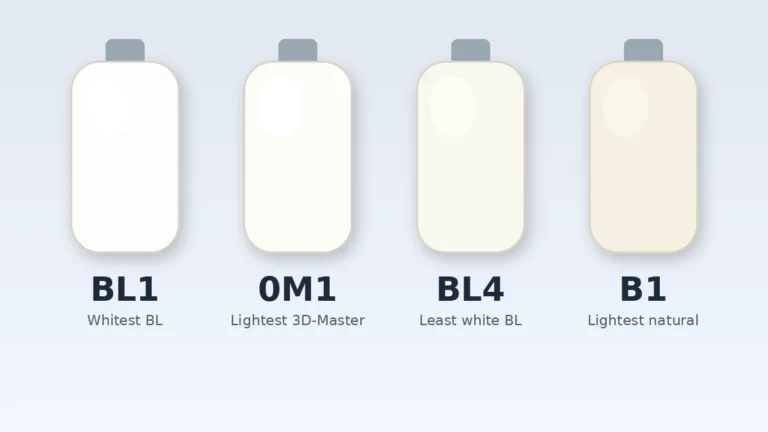
Short answer: the whitest natural tooth shade is B1, the lightest of the 16 shades on the VITA classical guide. Whiter than that are the bleach shades. In the BL system most often used for veneers and crowns (Ivoclar’s A–D guide with Bleach shades), BL1 is the whitest and BL4 the least white of the four, although BL4 is still lighter than B1. In the VITA 3D-Master system, the lightest shade is 0M1 (often written OM1). BL1 and OM1 come from different systems and don’t translate exactly into each other, but both sit at the extreme white end of what dental labs offer. The whitest shade isn’t automatically the best one: what looks right depends on your skin tone, your other teeth and the look you want, and it’s confirmed in person.
The whitest natural shade: B1
Most dentists describe natural tooth color with the VITA classical shade guide. It has 16 tabs in four hue groups: A (reddish-brown), B (reddish-yellow), C (grayish) and D (reddish-gray). The number shows lightness within each group, so 1 is the lightest and 4 the darkest.
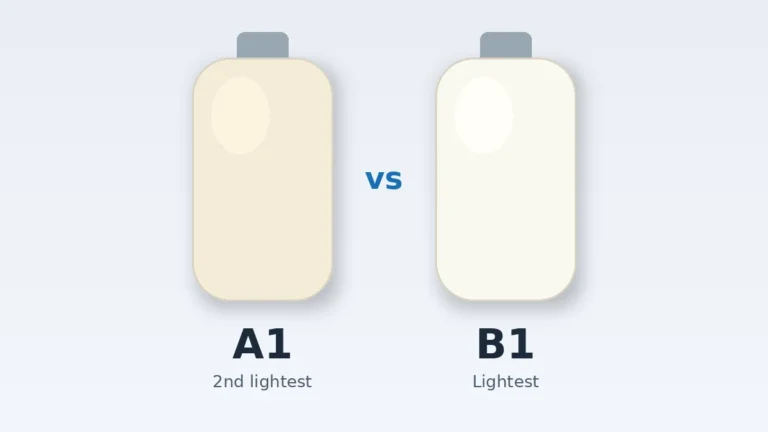
When the tabs are arranged by lightness instead of by letter, B1 comes first and A1 second. That makes B1 the whitest shade you’ll find on the natural scale. The difference between the two is subtle, and our comparison of A1 vs B1 tooth shade explains it in detail.
Everything whiter than B1 belongs to the bleach range. These shades were added to shade guides because whitening and cosmetic restorations can produce teeth lighter than the natural scale was designed to describe.
The whitest bleach shades: BL1–BL4
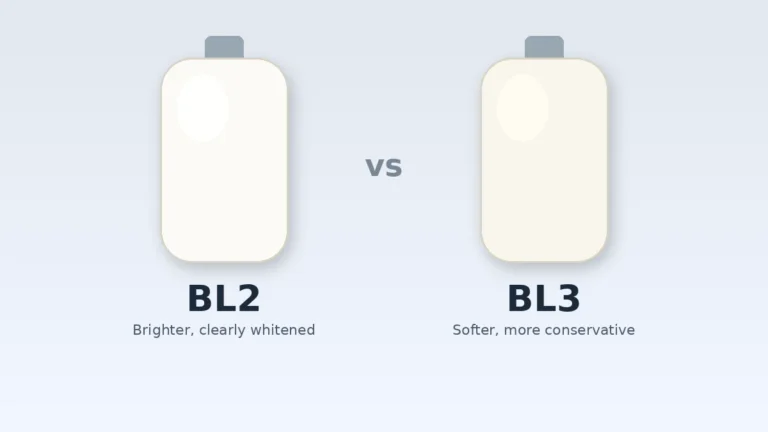
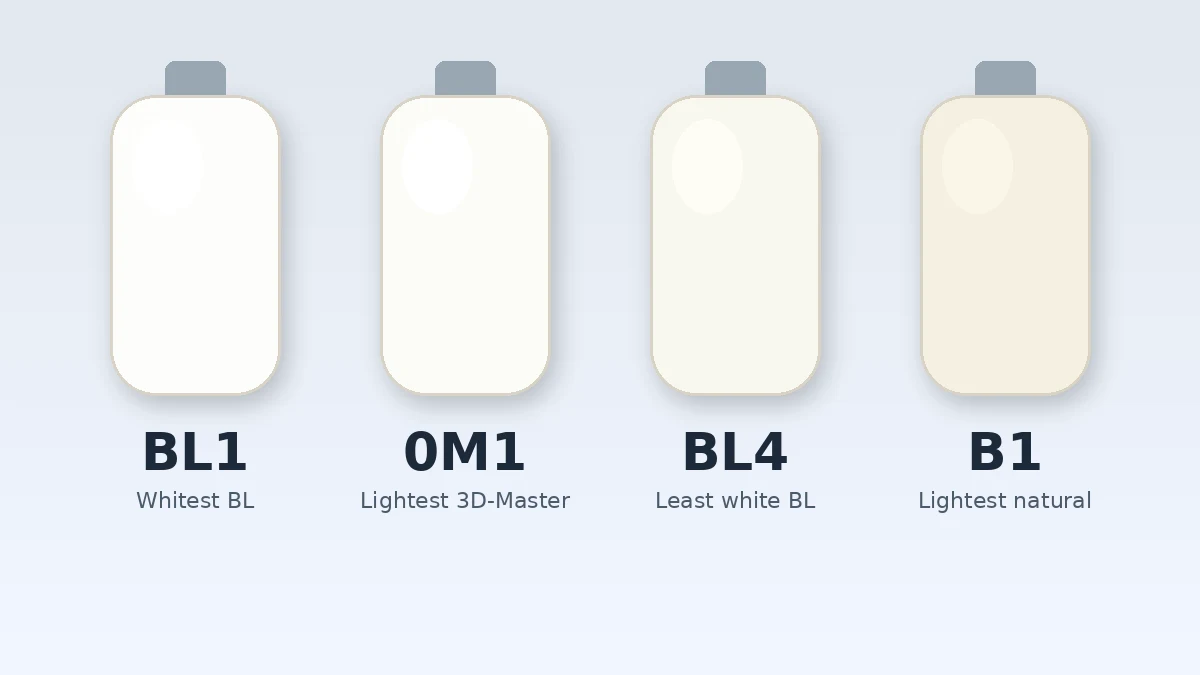
The BL shades come from Ivoclar’s A–D shade guide, which adds four Bleach shades, BL1 to BL4, to the 16 classical shades. They are widely used for ceramic veneers and crowns, including e.max restorations. In this system the order runs from whitest to least white:
Get your veneers in Colombia for up to 70% less.
In the US, 20 porcelain veneers run $30,000–$50,000. With Dr. Yazmin in Medellin, it's $6,900, all-inclusive.
Individual patient experience. Prices, inclusions and results are confirmed after a clinical evaluation. A full evaluation is required before any treatment.
bleach shade
a touch softer
more conservative
still lighter than B1
Swatches are illustrative only. Screens can’t reproduce real shade tabs accurately.
So if your question is “is BL1 the whitest shade?”, the answer in this system is yes. You may also see charts online that list the order the other way round, with BL4 as the whitest. Labeling isn’t identical across every chart and manufacturer, which is why it’s worth asking your clinic which shade guide they and their lab use, and looking at the physical tabs rather than relying on a code alone.
For the two most requested options, see our BL1 vs BL2 veneers guide. If you’re worried that the brightest end of the scale might look unnatural on you, our article on whether BL3 and BL4 veneers can look too white covers how skin tone, gum color and translucency change the result.
OM1 (0M1) and the VITA 3D-Master guide
The VITA 3D-Master shade guide organizes color differently from the classical guide. It groups shades by lightness first (value groups numbered 1 to 5, where 1 is the lightest), then by color intensity and hue. Its bleached group is labeled “0”, so its shades are written 0M1, 0M2 and 0M3. People often type them with the letter O, as OM1, OM2 and OM3.
0M1 is the lightest shade on the 3D-Master guide. That’s why both OM1 and BL1 get described as “the whitest shade”. They are each the whitest in their own system, but the systems measure color in different ways, so there’s no exact one-to-one conversion between them. Our article on OM1 vs BL1 veneer shades explains why it matters that your dentist and lab are using the same guide.
Whitest shades compared in one table
| Shade | Shade guide | Natural or bleach? | Where it sits |
|---|---|---|---|
| BL1 | Ivoclar A–D with Bleach shades | Bleach | Whitest of the four BL shades |
| BL2 | Ivoclar A–D with Bleach shades | Bleach | Second whitest BL shade |
| BL3 | Ivoclar A–D with Bleach shades | Bleach | Third BL shade |
| BL4 | Ivoclar A–D with Bleach shades | Bleach | Least white BL shade, still lighter than B1 |
| 0M1 (OM1) | VITA 3D-Master | Bleach | Lightest shade on the 3D-Master guide |
| 0M2, 0M3 | VITA 3D-Master | Bleach | Rest of the bleached “0” group |
| B1 | VITA classical | Natural | Lightest of the 16 natural shades |
| A1 | VITA classical | Natural | Second lightest natural shade |
BL and 0M shades appear in the same table here for convenience, but they shouldn’t be read as one continuous ranking. Compare shades within the same guide, and ask to see the real tabs. For a wider view of how natural and whitened shades are charted, see our teeth whitening shade guide.
B1 vs BL4: how big is the jump?
BL4 and B1 sit next to each other at the boundary between natural and bleach shades, which is why “B1 vs BL4” is such a common comparison. BL4 is the less extreme bleach shade, so it’s lighter than B1 but not as white as BL1 or BL2. On real tabs the step from B1 to BL4 is visible but moderate. The step from B1 to BL1 is much more noticeable.
In practice, B1 tends to read as “very white but still natural”, while BL4 tends to read as “clearly whitened”. Which one looks better depends on the person, the material and how many teeth are being treated.
Can you actually get the whitest shade?
With teeth whitening
- Whitening lightens your own natural teeth, but how far they lighten varies from person to person. Reaching B1, let alone a bleach shade, can’t be promised.
- Whitening doesn’t change the color of crowns, veneers or fillings.
- Some people get temporary sensitivity, and results can fade over time.
With veneers or crowns
- The shade is chosen with your dentist and made by a dental lab, so BL1, OM1 or any other available shade can be selected.
- Only the treated teeth change color. Untreated teeth keep their own shade, which can create a visible mismatch.
- Porcelain veneers usually involve preparing the tooth surface, so they’re a significant, long-term decision.
Composite bonding is another option for some cases. Composite brands offer extra-light shades, but names and ranges differ between brands, and composite tends to pick up surface stains more readily than porcelain over time. Your dentist can explain which material suits your teeth.
Should you choose the whitest shade?
Not necessarily. The whitest shade available is a starting point for the conversation, not a recommendation. A few factors usually decide how white is right:
- Your untreated teeth. If some natural teeth will stay visible, very white restorations beside them can look patchy unless those teeth are whitened or matched.
- Skin tone, lip and gum color. The same shade can look balanced on one face and stark on another.
- The look you want. Some people want a bright “Hollywood” look; others want people to assume their teeth are naturally nice.
- Material and lab work. Translucency and surface texture affect how natural a very light shade looks as much as the shade code does.
The reliable way to decide is to see real shade tabs next to your teeth in good light and, for veneers, ideally a trial smile or mock-up before anything is final. To see how Dr. Yazmín Escudero’s clinic in Medellín plans shade and treatment, visit our porcelain veneers in Colombia page.
Key takeaways
- B1 is the whitest natural shade on the VITA classical guide.
- In the BL bleach system, BL1 is the whitest and BL4 the least white, though BL4 is still lighter than B1.
- 0M1 (OM1) is the lightest shade on the VITA 3D-Master guide. It doesn’t convert exactly to BL1.
- Whitening results vary and can’t guarantee a specific shade. Veneers and crowns let you choose the shade of the treated teeth.
- The whitest shade isn’t always the best one. Your final shade is confirmed in person.
Frequently asked questions
What is the whitest shade of teeth?
The whitest natural tooth shade is B1, the lightest of the 16 shades on the VITA classical guide. Whiter than that are bleach shades: in the BL system, BL1 is the whitest, and on the VITA 3D-Master guide the lightest shade is 0M1 (OM1). These bleach shades are mostly reached with veneers or crowns, because whitening results on natural teeth vary.
Is BL1 the whitest shade?
In the BL bleach system used by many dental labs (Ivoclar’s A–D guide with Bleach shades), yes: BL1 is the whitest of the four BL shades. OM1 on the VITA 3D-Master guide is also described as the whitest in its own system. Some online charts list the BL order differently, so ask your clinic which shade guide they use.
Which is whiter, B1 or BL4?
BL4 is whiter. B1 is the lightest natural shade, and BL4 is the least extreme of the bleach shades, so it sits just beyond B1. The step between them is visible but moderate, much smaller than the jump from B1 to BL1.
What is BL4 tooth shade?
BL4 is one of the four bleach shades (BL1–BL4) added to the classical A–D shade guide. In the most common convention, it’s the least white of the bleach shades but still lighter than B1, the lightest natural shade. People often choose it when they want a whitened look that stays fairly conservative.
What is the order of BL1, BL2, BL3 and BL4?
In the BL system used by many ceramic systems, the order from whitest to least white is BL1, BL2, BL3, BL4. All four are lighter than the natural VITA classical shades. Labeling can vary between charts, so confirm the guide your clinic and lab use.
Is OM1 whiter than BL1?
They can’t be ranked precisely against each other. OM1 (0M1) is the lightest shade on the VITA 3D-Master guide, and BL1 is the whitest of the BL bleach shades. Both are at the extreme white end, but the two systems measure color differently, so there’s no exact conversion. What matters is that your dentist and lab use the same guide.
What are the whitest veneers?
The whitest veneers are made in the lightest bleach shades a lab offers, typically BL1 or OM1 (0M1). Whether they look good depends on your skin tone, your untreated teeth and the material’s translucency. A dentist can show you the shade next to your teeth, ideally with a trial smile, before anything is final.
Can teeth whitening make my teeth BL1?
It can’t be guaranteed. How much natural teeth lighten with whitening varies from person to person, and many people don’t reach the bleach range. Whitening also doesn’t change the color of existing crowns, veneers or fillings. A dentist can tell you what’s realistic for your teeth.
Wondering how white is right for you?
Send our team a message on WhatsApp at +57 300 300 0730 to ask about a free photo assessment with Dr. Yazmín Escudero’s clinic in El Poblado, Medellín. Your final shade is always confirmed in person, with real shade tabs next to your teeth.
Chat on WhatsApp