The Clinical Reality of Veneering Misaligned Teeth
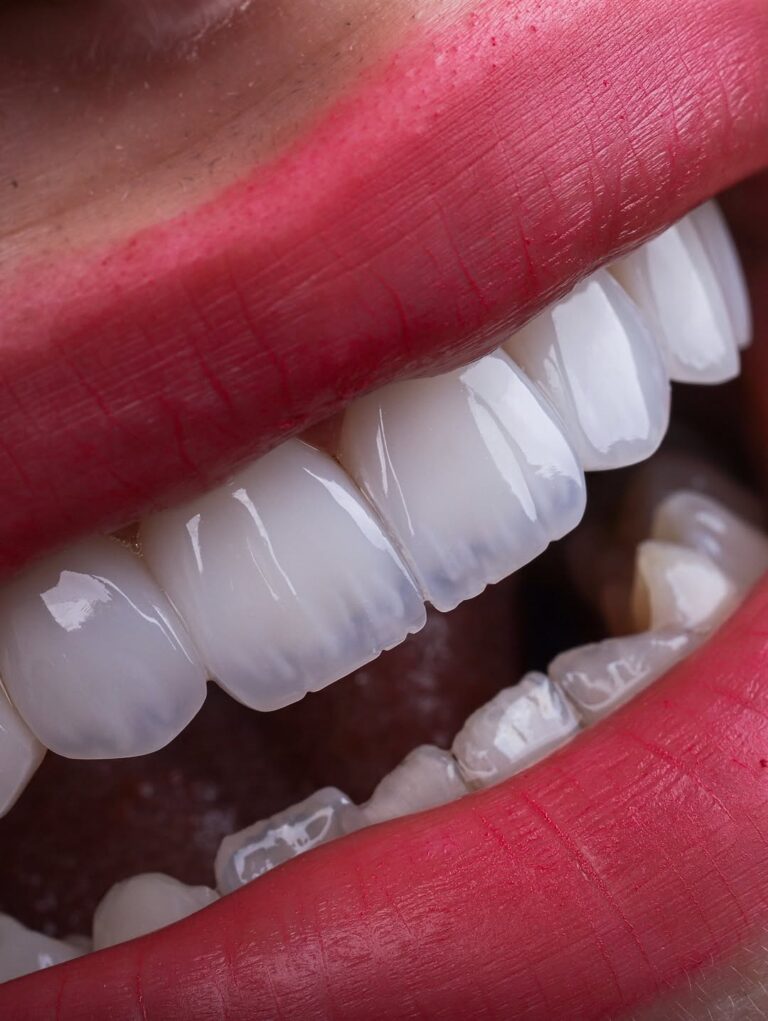
Veneers on crooked or crowded teeth are possible — but the clinical reality involves more enamel removal, more complex case planning, and a set of long-term risks that patients considering this route need to understand before committing. The marketing phrase “instant orthodontics” exists for a reason: veneers can make a smile look straighter almost immediately. What it obscures is that achieving that result often requires removing significantly more tooth structure than a standard veneer case, and in some situations creates bite problems that become expensive to fix later.
The same veneers cost up to 70% less in Colombia.
See if you qualify Free video call in English · on WhatsAppIndividual patient experience. Results and pricing are confirmed after a clinical evaluation.
When teeth are misaligned, the facial surfaces aren’t co-planar — they’re rotated, shifted forward or backward, or overlapping. To make veneers appear straight across all of those teeth, the dentist has to either build out the teeth that are set back (using thicker veneers, which may require little or no enamel removal) or reduce the teeth that protrude (removing more enamel to create a flat surface that can accept a veneer without making the tooth look enormous). In moderate to severe crowding, both situations occur simultaneously across adjacent teeth, meaning some teeth lose quite a bit of enamel while others receive thick ceramic shells.
How Much More Enamel Is Involved
Standard veneer prep on a well-positioned tooth removes roughly 0.3–0.5 mm of enamel. On a rotated or protruding tooth that needs significant recontouring to look straight, prep can reach 1.0–1.5 mm. At that depth, you’re approaching — or in some cases entering — dentin. The risk of pulp irritation, post-procedure sensitivity, and eventual pulp necrosis increases meaningfully. Some heavily prepped teeth eventually need root canal treatment even when the initial procedure appeared successful.
When Veneers Can Mask Mild Crowding
For mild crowding — dentists often use the term “minor irregularities” — veneers can produce a genuinely good aesthetic result with manageable risks. The criteria that make someone a reasonable candidate for veneers without prior orthodontics:
- Crowding of 2–3 mm or less across the arch (total space discrepancy, not per tooth)
- Rotation limited to 15–20 degrees on individual teeth — beyond this, the amount of reduction required on the rotated edge becomes clinically concerning
- No significant bite problems — the patient bites evenly, with no signs of joint dysfunction or excessive wear
- Healthy enamel thickness — enough existing enamel that the preparation required won’t consistently breach into dentin
- Realistic aesthetic expectations — understanding that the result is an improvement in appearance, not a true correction of position
In these cases, a skilled cosmetic dentist with CBCT imaging and digital smile design can plan a veneer case that produces a beautiful, straight-looking result. The underlying teeth haven’t moved, but the visible surfaces are reshaped and resized to create the illusion of alignment.
When Orthodontics Is Mandatory First
Orthodontic treatment before veneers isn’t optional in the following situations:
Get your veneers in Colombia for up to 70% less.
In the US, 20 porcelain veneers run $30,000–$50,000. With Dr. Yazmin in Medellin, it's $6,900, all-inclusive.
Individual patient experience. Prices, inclusions and results are confirmed after a clinical evaluation. A full evaluation is required before any treatment.
Significant Crowding or Crossbite
When crowding exceeds 4–5 mm, or when teeth are in crossbite (upper teeth biting inside lower teeth rather than outside), the amount of preparation required to make veneers look natural becomes aggressive enough that responsible dentists won’t proceed without first moving teeth into better position. Beyond a certain threshold, there is simply not enough enamel on a rotated tooth to safely create a preparation surface.
Deep Bite or Open Bite
Vertical bite problems — a deep overbite where the upper front teeth cover most or all of the lower front teeth, or an open bite where the front teeth don’t meet at all — cannot be corrected with veneers. Placing veneers without addressing the vertical dimension of the bite risks creating restorations that bear excessive force on the wrong vectors, leading to chipping, debonding, or fracture. Deep bites and open bites require orthodontic correction, sometimes combined with orthognathic surgery in severe cases, before cosmetic restorations are appropriate.
Skeletal Discrepancies
If the crowding or misalignment is driven by a jaw size discrepancy (a narrow upper arch, a recessive lower jaw, etc.), veneers address only the dental surface — the underlying skeletal cause remains. Over time, the teeth will continue to drift under those forces, and the veneers may crack, debond, or simply look wrong as the underlying structure continues to change.
The Problem of Veneering Without Fixing the Bite
This deserves its own section because it’s one of the most common sources of veneer failure in misalignment cases. The bite — the specific way upper and lower teeth contact each other — determines how force is distributed across all teeth throughout every chewing cycle and every contact during swallowing. When the bite is off, even subtly, certain teeth bear disproportionate load.
Porcelain veneers are hard and relatively brittle. They resist compression well but fracture under tensile stress. When a veneer is placed on a tooth that’s in a poor bite position — receiving force at the wrong angle or at moments when it shouldn’t be bearing load at all — it’s only a matter of time before something chips or debonds. In a series of veneers placed on teeth with underlying occlusal problems, you may see the same veneer repeatedly fracturing, or multiple veneers failing within a few years of placement, each repair costing $1,000–$2,500.
A competent pre-veneer workup always includes detailed occlusal analysis. If a dentist is proposing veneers on a crowded arch without any discussion of your bite, that’s a significant omission.
When Veneers + Invisalign (or Braces) Makes Sense Together
The combination of orthodontic treatment followed by veneers is a well-established sequencing for patients who have both alignment and cosmetic concerns. The orthodontics moves teeth into proper position and achieves correct bite alignment. The veneers then address color, shape, and minor surface irregularities that orthodontics alone doesn’t fix — size discrepancies between teeth, peg laterals (undersized lateral incisors), worn edges, chips, or staining.
This sequencing matters. Orthodontics first, then veneers. If veneers are placed first and then the patient wants orthodontic treatment, the veneers either have to be removed and remade (expensive) or the orthodontic options become limited because brackets can’t bond to porcelain as reliably as to enamel. Aligner-based treatment (Invisalign or similar) is more compatible with existing veneers than bracket-and-wire orthodontics, but alignment still changes tooth positions in ways that affect how veneers look and fit. Remakes are often needed after alignment if veneers were placed before treatment.
An ideal combined case looks like this: the patient completes 12–24 months of Invisalign, establishing correct tooth positions and bite. A 6-month retention period follows to allow bone remodeling around the moved teeth. Then, with stable, well-aligned teeth as the foundation, the dentist plans a limited number of veneers (or composite bonding) to refine shape and color. Total time: 18–30 months from start to final smile. The investment is higher than veneers alone, but the result is both stable and genuinely correct rather than cosmetically masked.
What “Instant Orthodontics” with Veneers Really Means — and Its Long-Term Cost
The phrase “instant orthodontics” was coined by cosmetic dentists in the 1990s and early 2000s to market veneer cases where multiple misaligned teeth were masked to look straight. The appeal is obvious: the result is fast, there are no years of braces, and the aesthetic outcome can be dramatic.
What the marketing doesn’t emphasize: every veneer is a permanent restoration that will eventually need replacement. Porcelain veneers typically last 10–15 years under ideal conditions. A full arch of 8–10 veneers placed in your 30s will likely need replacement once or twice in your lifetime. At $1,200–$2,500 per veneer, replacing a full arch costs $10,000–$25,000 each time. Over a lifetime, the total cost of “instant orthodontics” can substantially exceed what orthodontic treatment followed by limited cosmetic work would have cost.
There’s also the compounding problem of enamel. Each replacement cycle requires preparing the tooth again — removing slightly more enamel than the cycle before. By the second or third replacement, some of these teeth may have so little natural structure left that they require crowns rather than veneers, which means covering the entire tooth, removing even more structure, and committing to a more complex restoration permanently.
None of this means instant orthodontics is always wrong. For patients in their 50s or 60s who don’t want years of orthodontic treatment and have a realistic understanding of long-term maintenance costs, the calculus can favor veneers. For a 28-year-old with significant crowding, it almost never does.
Questions to Ask Your Dentist Before Choosing Veneers Over Orthodontics
- How much enamel will you need to remove from each tooth? Ask for this per-tooth, not as an average. Any tooth requiring more than 0.7 mm of reduction is a question worth pressing on.
- Will you be taking radiographs to assess enamel thickness before prep? CBCT imaging or high-quality periapical X-rays should precede aggressive prep on misaligned teeth.
- What happens to my bite when the veneers are placed? The dentist should be able to explain specifically how the new veneers will interact with your opposing teeth in all excursive movements, not just in the straight-ahead bite.
- Have you done a diagnostic wax-up? A wax-up (physical or digital) shows you and the dentist exactly what the final result will look like and lets you evaluate whether the tooth preparations required are realistic before anyone drills anything.
- What’s the expected lifespan and replacement plan? A dentist who says veneers “last forever” is not being accurate. Understand the replacement cycle and associated costs upfront.
- Would orthodontic treatment reduce how much enamel needs to be removed? If the answer is yes by a meaningful margin, ask the dentist to quantify it and discuss the timeline difference honestly.
- Do I have any signs of joint problems (TMJ) that should be evaluated before cosmetic work? Pre-existing temporomandibular dysfunction plus veneers on misaligned teeth is a high-risk combination.
- What’s my retention plan after treatment? Teeth continue to shift throughout life. Whether you choose orthodontics, veneers, or both, a long-term retention strategy protects the investment.
Veneers on crooked teeth can produce results that are genuinely transformative — but only when the case is planned comprehensively, the enamel removal is conservative, and the bite is either sound to begin with or corrected before the veneers go in. The cases where this goes wrong are almost always the ones where one of those conditions wasn’t met.