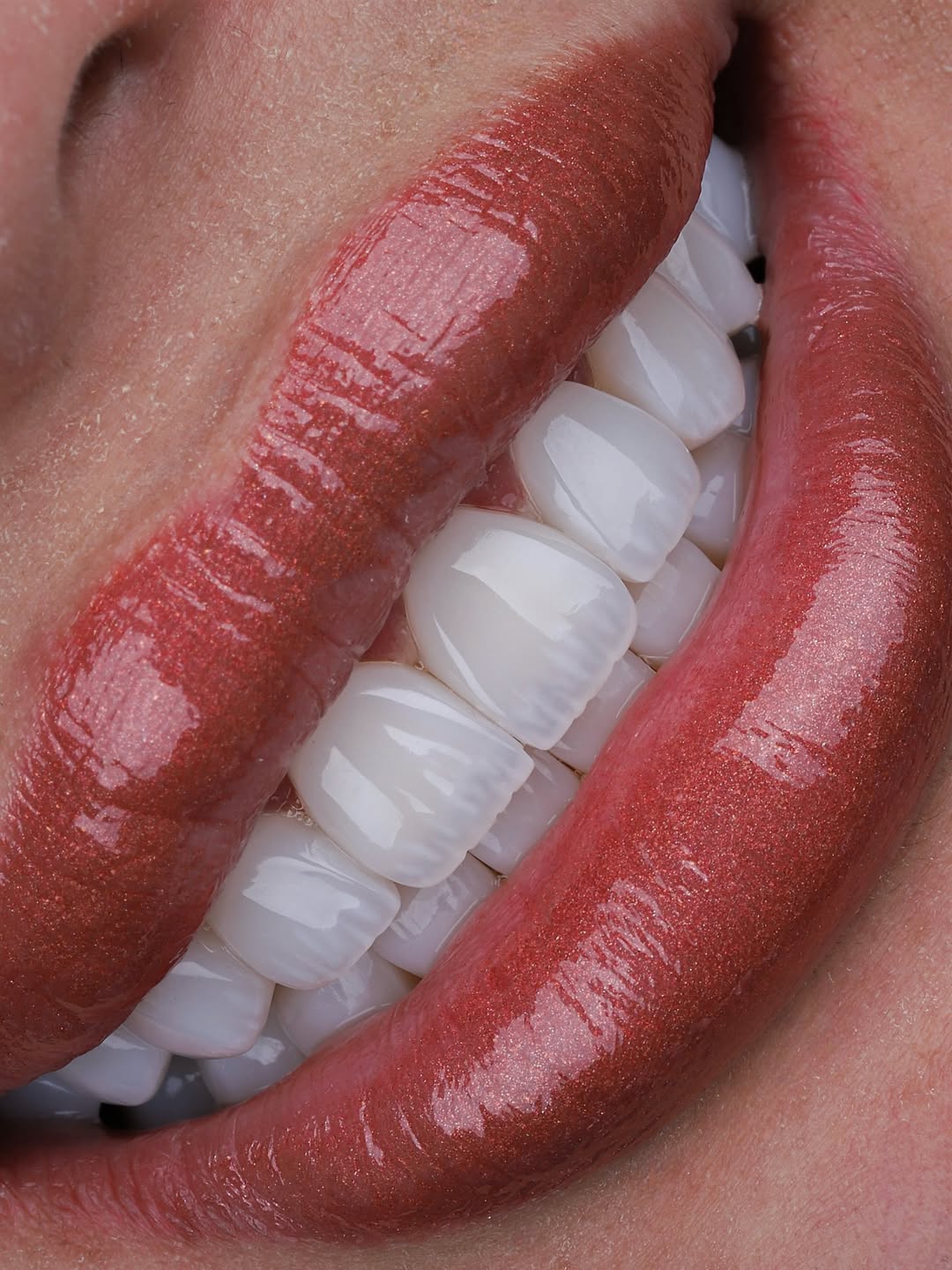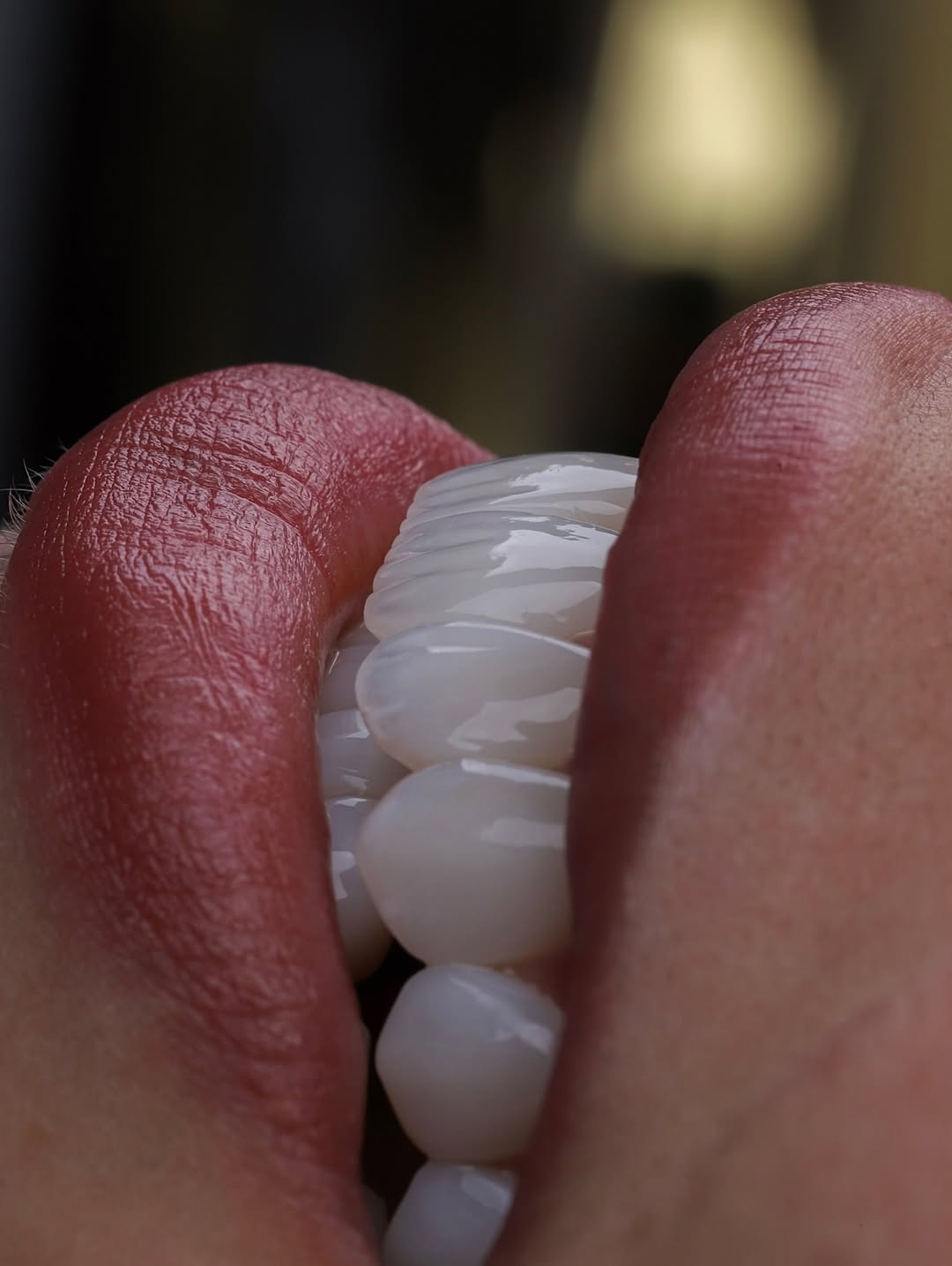
The Smile Zone: Which Teeth Actually Show
Before deciding how many veneers you need, you need to understand the smile zone — the teeth that are visible when you smile naturally. This isn’t fixed; it depends on your lip mobility, face width, and how broadly you smile. For most people, a relaxed social smile reveals between 6 and 10 upper teeth. A broad, open laugh can reveal all 12 upper teeth plus the gingival tissue above them.
The same veneers cost up to 70% less in Colombia.
See if you qualify Free video call in English · on WhatsAppIndividual patient experience. Results and pricing are confirmed after a clinical evaluation.
The key insight from smile design is this: any veneer treatment should cover a complete aesthetic unit. Stopping in the middle of a visible tooth zone creates an obvious mismatch. Your dentist isn’t just counting teeth — they’re mapping the boundaries of your natural smile to define a minimum treatment zone.
Why 4 Veneers Is Usually the Minimum Aesthetic Unit
Four upper veneers (the two central and two lateral incisors) is the smallest number that typically produces a visible smile transformation. These four teeth dominate the smile zone and are the most scrutinized. If your primary concern is discoloration, minor chipping, or slight size inconsistency limited to these four teeth, four veneers may be clinically sufficient.
However, four veneers create a real risk: color mismatch with the adjacent canines. Porcelain reflects light differently than natural enamel. Even when a lab matches color precisely at the time of placement, the veneered teeth and natural teeth age differently — porcelain doesn’t stain and yellow the way enamel does. In five years, the contrast between four brilliant veneers and two natural canines can become noticeable.
Four veneers also make sense in limited scenarios: repairing damage to specific front teeth while the rest of the dentition is healthy and well-colored, or when budget constraints make a partial treatment the pragmatic choice with a documented plan to complete the set later.
Six Veneers: Adding the Canines
Six upper veneers (centrals, laterals, and canines) is the standard minimum for comprehensive smile redesign. The canines define the corners of the smile and anchor the visual frame. Without covering them, the lateral-to-canine color transition is nearly impossible to disguise.
Get your veneers in Colombia for up to 70% less.
In the US, 20 porcelain veneers run $30,000–$50,000. With Dr. Yazmin in Medellin, it's $6,900, all-inclusive.
Individual patient experience. Prices, inclusions and results are confirmed after a clinical evaluation. A full evaluation is required before any treatment.
Six veneers are appropriate when:
- The premolars don’t show in your natural smile
- The shape and color changes needed are moderate
- Your face is narrower and your smile doesn’t expose the posterior teeth
Most cosmetic dentists default to six upper veneers for patients with a medium smile width. It balances cost with aesthetics for the majority of cases.
Eight Veneers and the Lateral Incisor Problem
Eight veneers extend coverage to the first premolars. This is where the treatment gets more nuanced — and where the “lateral incisor problem” compounds.
The lateral incisors (the teeth flanking the centrals) are already the most shape-variable teeth in the mouth. In patients with naturally small or peg-shaped laterals, building them out with veneers requires careful proportioning relative to the centrals and canines. When you move to eight veneers and include the premolars, your dentist must maintain a harmonious size graduation across all eight teeth. Any disproportionate sizing is visually amplified because the eye tracks along the full arch.
Eight veneers are typically recommended when:
- You have a broader smile that exposes your first premolars
- The premolars are visibly stained or structurally compromised
- You’re making significant color changes (e.g., from heavily stained to very bright) — the greater the change, the further back the treatment needs to extend to prevent visible contrast
Full Arch (10–12 Veneers) vs Full-Mouth Rehabilitation
Covering all upper teeth — typically 10 to 12 veneers — is a different clinical proposition than covering 6 to 8. At this scale, you’re redesigning the entire upper dentition. This approach is appropriate for patients with generalized discoloration (tetracycline staining, fluorosis), significant size asymmetry across multiple teeth, or those seeking a dramatic transformation who show all their upper teeth when smiling broadly.
This is distinct from full-mouth rehabilitation, which involves both arches and typically addresses functional concerns like severe wear, bite collapse, or TMJ issues. Full-mouth rehabilitation usually involves crowns rather than veneers, because it must also correct the occlusion. Veneers are primarily cosmetic; they don’t rebuild lost vertical dimension or correct significant bite problems.
If your dentist proposes full-mouth veneers for both upper and lower arches purely for cosmetic reasons on a structurally sound dentition, that warrants a second opinion. Lower veneers are more prone to fracture due to occlusal forces and are rarely necessary for a cosmetically satisfying result.
Color Matching When Doing Fewer Veneers
The fewer veneers you place, the harder color matching becomes. Porcelain laboratories work from a shade guide, photographs, and occasionally spectrophotometer readings to recreate your natural tooth color. The challenge is that natural teeth have internal chromatic depth — color variation from cervical to incisal, surface texture, and translucency at the edges. A single-shade porcelain block cannot perfectly replicate this.
When placing four or six veneers, the color match to adjacent natural teeth needs to be exact at day one, because over time the difference will grow. Some patients account for this by whitening their natural teeth to a stable shade (typically waiting 2–4 weeks after whitening before taking impressions) before the veneers are made — this gives the lab a lighter, more uniform baseline to match to.
The color matching problem largely disappears with a full upper arch — there’s nothing adjacent to mismatch against.
The One-Arch Scenario
Treating only the upper arch while leaving the lower untreated is the most common approach, and it works well in most cases. The lower teeth typically aren’t fully visible during social smiling, though they appear during open-mouthed laughter. If you’re making dramatic changes to upper tooth color and size, a review of the lower arch is warranted. Sometimes whitening the lower teeth is sufficient. In patients with very low lip lines, the lower arch may not matter at all aesthetically.
How Face Shape and Lip Mobility Affect the Count
Lip mobility — how much your lip moves during a full smile — is the primary anatomical driver of how many teeth show. High lip mobility can expose 10 or more upper teeth and the gingiva above them. Low lip mobility may show only 4 to 6 teeth even in a broad smile.
Face width also matters. A broader face with wider dental arches tends to expose more posterior teeth. A narrower face with a narrower arch keeps the posterior teeth out of the smile zone.
During your consultation, your dentist should photograph your smile — both relaxed and at full width — to map exactly how many teeth are visible. This is the foundation of any veneer count recommendation. If your dentist recommends a number without doing this analysis, push back and ask for it.
Cost Breakdown by Number
Veneer pricing is per tooth, with a typical range of $900–$2,500 per veneer in the United States (porcelain), depending on the provider’s location and experience. Composite veneers are significantly cheaper at $250–$1,500 per tooth but require replacement sooner.
- 4 veneers: $3,600–$10,000
- 6 veneers: $5,400–$15,000
- 8 veneers: $7,200–$20,000
- 10–12 veneers (full arch): $9,000–$30,000
Some practices offer package pricing for 6 or 8 veneers that reduces the per-tooth cost. Always ask whether the quote includes temporaries, any required preparatory work (fillings, gum recontouring), and follow-up adjustments.
Questions to Ask During Your Consultation
Go into your consultation with these specific questions:
- How many teeth show in my smile? Can you show me photographs?
- If you recommend 6 veneers, what happens at the canine-to-premolar transition — will there be a visible color difference?
- Can we do a wax-up or digital smile preview to see what the proposed number looks like?
- If I start with a smaller number now, can I add more later and still achieve a good color match?
- Do you use a dental laboratory for fabrication, or are these milled in-office? (Laboratory porcelain typically offers better esthetics)
- What is your policy if I’m unhappy with the color or shape after placement?
The right number of veneers is not arbitrary — it’s determined by your anatomy, your goals, and the constraints of color physics. A consultation that doesn’t include a smile analysis and a discussion of the color matching implications of any given count is incomplete.