What Smile Design Actually Means — and Why Most Clinics Skip the Hardest Steps
The phrase “smile design” has become ubiquitous in cosmetic dentistry marketing, but the term describes a rigorous, multi-step clinical and artistic process — not simply placing veneers and calling the result a design. True digital smile design (DSD) uses software-based facial analysis, precise tooth proportion planning, and physical mock-ups to ensure that the final result looks natural on your face — not just in stock photos — before any irreversible work is done.
The same veneers cost up to 70% less in Colombia.
See if you qualify Free video call in English · on WhatsAppIndividual patient experience. Results and pricing are confirmed after a clinical evaluation.
At Doctor Yazmin Dental Clinic in Medellín, Colombia, we follow a complete DSD protocol from the first consultation through final cementation. This article explains every step in detail: what happens, why it matters, and what questions you should ask any clinic to determine whether they are actually practicing digital smile design or simply using the phrase as a marketing label.
Step 1: Records Gathering — The Foundation of the Design
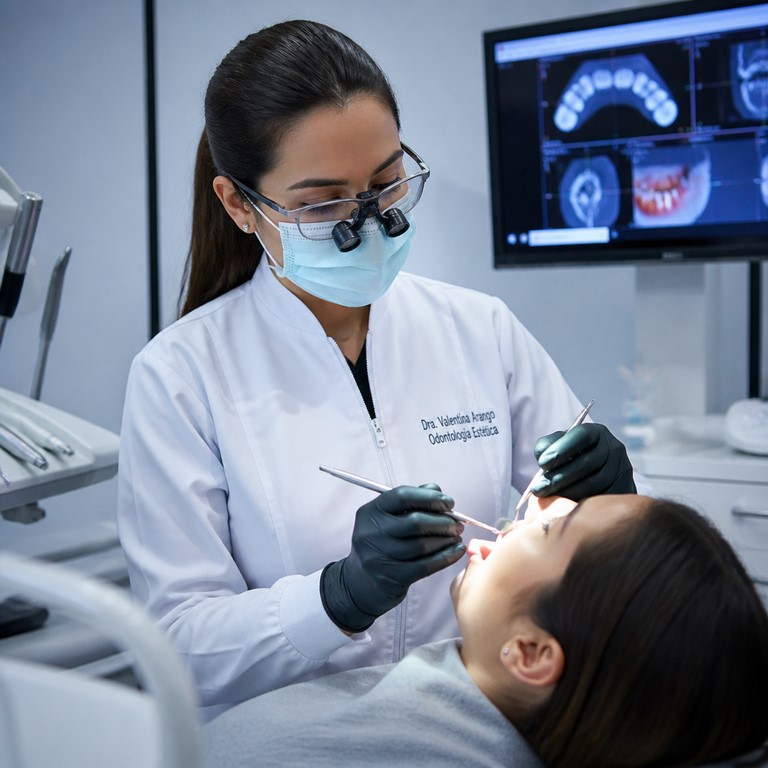
Smile design cannot begin without comprehensive clinical records. Rushing this step, or skipping parts of it, produces a design that may look acceptable on screen but fails in the patient’s mouth. A complete records appointment includes:
Facial and Dental Photography
Standardized clinical photographs are taken with calibrated lighting and consistent camera angles: frontal smile, retracted full-arch view, lateral profile, and close-up shots of individual dental segments. Video footage of the patient speaking and smiling naturally is equally important — the dynamic smile (what your teeth look like when you are talking and laughing) is often very different from the static smile, and the design must account for both.
Not sure which you need? Read veneers vs. whitening.
Radiographs
Periapical X-rays of all teeth to be treated confirm root health, bone levels, and the presence of any existing restorations or pathology. Panoramic X-ray provides an overview of the entire dentition and jaw. In complex cases involving implants, jaw discrepancies, or deep bite issues, a CBCT (cone beam computed tomography) scan is ordered to evaluate three-dimensional bone anatomy.
Get your veneers in Colombia for up to 70% less.
In the US, 20 porcelain veneers run $30,000–$50,000. With Dr. Yazmin in Medellin, it's $6,900, all-inclusive.
Individual patient experience. Prices, inclusions and results are confirmed after a clinical evaluation. A full evaluation is required before any treatment.
Digital or Physical Impressions
Study models — either digital scans (using an intraoral scanner) or physical plaster casts — capture the exact current position, shape, and relationship of your teeth. These are used for the wax-up and to fabricate mock-ups. Digital impressions are faster, more comfortable, and allow direct import into design software.
Considering whitening? See teeth whitening in Medellín.
Bite Analysis
How your upper and lower teeth meet (occlusion) directly affects the smile design. A design that ignores your existing bite may create veneers or crowns that interfere with normal jaw movement, leading to long-term problems. Bite registration and a functional assessment are required before any design work begins.
It is reassuring to know that the clinics offering veneer treatment in Colombia use FDA-approved materials for your safety.
Step 2: Digital Design — Translating Facial Anatomy into a Smile Blueprint
With all records in hand, the dentist imports the clinical photographs and digital models into DSD software (such as DSD App, 3Shape Dental System, or similar platforms) to begin the actual design. This phase involves several distinct analytical steps:
Facial Midline
The dental midline — the vertical line between the two upper central incisors — should ideally align with the facial midline (the center of the nose and philtrum). Even a 1–2 mm deviation is visible in photographs and creates an asymmetric appearance. The design maps this alignment and determines whether a midline correction is achievable with the planned restorations.
Lip Line and Smile Frame
The smile frame defines how much tooth is visible when the patient smiles. The upper lip position, the incisal edges of the upper front teeth, and the gingival (gum) contour all contribute. Ideal smile frames show 75–100% of the clinical crown height of the upper central incisors at full smile, with a slight crescentic curve of the incisal edges following the curvature of the lower lip.
Tooth Length, Width, and Proportion
The golden proportion principle — a mathematical ratio of approximately 1.618:1 used to define visually pleasing relationships — is applied to tooth width ratios across the smile. The central incisors should be the most dominant teeth; each successive tooth moving toward the back of the smile appears smaller by a consistent ratio. The length-to-width ratio of an ideal central incisor is approximately 75–80% (a tooth that is 10 mm long should be approximately 7.5–8 mm wide). Teeth that are too square or too narrow are identified in the digital design phase.
Gingival Architecture
The gumline framing the teeth is as important as the teeth themselves. Asymmetric gum levels, a “gummy smile” (excess gingival display), or recession create visual imbalance regardless of how well the ceramic work is executed. Where gingival corrections are needed — either through laser contouring or surgical crown lengthening — this is mapped in the digital design phase and planned as part of the overall treatment sequence.
Step 3: The Mock-Up — The Most Important Step Patients Skip
After the digital design is completed, it must be translated into the patient’s actual mouth before any teeth are prepared. This is the mock-up phase, and it is where clinics that cut corners are most easily identified.
A mock-up can be executed in two ways:
- Direct composite mock-up: The dentist applies tooth-colored composite resin directly over the existing teeth, using silicone matrices made from the wax-up, to temporarily recreate the planned tooth shapes in the mouth. No drilling occurs. The patient can see, feel, and — critically — speak and smile with the proposed new teeth. This takes approximately 30–60 minutes and is completely reversible.
- Printed or milled wax-up try-in: The digital design is used to 3D print or mill a physical model, from which a silicone index is made. Temporary bis-acrylic material is injected into the index and seated over the teeth, giving the patient a slightly more durable preview of the final result.
The mock-up is non-negotiable for several reasons: it reveals whether the planned tooth lengths will look natural when the patient speaks (the edges of the upper teeth should be visible during “F” and “V” sounds), confirms that the gumline framing matches the design, and gives the patient a chance to request adjustments before any irreversible tooth preparation begins. Budget clinics routinely skip the mock-up because it requires additional materials, additional appointment time, and a dentist skilled enough to place and assess it. The result is patients who receive permanent veneers they have never “tried on” — and some discover they don’t like them only after they are cemented.
Step 4: Patient Approval and the Design Conversation
The mock-up appointment is also the design conversation. The patient and dentist review the proposed shape together — in person, in the mirror, in photographs, and on video. Common modifications at this stage include:
- Adjusting tooth length (longer or shorter than the initial design)
- Modifying the contour of the lateral incisors (more rounded vs. more angular)
- Shifting the midline slightly if the initial mapping was off
- Addressing asymmetries in the gumline that weren’t apparent in photographs
Once the patient approves the mock-up — sometimes with minor modifications — the adjusted shape is documented and communicated to the ceramic lab as part of the fabrication prescription. This is the point of no return: tooth preparation begins at the next appointment.
Step 5: Tooth Preparation and Temporaries
Tooth preparation for veneers or crowns involves reducing the natural tooth surface to create space for the ceramic material. For veneers, this is a conservative 0.3–0.7 mm reduction on the facial surface. For crowns, the reduction is more extensive (1.5–2 mm circumferentially).
Immediately after preparation, temporaries are fabricated directly from the approved mock-up using the same silicone index. This means the patient leaves with temporaries that look essentially identical to the approved design — not generic shells. This is clinically important because the temporaries serve as a real-world test of the design: the patient wears them for the duration of the lab fabrication period and can report any functional or aesthetic concerns before the final ceramics are made.
Step 6: Lab Fabrication — Why the In-House Lab Changes Everything
After preparation, the case is sent to the ceramic lab with a full prescription: shade map, photographs of the temporaries in the patient’s mouth, the digital design files, and any specific notes on translucency or surface texture preferences.
At most clinics, this prescription goes to an external lab — often in a different city. Communication happens through a paper form or email. The ceramist fabricating the restorations has never seen the patient, and if the first attempt doesn’t match the photos, there is a week of delay for remake and shipping.
At Doctor Yazmin’s clinic, the ceramic lab is in-house. The ceramist sees the photographs, the digital design, and in many cases the patient directly. The dentist and ceramist review the case together before fabrication begins and again during the layering process. If a shade adjustment is needed after the bisque (pre-glaze) stage, it is made the same day. This direct collaboration produces restorations with better shade accuracy, more natural surface texture, and fewer remakes — and it compresses the fabrication timeline to 2–3 working days for most cosmetic cases instead of the 7–14 days typical with external labs.
Step 7: Try-In and Final Cementation
Final restorations arrive from the lab and are placed on the prepared teeth without cement first. This try-in phase serves as the final quality check:
- Fit check: Each restoration must seat fully on the prepared tooth with no rocking or gaps. Margins are inspected at the gumline with a probe.
- Occlusion check: Articulating paper identifies premature contacts that need adjustment. No restoration should hit harder than adjacent teeth.
- Aesthetics check: Color is assessed in natural light (not just the dental operatory light), ideally with the patient holding a mirror. Surface texture and translucency are compared to the adjacent natural teeth or the pre-agreed design.
- Contact point check: Dental floss confirms that interproximal contacts between adjacent restorations are present but not so tight that the floss shreds.
Only after all checks are passed does the dentist proceed to final cementation. Ceramic restorations are etched with hydrofluoric acid, silanated, and bonded using dual-cure resin cement. The gingival margins are cleaned of excess cement under magnification before the resin cures completely — a step that is often rushed and is a common source of gingival inflammation post-cementation if missed.
How Long Does the Full Smile Design Process Take?
At a clinic with a proper DSD protocol and an in-house lab, a complete smile makeover involving 6–10 veneers or crowns can typically be completed in 4–6 business days:
- Day 1: Records appointment (photos, scans, X-rays, bite registration)
- Day 2: Digital design review and mock-up appointment
- Day 3: Tooth preparation and temporaries
- Days 4–5: In-house lab fabrication
- Day 5–6: Try-in, adjustments, final cementation
This timeline makes Medellín an accessible dental tourism destination for patients who can allocate one week of travel. Clinics that rely on external labs require two visits separated by 2–3 weeks, which is logistically difficult for international patients and often means returning home with temporaries.
Questions to Ask Any Clinic to Verify They Actually Do DSD
The phrase “digital smile design” is used loosely in marketing. Here are concrete questions that separate clinics practicing genuine DSD from those borrowing the terminology:
- “Can I see the digital design before any preparation is done?” A clinic practicing DSD will show you a software-based preview of your proposed smile. A clinic that says “you’ll see it when the veneers are done” is not doing DSD.
- “Do you do a mock-up or wax-up before I commit to the design?” The answer should be yes, as part of the standard protocol — not an extra-cost add-on.
- “Is your ceramic lab in-house or do you use an external lab?” The answer directly determines your timeline and the dentist-ceramist communication quality.
- “Will my temporaries match the approved design?” Yes — temporaries should be fabricated from the approved mock-up index, not off-the-shelf shells.
- “Who fabricates the final restorations — a local ceramist or do you send the case overseas?” Some clinics in dental tourism destinations outsource fabrication to very low-cost labs in other countries. This is cost-cutting that shows up in the final result.
- “Can I see photographs of previous smile design cases you’ve done?” Legitimate results, not stock images. Ask for before-and-after with patient consent.
The Full Smile Design Experience at Doctor Yazmin’s Clinic in Medellín
Medellín has emerged as one of Latin America’s premier cosmetic dentistry destinations for precisely the reason this article illustrates: a complete, methodical smile design process does not have to cost $20,000 or take a month. At Doctor Yazmin’s clinic, international patients receive a full DSD workflow — from digital facial analysis through in-house lab fabrication — in a single trip, at costs that represent 40–70% savings compared to equivalent care in the United States, Canada, or Western Europe.
The mock-up appointment, the direct ceramist-dentist collaboration, the digital records, the try-in protocol — these are not premium add-ons. They are the standard of care. If the clinic you are evaluating cannot confirm that all of these steps are included, you are not receiving digital smile design, regardless of what their website says.