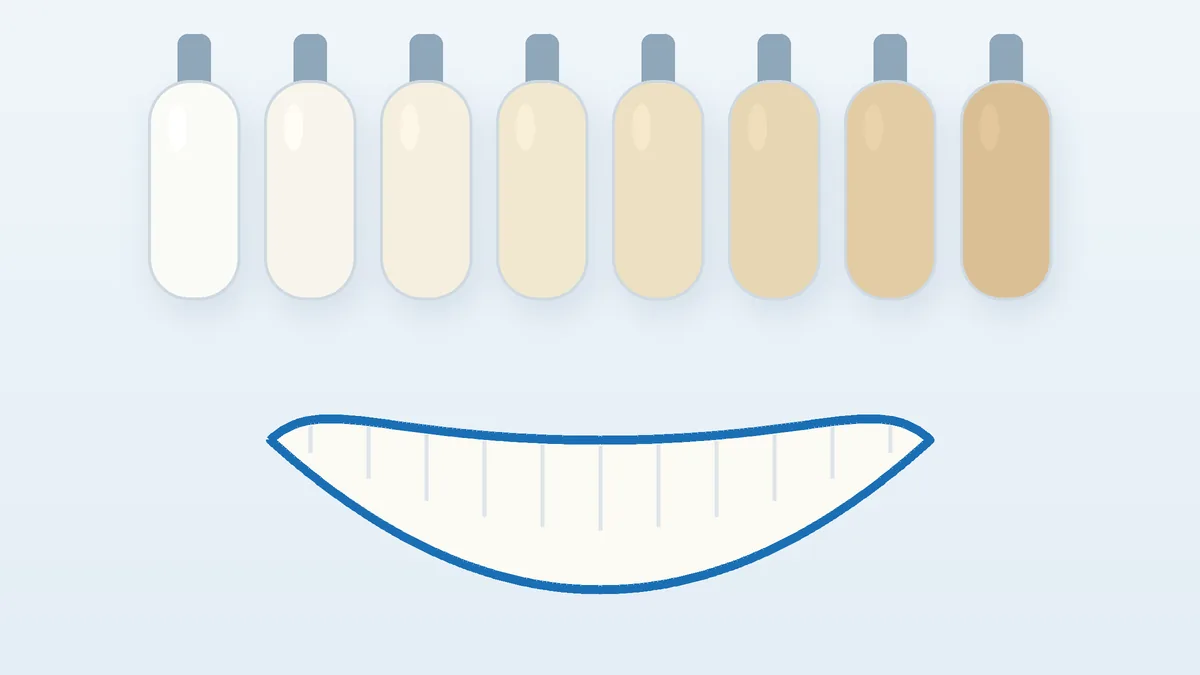
A practical, at-home way to estimate your tooth shade, what codes like A2, B1, BL2 or OM1 actually mean, and why only an in-person check by a dentist can confirm the result.
The same veneers cost up to 70% less in Colombia.
See if you qualify Free video call in English · on WhatsAppIndividual patient experience. Results and pricing are confirmed after a clinical evaluation.
Short answer: You can get a rough idea of your tooth shade at home by comparing your clean, moist front teeth to a shade chart in indirect daylight, with no filters and the flash off. Most natural teeth sit somewhere in the light-to-medium range of the VITA classical shade guide (A1–D4). A2 and A3 are commonly described as typical natural shades, and B1 is the lightest natural shade. An at-home check is only an estimate, though. Lighting, phone cameras, screens and even how dry your teeth are can shift what you see. A dentist confirms your real shade with physical shade tabs or a shade-measuring device.
What a “tooth shade” actually is
A tooth shade is a standardized code that describes the color of a tooth. Teeth are not one flat color. The outer enamel is fairly translucent and the dentin underneath is naturally more yellow. So the color you see is a mix of the two, and it changes along the tooth: usually a little darker near the gum line and more translucent at the biting edge.
Dentists describe that color using three properties:
- Value: how light or dark the tooth is. For most people this matters most to how “white” teeth look.
- Hue: the basic color family, for example more yellowish or more reddish-brown.
- Chroma: how intense or saturated that color is.
A shade code is shorthand for a combination of these. That’s why the same “white” can be described very differently depending on which shade system is used.
The three shade systems you’ll hear about
When you ask “what shade are my teeth?”, the answer depends on which reference you’re compared against. You only need a working understanding of three. For the full details, see our complete guide to teeth whitening shades and color scales.
Get your veneers in Colombia for up to 70% less.
In the US, 20 porcelain veneers run $30,000–$50,000. With Dr. Yazmin in Medellin, it's $6,900, all-inclusive.
Individual patient experience. Prices, inclusions and results are confirmed after a clinical evaluation. A full evaluation is required before any treatment.
1. VITA classical (A1–D4)
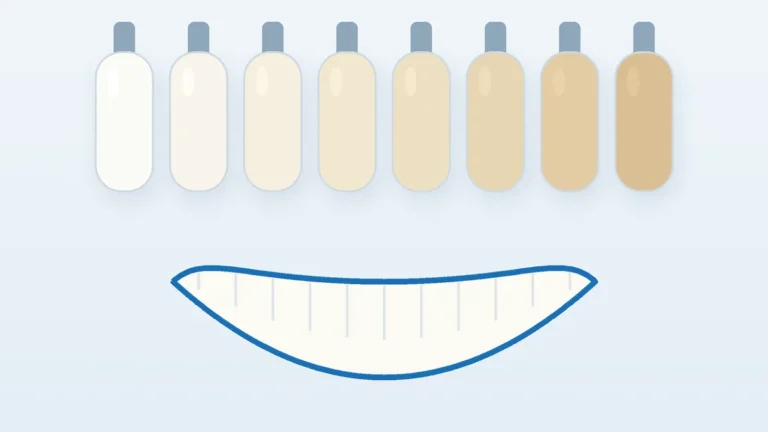
This is the most widely recognized dental shade guide. It has 16 shade tabs in four hue groups:
- A: reddish-brown (A1, A2, A3, A3.5, A4)
- B: reddish-yellow (B1, B2, B3, B4)
- C: grayish (C1, C2, C3, C4)
- D: reddish-gray (D2, D3, D4)
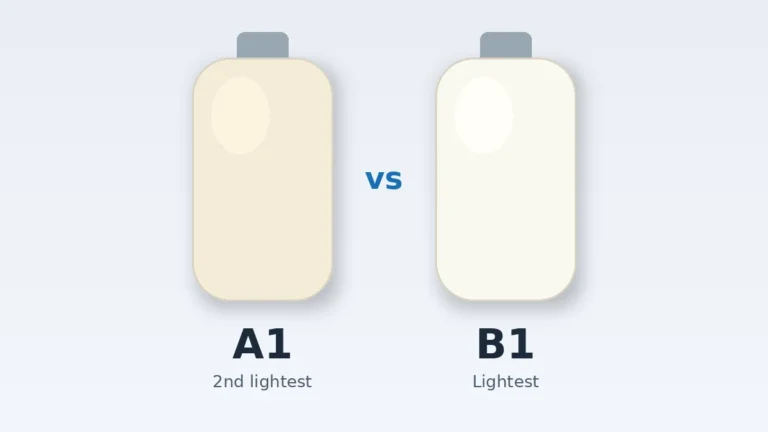
Within each group, a higher number means a darker, more saturated shade. A1 is lighter than A3, and A3 is lighter than A4. Because value matters most visually, dentists often arrange the tabs from lightest to darkest rather than by letter. In that order, B1 comes first.
VITA classical
warmer
natural
warmer
Swatches are illustrative only. Screens can’t reproduce real shade tabs accurately.
2. VITA 3D-Master (0M1 to 5M3)
The 3D-Master system is organized around the three color properties above. The first number is the value group (lightness), the letter is the hue (L = more yellowish, M = middle, R = more reddish) and the last number is the chroma. Its lightest group is labeled “0”, so you’ll see OM1/0M1, OM2 and OM3 used for very light, bleached-looking shades. If you’ve seen OM1 and BL1 both described as the “whitest”, our article on how OM1 and BL1 differ explains why they don’t translate one-to-one.
3. Bleach shades (BL1–BL4)
Many labs and ceramic systems use “bleach” shades lighter than anything on the classical A–D scale. In the most common convention, used by many ceramic systems, BL1 is the lightest and BL4 the least extreme of the four. Labeling isn’t identical across every manufacturer’s guide, so it’s worth confirming which guide your clinic and lab are using. These shades describe whitened teeth or very bright restorations such as porcelain veneers, not typical untreated teeth. If you’re weighing two of the most requested options, see BL1 vs BL2 for veneers.
How to check your tooth shade at home (step by step)
This method gives you a reasonable estimate to bring to a consultation. It isn’t a diagnosis.
Step 1: Prepare your teeth
- Brush normally, but don’t check right after whitening products, coffee, tea, red wine or strongly colored food.
- Wipe off lipstick or tinted lip balm. Strong lip colors change how white teeth look.
- Keep your teeth naturally moist. If you’ve had your mouth open for a while, close it and swallow a few times first. Dry teeth can look lighter and chalkier than they really are.
Step 2: Get the lighting right
- Stand near a window during the day, in indirect daylight. Avoid direct sun.
- Turn off warm or colored indoor lights that could tint the scene.
- Wear neutral colors (gray, white or black) and avoid bright clothing near your face, which can reflect color onto your teeth.
Step 3: Compare against a reference
- Use a shade chart showing the VITA classical tabs. A physical shade guide is best, a printed chart next, and an on-screen chart is least reliable.
- Hold the reference right next to your upper front teeth, at the same distance and angle as the teeth.
- Look at the middle third of the front tooth, not the edge (translucent) or the area near the gum (usually darker).
- Glance for a few seconds at a time. Staring too long tires your eyes and makes colors harder to tell apart. Squinting slightly can help you judge lightness.
- Narrow it to the two closest tabs. “Between A2 and A3” is a perfectly useful result.
Step 4: If you use your phone camera
- Turn off the flash, beauty mode, filters and any portrait or “enhance” effects.
- Take the photo in the same indirect daylight with the reference tab or chart in the frame, so both get the same camera processing.
- Don’t judge your shade from a photo against an unrelated chart on another screen. Each screen and each camera shows color differently.
Common mistake: comparing your teeth to a sheet of printer paper. Office paper is often treated to look bright blue-white, so almost any natural tooth will look yellow next to it. That doesn’t mean your shade is abnormal.
Why at-home checks are often wrong
Even when you do everything right, the result is still an estimate. The main reasons:
- Light changes color. Two colors can match under one light and look different under another. Shades taken under warm indoor light, cool LEDs and daylight often disagree.
- Cameras “correct” color. Phones automatically adjust white balance, exposure and contrast, and many add processing you can’t turn off completely.
- Screens and printers vary. An on-screen or printed chart only approximates the real tabs, and every display and printer reproduces color differently.
- Teeth aren’t one color. Translucency, surface texture and the darker area near the gums make a single code a simplification.
- Dehydration. Teeth that have dried out can look temporarily lighter.
- Surface stain vs. intrinsic color. External stains from coffee or tobacco can make teeth look darker than their underlying shade, and a home check can’t tell the two apart.
- Existing dental work. Crowns, veneers and tooth-colored fillings keep their own shade and can confuse the comparison.
A sudden change in the color of a single tooth, for example one tooth turning gray or darker after a knock, is not a cosmetic shade question. It should be examined by a dentist.
How a dentist confirms your shade
In the clinic, shade selection is done under controlled conditions:
- Physical shade tabs (VITA classical, 3D-Master or bleach tabs) are held against the moist tooth, usually at the start of the appointment before the teeth dry out.
- Color-balanced lighting and neutral surroundings reduce color casts.
- Some clinics also use shade-measuring devices and standardized photographs to share the shade with the dental lab.
- The shade system is written down by name (for example “VITA classical A2” or “3D-Master 1M1”), not just the code, so the lab reproduces the right color.
For cosmetic treatment, the shade conversation goes beyond the tab number. It also covers your skin tone, gum color, age, how many teeth are being treated and how natural or bright you want the result to look. That’s also why the “best” shade differs from person to person.
Your shade, whitening and veneers
Knowing your approximate starting shade is useful because it frames a realistic conversation about options.
Teeth whitening
- Lightens your own natural teeth. How much varies from person to person and can’t be guaranteed.
- Does not change the color of crowns, veneers or fillings.
- Some people experience temporary sensitivity.
- Results can fade over time with diet and habits.
Porcelain veneers
- The shade is chosen with your dentist and made by a dental lab, so a bleach shade like BL1–BL4 is possible.
- Treats only the teeth that receive veneers. Neighboring teeth keep their own shade.
- Usually involves preparing the tooth surface, so it is a significant decision.
- A trial or mock-up before final placement helps confirm the shade on your face.
If you plan to whiten and later get veneers or other tooth-colored dental work, whiten first. Dentists commonly wait a period after whitening for the color to settle before choosing the final restoration shade. Your dentist will tell you how long in your case.
You can read more about professional whitening options such as in-office and at-home systems. If you’re considering veneers, our veneer color shades guide explains how to narrow down a shade that suits your face. You can also see how the clinic approaches porcelain veneers in Medellín.
Key takeaways
- An at-home check gives you an estimate, such as “around A2–A3”. It isn’t a confirmed shade.
- Use indirect daylight, moist clean teeth, no filters or flash, and a reference held right next to your teeth.
- Natural teeth are usually described on the VITA classical scale. Bleach shades (BL1–BL4, OM1–OM3) describe whitened teeth or restorations.
- Only a dentist, using physical shade tabs or a measuring device, can confirm your shade and tell you which options are realistic for you.
Frequently asked questions
How white are my teeth compared with normal?
Most natural, untreated teeth fall in the light-to-medium part of the VITA classical guide. Shades such as A2 and A3 are commonly described as typical, and B1 is the lightest natural shade. Teeth that look slightly yellow are normal, because the dentin under the enamel is naturally yellowish. A dentist can tell you where your teeth sit and whether any discoloration needs attention.
Is there a yellow teeth scale?
There isn’t a separate official “yellow teeth scale”. Yellowness is described with the same shade guides. In the VITA classical guide, the B group is reddish-yellow, and higher numbers (for example B3 or B4) are darker and more saturated. In the VITA 3D-Master guide, the letter L marks a more yellowish hue.
What is the natural tooth color?
There is no single natural tooth color. It varies with genetics, age, enamel thickness and habits. Natural teeth are usually described on the VITA classical A1–D4 scale. Bleach shades such as BL1–BL4 or OM1–OM3 go beyond natural color and are typically reached only with whitening or restorations like veneers.
Is A3 a good tooth shade?
A3 is a common, healthy-looking natural shade. It isn’t a sign of a problem by itself. Whether you’d like something lighter is a cosmetic preference. A dentist can explain what whitening might realistically do for your teeth, or whether another option suits your goals better.
What is the whitest shade of teeth?
On the VITA classical guide, B1 is the lightest natural shade. Beyond it are bleach shades: OM1 (0M1) is the lightest group in the VITA 3D-Master guide, and BL1–BL4 are bleach shades used by many labs and ceramic systems. The whitest possible shade isn’t automatically the best choice. It should suit your face, skin tone and the rest of your teeth.
Can I find out my tooth shade from a photo?
A photo can give a rough idea if it’s taken in indirect daylight with no filters or flash and with a shade reference in the same frame. Cameras and screens alter color, though, so a photo can’t confirm your shade. Clinics may use photos to plan a consultation, but the final shade is chosen in person with physical shade tabs.
Not sure what shade your teeth are?
Send our team a message on WhatsApp to ask about a free photo assessment with Dr. Yazmín Escudero’s clinic in El Poblado, Medellín. Your final shade is always confirmed in person.
Chat on WhatsApp