Introduction
Dental veneers have become synonymous with the “perfect smile.” These thin porcelain shells promise a dramatic transformation with minimal invasiveness. Yet, the reality is more nuanced. For many patients, veneers are not the optimal solution—sometimes due to budget constraints, dental anatomy, or treatment goals that demand different approaches.
This guide explores the scenarios where veneers fall short and explains which alternatives actually deliver better outcomes. Whether you’re seeking affordability, minimal tooth preparation, or a solution tailored to your specific dental condition, understanding when veneers are not the best option is crucial for making informed decisions about your smile.
When Veneers Make Sense (And When They Don’t)
Veneers excel in specific scenarios: deep enamel staining that resists whitening, severely worn teeth, or cosmetic gaps. However, they require significant tooth preparation, carry high costs ($900–$2,500 per tooth), and demand a 10–15 year commitment. For patients outside these parameters, veneers represent unnecessary expense and tooth structure sacrifice.
Veneers require permanent alteration. The process involves removing 0.5–1mm of tooth enamel—irreversible preparation that locks you into continued veneer maintenance. This makes them unsuitable for:
- Patients with limited budgets seeking quick cosmetic fixes
- Those with minimal cosmetic concerns (small chips, light discoloration)
- Individuals with thin enamel or underlying decay
- Patients prioritizing maximum tooth preservation
- Anyone uncertain about long-term commitment to cosmetic treatment
The 5 Best Alternatives to Veneers
1. Dental Bonding: The Affordable Quick Fix
What It Is: Dental bonding uses tooth-colored composite resin applied directly to the tooth surface. The procedure requires no lab work and is completed in a single 30-60 minute appointment.
Best For:
- Minor chips, cracks, or cosmetic imperfections
- Patients with budget constraints ($150–$500 per tooth vs. $900–$2,500 for veneers)
- Those seeking immediate results without waiting for lab fabrication
- Small gaps or tooth shape refinement
Key Advantages:
- Minimally invasive; less enamel removal than veneers
- Reversible; can be removed or replaced without permanent damage
- One-visit completion
- Immediate cosmetic improvement
- Lower cost barrier to treatment
Limitations to Consider:
- Less durable than veneers; typically lasts 5–7 years vs. 10–15 years
- More prone to discoloration and staining over time
- Higher maintenance; can require frequent polishing or reapplication
- Less resistant to wear from chewing and biting forces
- More suitable for isolated teeth rather than full smile makeovers
Real Application: A patient with a single chipped front tooth, tight budget, and realistic expectations about durability would be an ideal candidate. Bonding restores the tooth cosmetically while preserving maximum tooth structure.
2. Dental Crowns: Protection Over Cosmetics
What It Is: Dental crowns are full-coverage restorations that completely encase damaged or weakened teeth. Unlike veneers (which cover only the front), crowns protect the entire tooth structure.
Best For:
- Severely decayed or damaged teeth
- Teeth with large existing fillings
- Root canal-treated teeth needing protection
- Misaligned or severely discolored teeth
- Patients prioritizing longevity and durability
Key Advantages:
- Maximum tooth protection; ideal for compromised teeth
- Highly durable; lasts 15+ years with proper care
- Stronger than veneers; withstands greater bite force
- Excellent for functional and aesthetic restoration
- Suitable for patients with multiple cosmetic concerns
Limitations to Consider:
- Requires more enamel removal than veneers (often 1.5–2mm)
- Higher cost than veneers ($800–$3,000+ per tooth depending on material)
- Requires at least two dental visits
- Irreversible tooth preparation
- May not be appropriate for purely cosmetic cases without underlying damage
- Can look artificial if poorly designed
Why Crowns Over Veneers: When a tooth has structural compromise—decay, large filling, or endodontic treatment—veneers cannot provide adequate protection. Crowns are the clinical standard for teeth needing both cosmetic and functional restoration.
3. Professional Teeth Whitening: The Reversible Solution
What It Is: Professional in-office or custom take-home whitening treatments use higher-concentration bleaching agents than over-the-counter products to lighten discolored teeth.
Best For:
- Patients with age-related or surface tooth discoloration
- External staining from coffee, wine, tobacco, or medications
- Those seeking significant color improvement without preparation
- Budget-conscious patients; typically $300–$800 per session
- Any patient wanting to test cosmetic improvement before committing to veneers
Key Advantages:
- Completely reversible; no permanent tooth modification
- Non-invasive; no tooth preparation required
- Immediate results; often seen within 48–72 hours
- Affordable compared to veneers or crowns
- Excellent option to explore before considering more invasive treatment
- Can complement other cosmetic procedures
Limitations to Consider:
- Ineffective on intrinsic (internal) staining or enamel defects
- Results not permanent; requires maintenance every 6–12 months
- May cause temporary tooth sensitivity
- Not suitable for severely compromised or existing restorations
- Limited to discoloration; cannot address shape, gaps, or alignment issues
Strategic Application: A 45-year-old patient with yellowed teeth from decades of coffee consumption could achieve dramatic smile improvement through professional whitening before exploring veneers. Often, this removes the primary cosmetic concern.
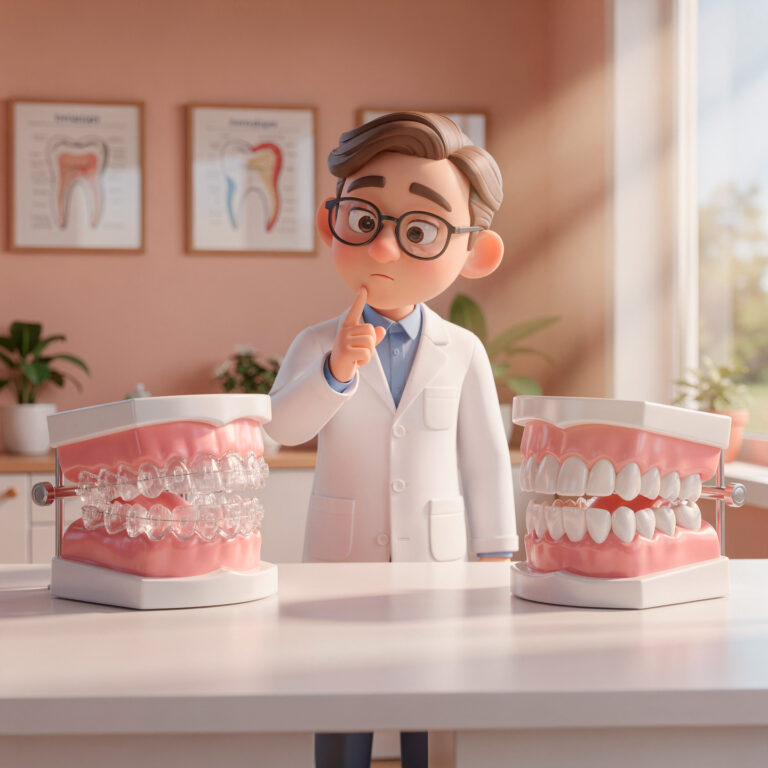
4. Orthodontics (Braces/Aligners): The Structural Approach
What It Is: Orthodontic treatment (traditional braces or clear aligners like Invisalign) moves teeth into proper alignment over months or years.
Best For:
- Misaligned, crowded, or gapped teeth
- Patients seeking to preserve maximum tooth structure
- Those with bite irregularities (overbite, underbite, crossbite)
- Younger patients or those motivated for 6–24 month treatment duration
- Anyone with gaps or rotations that veneers would merely “cover”
Key Advantages:
- Addresses root causes (misalignment) rather than cosmetic symptoms
- Fully reversible; no permanent tooth alteration
- Improves both aesthetics and oral function
- No tooth structure sacrificed
- Cost-competitive with veneers over time ($3,000–$8,000 total vs. $900–$2,500 per tooth)
- Prevents long-term bite problems and wear
- Clear aligners provide discrete aesthetic option
Limitations to Consider:
- Longer treatment timeline (6 months to 2+ years)
- Requires patient compliance and consistent wear (especially with aligners)
- May involve temporary tooth sensitivity or discomfort
- Not suitable for severe cosmetic issues (staining, shape defects)
- Ongoing maintenance with retainers post-treatment
When to Choose Orthodontics Over Veneers: A patient with moderate tooth crowding and gaps could choose a 12-month Invisalign treatment ($4,000–$6,000) versus four veneers ($3,600–$10,000) plus remaining cosmetic concerns. Orthodontics delivers superior long-term outcomes and actual tooth alignment.
5. No-Prep or Minimal-Prep Veneers: The Compromise Option
What It Is: Ultra-thin veneers (0.3–0.5mm) require minimal to no enamel preparation, representing a middle ground between traditional veneers and bonding.
Best For:
- Patients seeking veneer results with maximum tooth preservation
- Those with thin enamel or previous dental work concerns
- Mild to moderate cosmetic improvements
- Patients wanting reversibility compared to traditional veneers
Key Advantages:
- Requires little to no tooth preparation
- More reversible than conventional veneers
- Combines durability of veneers with minimal invasiveness
- Suitable for patients hesitant about permanent enamel removal
- Natural light transmission for authentic appearance
Limitations to Consider:
- Higher cost due to specialized fabrication ($1,000–$3,000+ per tooth)
- Limited availability; requires experienced cosmetic dentist
- Still technically irreversible if any enamel removal is done
- May not work for severely discolored teeth due to thin material
- Thinner material can be more prone to chipping
Comparative Analysis: Veneers vs. Alternatives
| Feature | Veneers | Bonding | Crowns | Whitening | Orthodontics |
|---|---|---|---|---|---|
| Cost per tooth | $900–$2,500 | $150–$500 | $800–$3,000 | $300–$800 (full mouth) | $3,000–$8,000 (full treatment) |
| Durability | 10–15 years | 5–7 years | 15+ years | 6–12 months | Permanent (function) |
| Tooth preparation | 0.5–1mm enamel | Minimal | 1.5–2mm enamel | None | None |
| Reversibility | No | Partial | No | Yes | Yes |
| Treatment time | 2–3 visits | 1 visit | 2–3 visits | 1 visit | 6–24 months |
| Best for | Full smile makeover, staining | Minor imperfections | Damaged teeth, protection | Discoloration | Misalignment, gaps |
| Maintenance | Moderate | High | Moderate | High (recurring) | Low (post-retainers) |
Decision-Making Framework: Is a Veneer Right for You?
Use this framework to determine the most appropriate treatment:
Step 1: Identify Your Primary Concern
- Discoloration → Whitening (first) or Veneers/Crowns (if resistant)
- Misalignment/Gaps → Orthodontics or Aligners
- Chips/Minor Damage → Bonding
- Severe Damage/Decay → Crowns
- Multiple cosmetic concerns (shape, color, alignment) → Comprehensive evaluation
Step 2: Assess Your Constraints
- Budget: <$1,000 total? → Bonding or Whitening
- Time: Need results in <2 weeks? → Bonding or Whitening
- Tooth Structure: Concerned about enamel loss? → Whitening, Bonding, or Orthodontics
- Commitment: Willing to wear retainers/maintain for years? → Orthodontics or Veneers
Step 3: Consult Your Dentist
A qualified cosmetic dentist will assess tooth structure, underlying health, and realistic outcomes. Professional guidance is essential—not all cosmetic improvements suit every patient.
Common Scenarios Where Veneers Are Unnecessary
Scenario 1: The Budget-Conscious Patient with Minor Cosmetics
Situation: 28-year-old with two slightly chipped front teeth and limited budget
Why Not Veneers: Overkill for isolated damage; unnecessary enamel removal; cost-prohibitive ($1,800–$5,000 total)
Better Option: Composite bonding ($300–$1,000 total); can be redone if needed
Scenario 2: The Discolored-Tooth Patient
Situation: 35-year-old with yellowed but structurally healthy teeth
Why Not Veneers: Addresses symptom, not root cause; expensive; irreversible
Better Option: Professional whitening ($300–$800); first test cosmetic improvement; revisit if inadequate
Scenario 3: The Crowded-Smile Patient
Situation: 22-year-old with moderate crowding and gaps; never had braces
Why Not Veneers: Veneers mask alignment issues; true problem remains; future relapse likely
Better Option: Invisalign (12–18 months, $4,000–$6,000); corrects root cause; superior long-term function
Scenario 4: The Thin-Enamel Patient
Situation: 45-year-old with naturally thin enamel and three previous fillings
Why Not Veneers: Additional enamel removal increases sensitivity and decay risk; compromises tooth viability
Better Option: Minimal-prep veneers or crowns (if structural weakness exists)
Scenario 5: The Uncertain Patient
Situation: 55-year-old interested in cosmetic improvement but unsure of commitment
Why Not Veneers: Permanent enamel removal locks patient into veneers; high regret risk if dissatisfied
Better Option: Start with reversible options (whitening, bonding, orthodontics); upgrade to veneers if motivated
The Hidden Costs of Veneers
Beyond the upfront $900–$2,500 per tooth, veneers carry ongoing expenses often overlooked:
- Maintenance: Special non-abrasive toothpaste and meticulous flossing technique
- Replacement cycles: Every 10–15 years, complete re-preparation and replacement ($900–$2,500 per tooth recurring)
- Repairs: Chipped or damaged veneers may require full replacement, not simple repair
- Sensitivity management: Temporary post-placement sensitivity often requires special toothpaste
- Underlying decay risk: If gum disease or decay develops beneath veneers, the entire restoration must be removed for treatment
A patient who places four veneers at age 35 faces replacement costs around age 50—a 20-year commitment with cumulative costs exceeding $10,000–$15,000.
What Dentists Want Patients to Know
The most successful cosmetic outcomes occur when treatment matches patient expectations, anatomy, and lifestyle—not when it follows cosmetic trends. A skilled cosmetic dentist evaluates whether veneers are truly optimal or whether an alternative achieves better results.
Red flags suggesting veneers may not be right:
- Dentist recommends veneers without exploring alternatives
- Pressure to “commit” without discussing reversibility or longevity
- No discussion of underlying tooth health before veneer preparation
- Cost presented without comparison to other options
- Limited discussion of realistic timelines or maintenance
Conclusion
Veneers remain an excellent solution for specific scenarios—primarily full smile makeovers involving multiple cosmetic and structural concerns. However, they are not universally appropriate. Dental bonding, crowns, professional whitening, orthodontics, and minimal-prep veneers each address distinct patient needs more effectively than traditional veneers in many situations.
The most important decision is not whether to choose veneers, but whether to choose veneers for your specific situation. A thorough consultation with an experienced cosmetic dentist, combined with honest self-assessment of budget, commitment, and dental anatomy, ensures you select the treatment that maximizes aesthetics while preserving tooth structure and financial prudence.
Your smile is a long-term investment. Choose an approach aligned with your goals, not just current cosmetic trends.
FAQ Section (Optimized for Featured Snippets & Voice Search)
Q: Are veneers reversible?
A: No. Traditional veneers require permanent enamel removal. While the veneer shells can be replaced, the underlying tooth preparation cannot be reversed. Patients choosing veneers commit to veneer maintenance indefinitely.
Q: What’s the cheapest alternative to veneers?
A: Composite dental bonding ($150–$500 per tooth) is the most affordable option, followed by professional whitening ($300–$800 full mouth). Bonding is ideal for isolated cosmetic imperfections; whitening works best for discoloration.
Q: Can I get veneers on just my front teeth?
A: Yes, but dentists typically recommend treating 4–8 front teeth to ensure color and shade matching. Treating only one or two teeth often creates noticeable mismatches with natural teeth.
Q: How long do alternatives to veneers last?
A: Composite bonding lasts 5–7 years; crowns 15+ years; whitening 6–12 months (with maintenance); orthodontics permanently improves alignment (retention required). Veneers last 10–15 years.
Q: Is orthodontics worth the time compared to veneers?
A: For misalignment or gaps, yes. Orthodontics costs $4,000–$8,000 total and solves the root problem while preserving 100% of tooth structure. Veneers mask the issue while removing permanent tooth structure.