A1 and B1 are the two lightest shades on the VITA classical guide, and they’re the two most people end up choosing between. Here’s which one is whiter, whether B1 can look too white, and how a dentist helps you decide.
The same veneers cost up to 70% less in Colombia.
See if you qualify Free video call in English · on WhatsAppIndividual patient experience. Results and pricing are confirmed after a clinical evaluation.
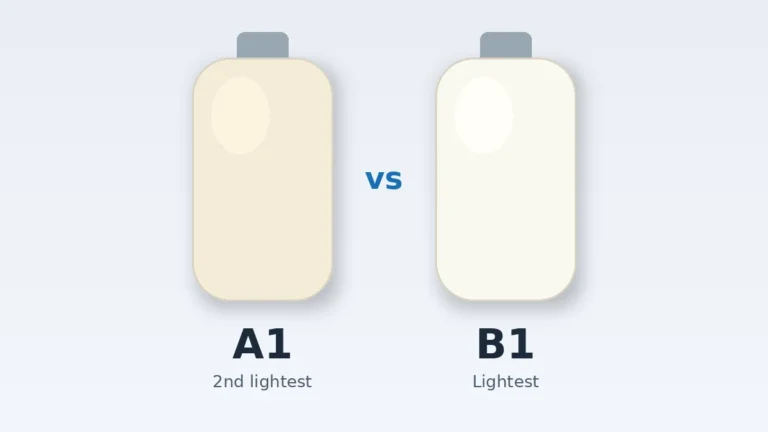
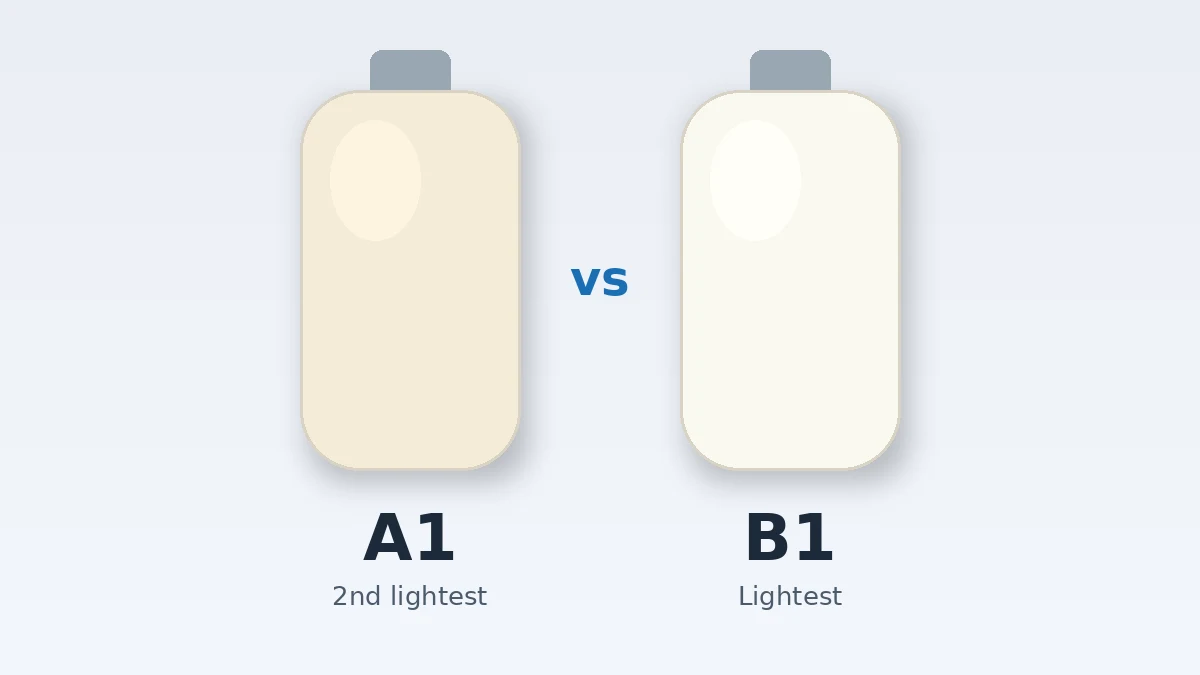
Short answer: B1 is whiter than A1. On the VITA classical shade guide, B1 is the lightest shade of all 16 tabs and A1 is the second lightest. The difference is small: B1 is a touch brighter and less warm, while A1 has a slightly warmer, more reddish-brown undertone. B1 is not “too white” in the clinical sense, because it’s still a natural tooth shade, well short of bleach shades like BL1. Whether B1 looks right on you depends on your skin tone, your other teeth, how many teeth are being treated and the look you want, which is something a dentist confirms in person.
Where A1 and B1 sit on the VITA scale
Most dentists and dental labs describe natural tooth color with the VITA classical shade guide. It has 16 tabs in four hue groups: A (reddish-brown), B (reddish-yellow), C (grayish) and D (reddish-gray). Within each group, the number tells you how light or dark the shade is, so 1 is the lightest in its group and 4 is the darkest. Our VITA shade guide explained in plain English covers every tab in detail.
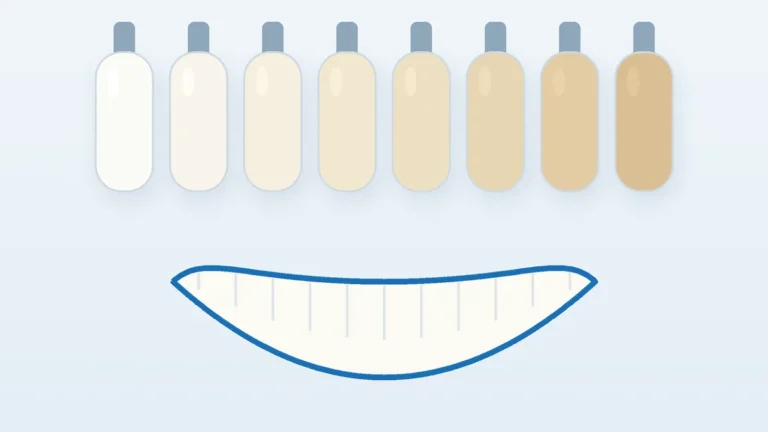
Because lightness (what dentists call value) affects how white teeth look more than anything else, the tabs are often arranged from lightest to darkest instead of by letter. In that value order, the guide starts like this:
natural shade
slightly warmer
more yellow
natural
Swatches are illustrative only. Screens can’t reproduce real shade tabs accurately. (D2 sits between B2 and A2 in the full value order.)
So when you compare “A1 or B1”, you’re comparing the two lightest natural shades on the guide. Both are already lighter than many untreated adult teeth. If you’re not sure where your own teeth sit today, our guide on how to check what shade your teeth are walks you through a careful at-home estimate.
Get your veneers in Colombia for up to 70% less.
In the US, 20 porcelain veneers run $30,000–$50,000. With Dr. Yazmin in Medellin, it's $6,900, all-inclusive.
Individual patient experience. Prices, inclusions and results are confirmed after a clinical evaluation. A full evaluation is required before any treatment.
A1 vs B1: the actual difference
| A1 | B1 | |
|---|---|---|
| Hue group | A: reddish-brown | B: reddish-yellow |
| Lightness | 2nd lightest of the 16 VITA classical tabs | Lightest of the 16 VITA classical tabs |
| How it tends to read | Bright but soft, with a slightly warmer undertone | Bright and clean, slightly cooler-looking |
| Is it a natural shade? | Yes | Yes, the lightest one before bleach shades |
In person, the gap between A1 and B1 is subtle. Many people can’t tell them apart without the tabs side by side. What changes more is the overall impression: A1 can feel a little softer and warmer, while B1 can feel a little crisper. Lighting, lip color, gum color and the shape and texture of the teeth all influence that impression as much as the shade code.
Keep in mind: a shade code tells a lab the target color, but not the translucency, surface texture or how the color changes from the gum line to the edge. Two restorations both labeled “B1” can look different depending on the material and the lab. That’s one reason the final shade is chosen in person, not from a code alone.
Is B1 too white?
For most people, no. B1 is still a natural tooth shade. It sits at the top of the natural range, below the bleach shades (BL1–BL4) and the very light OM1–OM3 groups that are typically used for a “Hollywood” look. Many patients who want a bright result that still looks like their own teeth end up choosing B1 or A1.
B1 can, however, look too white for a particular smile in some situations:
- Only some teeth are being treated. If you get veneers or crowns on the front teeth but keep your natural teeth next to them, a B1 restoration beside a darker natural tooth (for example A3) can look patchy. In that case the shade usually needs to match your other teeth, or you whiten those first.
- Your skin tone, age or gum color. A very bright shade can stand out more against some complexions. Our article on choosing a veneer color shade explains how these factors are weighed.
- The look you want. If your goal is “nobody can tell I had work done”, a shade slightly darker than B1 may serve you better. If you want a clearly brighter smile, B1 is often where natural-looking options end.
- The material. Opaque, flat-looking restorations make any light shade look more artificial than layered ceramics with natural translucency.
The same logic applies to the question “is A1 too white?” A1 is a natural shade too, just a little less bright than B1.
A1 or B1: how to choose
A1 may suit you if…
- You want a bright smile that stays soft and warm.
- Your natural teeth, which will stay visible, lean warm.
- You’d rather err on the side of looking natural.
B1 may suit you if…
- You want the brightest shade that still reads as natural.
- All the visible teeth are being treated or whitened, so there’s no mismatch.
- You’ve considered bleach shades but want something more conservative.
These are general tendencies, not rules. In practice, the choice is made with real shade tabs held next to your teeth in good light, and, for veneers, often with a trial smile or mock-up so you can see the shade on your face before anything is final. Your dentist can also show you why one shade suits your features better than another.
B1 vs B2, and B1 vs bleach shades (BL1–BL4)
B1 vs B2
B2 is the next step down in the same reddish-yellow group. It’s a little darker and a little more yellow than B1, and in the value order it sits just after A1. B2 is a light, natural-looking shade and is not considered too white. People who want a subtle improvement sometimes prefer it.
B1 vs BL1 and other bleach shades
B1 is the lightest natural shade. Bleach shades go beyond it. In the most common convention, used by many ceramic systems, BL1 is the lightest bleach shade and BL4 the least extreme, with BL4 being the closest of the four to B1. Labeling isn’t identical across every manufacturer, so it’s worth confirming which guide your clinic and lab use. If you’re deciding between the two most requested bleach shades, read our BL1 vs BL2 veneers guide. For how bleach and natural shades compare on one chart, see our guide to teeth whitening shades and color scales.
Getting to A1 or B1: whitening vs veneers
Teeth whitening
- Lightens your own natural teeth. How far they lighten varies from person to person, so reaching A1 or B1 can’t be promised.
- Doesn’t change the color of existing crowns, veneers or fillings.
- Some people get temporary sensitivity, and results can fade over time.
Porcelain veneers
- The shade is selected with your dentist and made by a dental lab, so A1, B1 or a bleach shade can be chosen.
- Only the treated teeth change. The others keep their own shade.
- Usually involves preparing the tooth surface, so it’s a significant, long-term decision.
If you plan to whiten and then get veneers or other tooth-colored work, whitening usually comes first. Dentists commonly wait for the color to settle before choosing the final restoration shade, and your dentist will tell you how long that is in your case. To see how Dr. Yazmín Escudero’s clinic in Medellín plans shade and treatment, visit our porcelain veneers in Colombia page.
Key takeaways
- B1 is whiter than A1. They’re the lightest and second-lightest of the 16 VITA classical shades.
- The difference is subtle: B1 is a little brighter and cooler, A1 a little warmer.
- B1 is a natural shade, not a bleach shade, so it isn’t “too white” in itself. It can look too bright next to darker natural teeth or for some features.
- The right shade is confirmed in person with real shade tabs and, for veneers, ideally a trial smile.
Frequently asked questions
Is B1 tooth shade too white?
Usually not. B1 is the lightest natural shade on the VITA classical guide, below bleach shades such as BL1–BL4. It can look too bright if it sits next to darker natural teeth that aren’t being treated, or if it doesn’t suit your features. A dentist can show you B1 next to your own teeth before you decide.
Which is whiter, A1 or B1?
B1 is whiter. In the VITA classical guide arranged from lightest to darkest, B1 comes first and A1 second. The difference is small: B1 looks slightly brighter and cooler, while A1 has a slightly warmer, reddish-brown undertone.
Is A1 tooth shade too white?
A1 is a natural tooth shade and the second lightest on the VITA classical guide, so it isn’t considered too white in itself. Like B1, it can stand out if only some teeth are treated and the neighboring natural teeth are darker.
What is B1 tooth shade?
B1 is a shade tab in the VITA classical shade guide. It is the lightest shade in the B (reddish-yellow) group and the lightest of all 16 natural shades on that guide. Dentists and labs use it to describe natural teeth and to choose the color of veneers, crowns, fillings and denture teeth.
Is B1 the same as BL1?
No. B1 is the lightest natural shade on the VITA classical guide. BL1 is a bleach shade that is lighter than any natural shade. In the most common convention, BL1 is the lightest of the bleach shades, and labeling can vary between manufacturers.
Is B2 tooth shade too white?
No. B2 is a light, natural shade that is slightly darker and more yellow than B1. Some people choose it when they want a subtle, natural-looking improvement rather than the brightest natural option.
Can teeth whitening get my teeth to B1?
Sometimes, but it can’t be guaranteed. How much natural teeth lighten with whitening varies from person to person, and whitening doesn’t change the color of crowns, veneers or fillings. A dentist can examine your teeth and tell you what’s realistic in your case.
Should I choose A1 or B1 for a Hollywood smile?
A1 and B1 are natural shades, so they give a bright result that still looks like natural teeth. What people call a Hollywood smile usually refers to even brighter bleach shades such as BL1 or BL2. The best choice depends on your skin tone, your other teeth and how natural you want the result to look, and it is confirmed in person.
Torn between A1 and B1?
Send our team a message on WhatsApp to ask about a free photo assessment with Dr. Yazmín Escudero’s clinic in El Poblado, Medellín. Your final shade is always confirmed in person, with real shade tabs next to your teeth.
Chat on WhatsApp