What Are Mini Dental Implants?
Mini dental implants (MDIs) are implants with a smaller diameter than standard implants — typically between 1.8 mm and 3.0 mm, compared to the 3.5 mm to 5.0 mm range used in conventional implant dentistry. They were designed for specific clinical scenarios where standard-diameter implants are not anatomically feasible, most notably in patients with narrow ridge width or limited bone volume.
The same veneers cost up to 70% less in Colombia.
See if you qualify Free video call in English · on WhatsAppIndividual patient experience. Results and pricing are confirmed after a clinical evaluation.
Mini implants are one-piece devices: the implant body and the abutment (the connector that attaches to the prosthesis) are manufactured as a single unit, unlike the two-piece design of standard implants. This makes the surgical procedure simpler and less invasive — often a single small incision or even a flapless placement — but it also imposes structural limitations on how much load they can bear.
Legitimate Clinical Uses for Mini Implants
Mini dental implants do have a real, evidence-supported place in dentistry. The key is that their use needs to match the specific clinical scenario they were designed for.
Stabilizing Lower Dentures
The most well-documented use for mini implants is stabilizing lower full dentures using an O-ball attachment system. Four mini implants placed in the anterior mandible can significantly reduce denture movement, improving chewing function and comfort for patients who find conventional lower dentures unstable. This is a procedure with meaningful clinical evidence and is appropriate for elderly or medically compromised patients who cannot undergo longer, more involved standard implant surgery.
An all-inclusive package for veneers Colombia means you will not encounter any hidden fees or surprise costs.
Replacing Small Teeth
Some teeth — particularly maxillary lateral incisors — sit in narrow anatomical spaces where a standard-diameter implant does not fit without bone grafting or adjacent root damage. In these cases, a mini implant of appropriate diameter may be the most conservative, clinically appropriate choice.
Get your veneers in Colombia for up to 70% less.
In the US, 20 porcelain veneers run $30,000–$50,000. With Dr. Yazmin in Medellin, it's $6,900, all-inclusive.
Individual patient experience. Prices, inclusions and results are confirmed after a clinical evaluation. A full evaluation is required before any treatment.
Interim (Temporary) Implants
Mini implants are sometimes used as temporary anchors during orthodontic treatment (known as temporary anchorage devices or TADs) or as provisional implants during the healing phase of a larger treatment plan. In these applications, they are not intended as permanent restorations.
The Limitations You Need to Understand
Mini implants have a narrower cross-section, which directly limits their load-bearing capacity. This has concrete clinical implications:
- Not appropriate for posterior teeth: Molars and premolars bear the highest bite forces in the mouth — typically three to four times the force on front teeth. Mini implants lack the structural cross-section to withstand these forces reliably over time, making them unsuitable for posterior single-tooth replacement in most adults.
- Not suitable for full-arch cases: Mini implants should not be used as the foundation for full-arch fixed prostheses (All-on-4 style). The cumulative load on a full arch bridge exceeds what mini implant diameters can reliably support long-term.
- Shorter clinical track record for permanent restoration: The long-term evidence base for mini implants as permanent single-tooth replacements is considerably thinner than for standard implants. Most of the high-quality clinical data pertains to mandibular denture stabilization specifically.
- Higher fracture risk: The smaller diameter creates a narrower stress cross-section. Under repeated high occlusal loading, mini implants have a higher fracture rate than standard implants.
The Marketing Problem
Here is where patients need to be particularly cautious: mini implants are sometimes promoted as a “cheaper, easier, faster” alternative to standard implants for cases that actually require standard-diameter implants. This mismatch — using mini implants in cases they were not designed for — is one of the more common sources of implant failure in dental tourism markets.
The appeal is understandable from a marketing standpoint. Mini implants involve a shorter, less invasive procedure, no bone grafting, and a lower upfront cost. A patient who is anxious about surgery and budget-conscious may find a mini implant pitch very attractive — without understanding that applying this tool to the wrong case leads to higher failure rates, additional corrective surgery, and ultimately more cost.
A responsible clinician recommends mini implants only when there is a clear anatomical or medical reason that makes standard implants inappropriate for that specific patient. When the recommendation is primarily driven by cost or convenience, that is a warning sign.
Cost in Colombia: Mini vs. Standard Implants
| Implant Type | Cost Per Implant (Colombia) | Best Use Case |
|---|---|---|
| Mini dental implant | $500 – $900 USD | Denture stabilization, narrow ridges, small-tooth spaces |
| Standard implant (single tooth) | $800 – $1,500 USD | Single-tooth replacement, full-arch foundations, posterior teeth |
| Standard implant (USA) | $3,000 – $5,000 USD | All single-tooth and full-arch applications |
The $300 to $600 difference per implant in Colombia between mini and standard is meaningful — but only justifies choosing mini implants if the clinical indication supports it. Saving $500 per implant on a treatment that is likely to fail within five years is not a saving; it is a deferred, more expensive problem.
Who Genuinely Benefits from Mini Implants?
Mini dental implants are genuinely the right choice for a subset of patients:
- Elderly patients with severe bone resorption who want lower denture stabilization and are not candidates for the more involved surgery required for standard implants
- Patients with anatomically narrow ridges where standard implant placement would require bone grafting and the case does not justify that complexity
- Patients replacing anatomically small teeth (lateral incisors, lower incisors) where narrow spaces make standard diameters impractical
- Patients with significant medical comorbidities that make longer surgical procedures high-risk, but who would still benefit from improved denture retention
Questions to Ask Your Clinician
If a clinic in Colombia — or anywhere — recommends mini implants for your case, these questions will help you evaluate whether the recommendation is clinically sound:
- “Am I a candidate for standard-diameter implants in this location?” If yes, ask why mini implants are being recommended instead.
- “What is the clinical reason for recommending mini implants specifically for my case?” The answer should reference your anatomy (narrow ridge, limited bone volume, small tooth space) — not primarily cost or speed.
- “What is the long-term plan if the mini implant fails?” Understanding the contingency is important, particularly for international patients who won’t be returning regularly.
- “Are you using FDA-cleared mini implants from a reputable manufacturer?” Brand quality matters for mini implants just as it does for standard implants.
The Honest Verdict
Mini dental implants are a legitimate tool with a specific, limited set of appropriate applications. When used correctly — most notably for mandibular denture stabilization in elderly patients with significant bone loss — they deliver real quality-of-life improvements with a lower surgical burden than standard implants.
The problem is not mini implants themselves; it is the misapplication of mini implants to cases that require standard-diameter implants, driven by the marketing appeal of lower cost and a quicker procedure. Patients researching dental implants in Colombia — or anywhere — should approach any mini implant recommendation with the same question they would apply to any clinical recommendation: what is the specific anatomical or medical reason this is the right choice for my case?
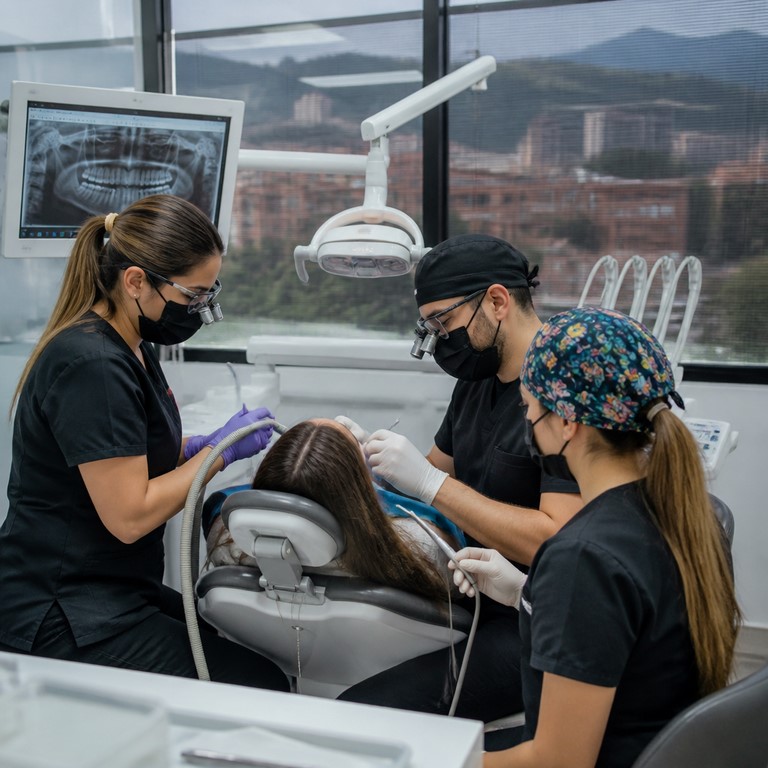
At Doctor Yazmin’s clinic in Medellín, implant case planning begins with CBCT imaging, which provides the three-dimensional bone data needed to recommend the right implant type and diameter for each patient’s specific anatomy — rather than defaulting to a particular product for cost or convenience.