A transparent, data-driven guide for U.S. patients researching dental tourism — published by DoctorYazmin.com
The same veneers cost up to 70% less in Colombia.
See if you qualify Free video call in English · on WhatsAppIndividual patient experience. Results and pricing are confirmed after a clinical evaluation.
Executive Summary
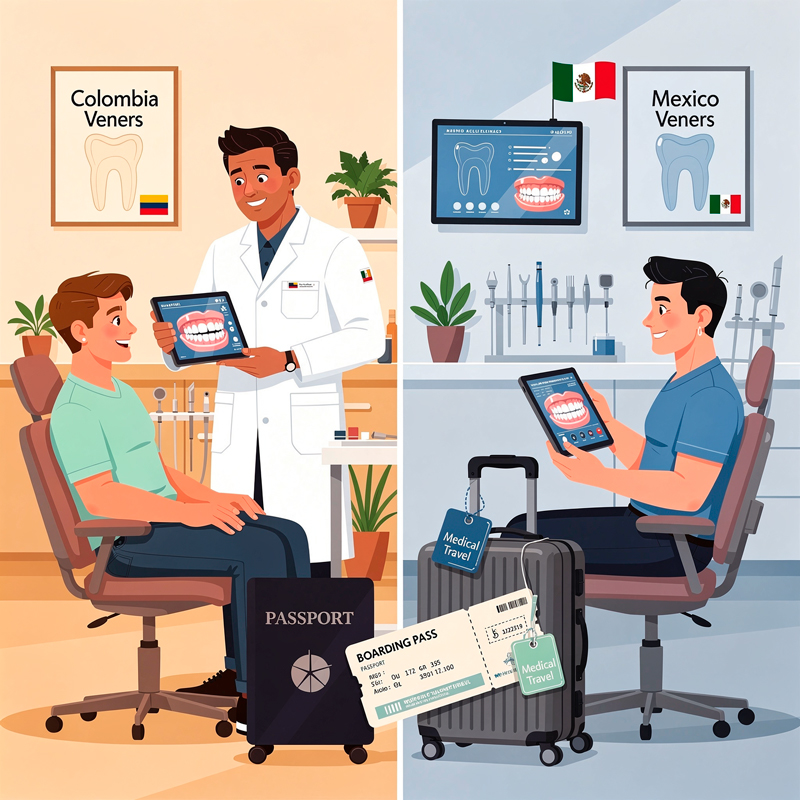
Every year, hundreds of thousands of Americans travel abroad for dental care, driven largely by one reality: dental veneers that cost $1,000–$2,500 per tooth in the U.S. can be obtained for $200–$600 in Latin America. Colombia and Mexico are the two most discussed destinations for Americans seeking porcelain or composite veneers, and each offers compelling advantages — along with real trade-offs that every patient deserves to understand before booking a flight.
This guide provides objective, data-backed comparisons across cost, quality, safety, logistics, and aftercare, so you can make the decision that is right for your situation — not a decision made for you by marketing.
What Are Dental Veneers? A Quick Primer
Dental veneers are thin, custom-made shells bonded to the front surface of teeth to improve their appearance — correcting discoloration, chips, gaps, or minor alignment issues. There are two primary types:
Key insight: Because veneer preparation is irreversible (enamel is removed and cannot grow back), choosing the right clinic and material is a permanent decision.
Cost Comparison: Colombia vs. Mexico vs. U.S.
Cost savings are the primary driver of dental tourism, and both countries offer dramatic reductions compared to U.S. prices. Below is a side-by-side breakdown based on published 2025–2026 price data:
Find the best place to get veneers in Colombia{‘id’: 4991, ‘date’: ‘2026-05-21T11:47:10’, ‘date_gmt’: ‘2026-05-21T11:47:10’, ‘guid’: {‘rendered’: ‘https://doctoryazmin.com/?p=4991’, ‘raw’: ‘https://doctoryazmin.com/?p=4991’}, ‘modified’: ‘2026-07-13T05:18:40’, ‘modified_gmt’: ‘2026-07-13T05:18:40’, ‘password’: ”, ‘slug’: ‘colombia-vs-mexico-dental-veneers-for-americans’, ‘status’: ‘publish’, ‘type’: ‘post’, ‘link’: ‘https://doctoryazmin.com/colombia-vs-mexico-dental-veneers-for-americans/’, ‘title’: {‘raw’: ‘Colombia vs. Mexico for Dental Veneers: Which Is Better for Americans?’, ‘rendered’: ‘Colombia vs. Mexico for Dental Veneers: Which Is Better for Americans?’}, ‘content’: {‘raw’: ‘\n
A transparent, data-driven guide for U.S. patients researching dental tourism — published by DoctorYazmin.com
The same veneers in Colombia cost up to 70% less.
In the US, 20 porcelain veneers run $30,000–$50,000. With Dr. Yazmin in Medellin, it's $7,000, all-inclusive.
Individual patient experience. Prices, inclusions and results are confirmed after a clinical evaluation. A full evaluation is required before any treatment.
\n\n\n\n
Executive Summary
\n\n\n\nEvery year, hundreds of thousands of Americans travel abroad for dental care, driven largely by one reality: dental veneers that cost $1,000–$2,500 per tooth in the U.S. can be obtained for $200–$600 in Latin America. Colombia and Mexico are the two most discussed destinations for Americans seeking porcelain or composite veneers, and each offers compelling advantages — along with real trade-offs that every patient deserves to understand before booking a flight.
\n\n\n\nThis guide provides objective, data-backed comparisons across cost, quality, safety, logistics, and aftercare, so you can make the decision that is right for your situation — not a decision made for you by marketing.
\n\n\n\n\n\n\n\n
What Are Dental Veneers? A Quick Primer
\n\n\n\nDental veneers are thin, custom-made shells bonded to the front surface of teeth to improve their appearance — correcting discoloration, chips, gaps, or minor alignment issues. There are two primary types:\u200b
\n\n\n\n\n\n\n\n\nKey insight: Because veneer preparation is irreversible (enamel is removed and cannot grow back), choosing the right clinic and material is a permanent decision.\u200b
\n
\n\n\n\n
Cost Comparison: Colombia vs. Mexico vs. U.S.
\n\n\n\nCost savings are the primary driver of dental tourism, and both countries offer dramatic reductions compared to U.S. prices. Below is a side-by-side breakdown based on published 2025–2026 price data:
\n\n\n\nPrice Per Tooth
\n\n\n\n| Veneer Type | United States | Colombia | Mexico |
|---|---|---|---|
| Composite veneer | $800–$1,500\u200b | $80–$300\u200b | $40–$250\u200b |
| Porcelain / E.max veneer | $1,000–$2,500\u200b | $200–$500\u200b | $350–$600\u200b |
| Zirconia veneer | $1,700–$2,500\u200b | $350–$550\u200b | $500–$750\u200b |
Full Smile Packages (10–20 veneers)
\n\n\n\nPotential Savings
\n\n\n\nBoth destinations offer savings of 50%–75% vs. U.S. prices. Colombia\’s per-tooth prices for porcelain veneers tend to be slightly lower than comparable Mexican clinics in tourist hubs like Cancún, though Mexico\’s border cities (Los Algodones, Tijuana) can match or undercut Colombia\’s pricing.
\n\n\n\nImportant caveat: Published prices are not final quotes. The actual cost depends on the specific clinic, number of teeth, materials used, complexity of the case, and whether lab work is done on-site. Always request a personalized treatment plan before comparing destinations.
\n\n\n\n\n\n\n\n
Quality of Care: Training, Technology & Materials
\n\n\n\nDentist Education and Credentials
\n\n\n\nColombia: Colombian dentists complete a 5-year dental school program, followed by a mandatory year of public service before licensing. Many top cosmetic dentists in Medellín and Bogotá hold additional international certifications and have trained in the U.S. or Europe. Clinics serving international patients regularly use Digital Smile Design (DSD), CAD/CAM systems, and 3D imaging technology.
\n\n\n\nMexico: Mexican dentists also complete a 5-year Doctor of Dental Surgery (DDS) program and must register with state dental boards. According to the Mexican Dental Association, over 70% of dentists in major medical tourism destinations have completed additional international training or hold dual certifications. Border cities like Los Algodones and resort destinations like Cancún have long-established dental tourism ecosystems serving millions of American patients annually.
\n\n\n\nBoth countries use internationally recognized premium materials, including:
\n\n\n\n- \n
- IPS e.max (lithium disilicate glass-ceramic) — considered an industry gold standard for veneers with documented 20+ year performance\u200b \n\n\n\n
- Zirconia ceramics — high strength, ideal for posterior veneers \n\n\n\n
- Ivoclar Vivadent, 3M ESPE\xa0— same brands used in top U.S. clinics \n
Taking the first step toward your dream teeth is completely risk-free. You can easily book a complimentary virtual consultation from home to see if you qualify for affordable veneers in Colombia before booking your flight.
\n\n\n\nQuality Verification Checklist (for either destination)
\n\n\n\n- \n
- ✅ Verify dentist\’s license through official government registries (Colombia: RETHUS; Mexico: SEP national registry)\u200b \n\n\n\n
- ✅ Look for board certifications from national associations (ADM in Mexico, SCP in Colombia) \n\n\n\n
- ✅ Confirm the clinic uses in-house or certified labs — critical for material quality and turnaround\u200b \n\n\n\n
- ✅ Request a Digital Smile Design (DSD) preview before any tooth preparation \n\n\n\n
- ✅ Ask for clinic infection control and sterilization protocols \n\n\n\n
- ✅ Check Google, Dental Departures, or Bookimed reviews from verified international patients \n
\n\n\n\n
Safety: Travel Advisories & Personal Security
\n\n\n\nThis is an area where honest information matters most, and where both destinations carry considerations that patients must weigh seriously.
\n\n\n\nU.S. State Department Travel Advisories (as of 2025)
\n\n\n\nColombia\’s Level 3 advisory was reissued in April 2025, citing violent crime, terrorism, civil unrest, and kidnapping risks. The U.S. State Department explicitly warns against travel to specific departments, while acknowledging that cities like Medellín and Bogotá operate in a different risk category from the conflict zones. The advisory recommends keeping a low profile, avoiding displays of wealth, and traveling only during daylight hours.
\n\n\n\nMexico\’s Level 2 advisory covers the country broadly, with specific states at Level 3 or Level 4. Cancún (Quintana Roo) and the dental hub of Los Algodones (near the Arizona border) currently fall under Level 2 — the same caution level as many European countries. Border towns like Tijuana carry a Level 3 advisory.\u200b\u200b
\n\n\n\nPractical Safety Realities
\n\n\n\n- \n
- Medellín has undergone remarkable urban transformation and is home to internationally recognized dental tourism infrastructure in neighborhoods like El Poblado and Laureles, both of which are considered safe and well-serviced for tourists.\u200b \n\n\n\n
- Los Algodones, Mexico — known as “Molar City” — hosts over 1,000 dentists in a small border town and receives millions of American visitors per year; violent crime in the dental tourist district is described as “virtually non-existent”.\u200b \n\n\n\n
- Both destinations require standard urban vigilance: avoiding isolated areas at night, not displaying expensive jewelry or devices, and using verified transportation.\u200b \n
\n\n\n\n\nBottom line on safety: Mexico\’s overall lower travel advisory level gives it a statistical edge for risk-averse travelers. Within Colombia, choosing accredited clinics in Medellín or Bogotá\’s established tourist districts substantially mitigates the broader country-level risks. Neither destination is risk-free, and both require the same common-sense precautions any traveler applies to an unfamiliar city.
\n
\n\n\n\n
Logistics: Getting There, Staying, and Treatment Timeline
\n\n\n\nTravel Distance and Cost
\n\n\n\n| Factor | Colombia (Medellín/Bogotá) | Mexico (Cancún/Los Algodones) |
|---|---|---|
| Flight from NYC | ~5 hours, direct\u200b | ~4 hours to Cancún |
| Flight from Miami | ~3.5 hours, direct\u200b | ~2 hours to Cancún |
| Flight from California | ~7–8 hours | Driveable to Los Algodones; ~4 hrs to Cancún |
| Visa required | No (tourist card issued on arrival) | No |
| Average daily hotel cost | $50–$120 (El Poblado, Bogotá) | $60–$200 (Cancún resort strip) |
| English proficiency at clinics | High (internationally oriented clinics) | High (in dental tourism hubs) |
Mexico holds a meaningful logistics advantage for Americans living in the South, Southwest, or Midwest due to proximity and direct flight frequency. For border-state residents in California, Arizona, or Texas, driving to Los Algodones or Tijuana eliminates flight costs entirely.
\n\n\n\nColombia is a longer journey but offers nonstop flights from major East Coast and Southern hubs. For many patients, the trip becomes a combined dental + vacation experience — Medellín and Cartagena are internationally recognized as vibrant, culturally rich destinations.\u200b
\n\n\n\nTreatment Timeline
\n\n\n\nBoth destinations typically require one trip for veneers, unlike implants which may require two separate visits. Plan for at least 5 days in-country to allow for initial assessment, temporary placement, lab fabrication, and final fitting.
\n\n\n\n\n\n\n\n
Pros and Cons: Colombia vs. Mexico for Veneers
\n\n\n\nColombia
\n\n\n\n✅ Pros
\n\n\n\n- \n
- Very competitive per-tooth pricing, especially for porcelain — among the lowest in Latin America for comparable quality \n\n\n\n
- Strong cosmetic dentistry specialization; many top clinics focus exclusively on aesthetic and restorative work\u200b \n\n\n\n
- Use of premium international materials (IPS e.max, zirconia) is standard at established tourist-oriented clinics\u200b \n\n\n\n
- Cities like Medellín offer high-quality tourist infrastructure, making treatment + vacation highly viable\u200b \n\n\n\n
- Growing track record with U.S. and Canadian dental tourists, with medical tourism volumes increasing 22.9% annually\u200b \n\n\n\n
- Many clinics offer English-speaking staff, concierge services, and airport pickup\u200b \n\n\n\n
- In-house labs at select clinics allow faster turnaround (ceramic veneers in as little as 24 hours)\u200b \n
❌ Cons
\n\n\n\n- \n
- U.S. State Department Level 3 travel advisory (Reconsider Travel) requires careful risk assessment\u200b \n\n\n\n
- Longer flights from most U.S. cities compared to Mexico\u200b \n\n\n\n
- Quality varies significantly by clinic and city — vetting is essential \n\n\n\n
- Post-treatment follow-up and warranty claims across international borders can be logistically difficult\u200b \n\n\n\n
- Some regions have genuine safety concerns unrelated to tourist areas\u200b \n
\n\n\n\n
Mexico
\n\n\n\n✅ Pros
\n\n\n\n- \n
- Lower travel advisory level (Level 2 overall; Level 2 for Cancún) — a meaningful factor for risk-conscious patients\u200b \n\n\n\n
- Unmatched proximity to the U.S. — driveable from border states, short flights from most cities\u200b \n\n\n\n
- Decades-long, well-established dental tourism ecosystem with millions of returning American patients annually\u200b \n\n\n\n
- Border towns like Los Algodones have near-zero violent crime in tourist zones\u200b \n\n\n\n
- Strong competition among clinics in tourism hubs drives quality and keeps prices competitive\u200b \n\n\n\n
- Many clinics affiliated with or certified by U.S. dental organizations (ADA-affiliated)\u200b \n
❌ Cons
\n\n\n\n- \n
- Specific popular border cities (Tijuana, Rosarito, Ensenada) carry a Level 3 travel advisory — patients must choose destinations carefully\u200b \n\n\n\n
- Price quality varies enormously; “budget” clinics in border towns may use inferior materials or rushed timelines\u200b \n\n\n\n
- The large supply of dental clinics makes credential verification more time-consuming \n\n\n\n
- Cancún and resort areas typically charge more than border towns, partially offsetting the convenience advantage\u200b \n\n\n\n
- Language barriers more common outside major tourist hubs\u200b \n
\n\n\n\n
Universal Risks of Getting Veneers Abroad
\n\n\n\nRegardless of destination, patients considering dental veneers abroad should understand these universal risks:
\n\n\n\nClinical risks:
\n\n\n\n- \n
- Irreversibility: Enamel removal for veneer preparation cannot be undone — if the result is unsatisfactory, options are limited and expensive\u200b \n\n\n\n
- Over-preparation: A documented risk in some overseas clinics, where too much enamel is removed, turning a veneer case into a crown case with elevated infection risk\u200b \n\n\n\n
- Chronic sensitivity: Improper tooth preparation can result in pain lasting six months or longer after placement\u200b \n\n\n\n
- Premature failure: Poor bonding, inferior materials, or incorrect bite alignment can cause veneers to chip or detach prematurely\u200b \n
Logistical risks:
\n\n\n\n- \n
- Follow-up difficulty: If a veneer requires adjustment weeks after you return home, your local dentist may decline to work on another provider\’s case, or charge premium rates \n\n\n\n
- Warranty enforcement: Clinic warranties are difficult to enforce from across an international border; understand exactly what a guarantee covers before committing\u200b \n\n\n\n
- Hidden costs: When factoring in flights, accommodation, meals, and potential follow-up visits, the true savings may be less than the headline price difference\u200b \n
Risk mitigation strategies:
\n\n\n\n- \n
- Always schedule a virtual consultation first to assess the clinic\’s communication quality and treatment planning \n\n\n\n
- Request before/after photos of real patients with similar cases \n\n\n\n
- Confirm the material brand (e.g., IPS e.max, Ivoclar) will be used — not generic alternatives \n\n\n\n
- Choose clinics with a written, enforceable warranty that specifies coverage terms \n\n\n\n
- Ensure your home dentist agrees to monitor and maintain the work after you return \n
\n\n\n\n
The Total Cost of a Dental Veneers Trip: A Realistic Estimate
\n\n\n\nThe sticker price of veneers is only part of the equation. Here is a realistic budget breakdown for each destination from a mid-U.S. city (e.g., Atlanta or Dallas):
\n\n\n\nEstimates based on published 2025–2026 price data. Individual costs will vary significantly based on origin city, clinic tier, number of veneers, and accommodation choices.
\n\n\n\n\n\n\n\n
Who Should Choose Colombia?
\n\n\n\nColombia may be the better fit if you:
\n\n\n\n- \n
- Prioritize competitive pricing for premium porcelain veneers and are willing to do thorough clinic research \n\n\n\n
- Live on the East Coast or South (Miami, Atlanta, New York, Houston) where direct flights are abundant \n\n\n\n
- Want to combine a cultural vacation with dental treatment — Medellín and Cartagena offer world-class tourism \n\n\n\n
- Are comfortable navigating the Level 3 advisory by selecting established, internationally recognized clinics in secure tourist neighborhoods \n\n\n\n
- Value clinics with in-house labs that can reduce your total days in-country \n
\n\n\n\n
Who Should Choose Mexico?
\n\n\n\nMexico may be the better fit if you:
\n\n\n\n- \n
- Live in border states (California, Arizona, Texas, New Mexico) where driving to Los Algodones is a realistic option \n\n\n\n
- Prefer the lower travel advisory level (Level 2) for peace of mind \n\n\n\n
- Want the shortest travel time and lowest flight costs \n\n\n\n
- Are considering combining dental work with a beach vacation in Cancún or Playa del Carmen \n\n\n\n
- Want access to a highly competitive market with many clinics and established American patient communities \n
\n\n\n\n
Questions to Ask Any Clinic Before Booking
\n\n\n\nWhether you choose Colombia or Mexico, ask every prospective clinic the following:
\n\n\n\n- \n
- What specific material (brand and type) will be used for my veneers? \n\n\n\n
- Is your laboratory in-house or outsourced? What is the lab\’s name? \n\n\n\n
- What is included in the warranty — and how do I make a claim from the U.S.? \n\n\n\n
- Can I see a Digital Smile Design (DSD) preview before any tooth preparation? \n\n\n\n
- What is the minimum number of days I need to be in-country? \n\n\n\n
- Do you have a partner dentist network in the U.S. for follow-up care? \n\n\n\n
- Can I speak with previous international patients as references? \n\n\n\n
- What happens if I am unsatisfied with the result? \n
\n\n\n\n
Conclusion: An Honest Verdict
\n\n\n\nThere is no universal “winner” between Colombia and Mexico for dental veneers — the right choice depends on where you live, how you weigh travel risk, and what kind of experience you want.
\n\n\n\nColombia offers some of the most competitive porcelain veneer pricing in Latin America, a rapidly growing cosmetic dentistry specialization, and the chance to combine treatment with a culturally rich destination. The trade-off is a higher U.S. State Department travel advisory that requires careful planning and deliberate clinic selection.
\n\n\n\nMexico offers unmatched convenience and proximity for most Americans, a decades-established dental tourism infrastructure, and a lower overall travel advisory level. The trade-off is greater variability in clinic quality and the need to carefully distinguish between tourist hub clinics and lower-tier budget options.
\n\n\n\nIn both countries, the key variable is not the destination — it is the clinic. A well-credentialed, internationally experienced cosmetic dentist using premium materials in either Colombia or Mexico can deliver results that rival or exceed what many Americans receive at home, at a fraction of the cost. The patient who does their research, verifies credentials, plans their timeline carefully, and maintains proper aftercare is the patient who gets the smile they traveled for.
\n\n\n\n\n\n\n\n
This article was produced for informational purposes by DoctorYazmin.com. It does not constitute medical advice. Always consult a licensed dental professional to evaluate your individual oral health needs before scheduling any treatment abroad.
\n\n\n\n\n\n📚 Sources & References
\n- \n\n \n
- \n \n Veneers Colombia vs USA Cost – 2025 Price Comparison – Dra. Sara Restrepos\n Colombia\n \n \n\n
- \n \n Are Dentists in Colombia Good? 2025 Honest Review – Dra. Sara Restrepos\n Colombia\n \n \n\n
- \n \n Is Colombia a Good Place to Get Dental Work? 2025 Guide – Dra. Sara Restrepos\n Colombia\n \n \n\n
- \n \n Why the Cost of Veneers in Colombia Makes It a Top Destination – Dental Tourism Colombia\n Colombia\n \n \n\n
- \n \n Veneers in Medellín – Dental Tourism Colombia\n Colombia\n \n \n\n
- \n \n Why Colombia Is the Best Country to Get Dental Work Overseas – Dental Tourism Colombia\n Colombia\n \n \n\n
- \n \n Is Visiting a Dentist in Medellín, Colombia Worth It? – Dental Tourism Colombia\n Colombia\n \n \n\n
- \n \n Colombia, Top Dental Tourism Destination in Latin America – Colombia One\n Colombia\n \n \n\n
- \n \n Medical Tourism in Colombia – Facts, Trends, and Statistics – Medical Tourism Business\n Colombia\n \n \n\n
- \n \n Dental Veneers in Medellín – Dental Medellín\n Colombia\n \n \n\n
- \n \n Veneers in Colombia | E-max from $4,950 + Triple Guarantee – Clínica Viena\n Colombia\n \n \n\n
- \n \n How Much Dental Veneers Cost in Bogota, Colombia – PlacidWay\n Colombia\n \n \n\n
- \n \n Top 10+ Clinics for Veneers in Colombia – Dental Departures\n Colombia\n \n \n\n
- \n \n Veneers in Colombia: Cost & FAQs – GR Dents Cali\n Colombia\n \n \n\n \n\n
- \n \n Best Dentist in Mexico for Veneers | Dental Trip & Costs – A1 Smile Design\n Mexico\n \n \n\n
- \n \n Veneers in Mexico: Comparing Top Dental Tourism Destinations for Americans – CliquePlus\n Mexico\n \n \n\n
- \n \n Is Dental Tourism in Mexico Safe? – Heva\n Mexico\n \n \n\n
- \n \n Is It Safe to Get Dental Work in Mexico? – Quality Standards Guide – Heva\n Mexico\n \n \n\n
- \n \n How Can I Verify a Dentist\’s Credentials in Tijuana? – Dental Artistry MX\n Mexico\n \n \n\n
- \n \n Mexico\’s Health and Safety Regulations | Dental – Pure Smile Cabo\n Mexico\n \n \n\n
- \n \n Cancun Dental Price List 2026 – Mexico Dentist Directory\n Mexico\n \n \n\n
- \n \n Getting Veneers in Mexico: What to Know Before You Go – GetGlobalCare\n Mexico\n \n \n\n
- \n \n Experience Dental Tourism With an ADA Accredited Dentist – Dental Mexico\n Mexico\n \n \n\n
- \n \n Navigating Dental Care in Mexico: Legal Issues in Dentistry – Pure Smile Cabo\n Mexico\n \n \n\n
- \n \n Dental Veneers in Los Algodones, Mexico – Dentavacation\n Mexico\n \n \n\n
- \n \n Why Mexico Is the #1 Destination for Dental Work – Dental Design Studio\n Mexico\n \n \n\n \n\n
- \n \n U.S. Elevated Travel Advisory for Colombia – Travel and Tour World\n Advisory\n \n \n\n
- \n \n US Issues Travel Warning for Colombia – Hindustan Times\n Advisory\n \n \n\n
- \n \n Americans Planning Mexico Vacations Face New Safety Concerns – FOX 10 Phoenix\n U.S.\n \n \n\n
- \n \n US State Department Issues Travel Advisory for Colombia – NTD\n U.S.\n \n \n\n
- \n \n Maps of Restricted Areas – U.S. Embassy & Consulates in Mexico\n U.S.\n \n \n\n
- \n \n US State Department Travel Advisory Update – Travel Off Path\n U.S.\n \n \n\n
- \n \n Risks of Dental Tourism – Chronic Pain and Other Complications – Uniqa Dental\n International\n \n \n\n
- \n \n Why You Should Be Careful of Cosmetic Dentistry Tourism – Dentist Downey\n U.S.\n \n \n\n
- \n \n Dental Implants Mexico vs. Colombia: Affordable & Quality Solutions – PlacidWay\n International\n \n \n\n
- \n \n Dental Education in Colombia – PubMed / NCBI\n Academic\n \n \n\n
- \n \n Dental Education in Colombia – PMC / NCBI\n Academic\n \n \n\n
- \n \n Cancun Dental Standards 2025: Quality & Safety – PlacidWay\n Mexico\n \n \n\n
- \n \n Dental Veneers Abroad: Risks and Local Alternatives – Edmonton Smiles\n International\n \n \n\n
- \n \n Veneers Abroad | What to Expect? – Pearl Dental Clinic\n International\n \n \n\n
- \n \n Mexico\’s Molar City Could Transform My Smile – The New Yorker\n U.S.\n \n \n\n
- \n \n IPS E.max: Strength in a Smile – Burbank Dental\n U.S.\n \n \n\n
- \n \n Your Ultimate Guide to Getting Dental Veneers in Colombia – Medical Tourism Packages\n International\n \n \n\n
A transparent, data-driven guide for U.S. patients researching dental tourism — published by DoctorYazmin.com
\n\n\n\n\n\n\n\n
Executive Summary
\n\n\n\nEvery year, hundreds of thousands of Americans travel abroad for dental care, driven largely by one reality: dental veneers that cost $1,000–$2,500 per tooth in the U.S. can be obtained for $200–$600 in Latin America. Colombia and Mexico are the two most discussed destinations for Americans seeking porcelain or composite veneers, and each offers compelling advantages — along with real trade-offs that every patient deserves to understand before booking a flight.
\n\n\n\nThis guide provides objective, data-backed comparisons across cost, quality, safety, logistics, and aftercare, so you can make the decision that is right for your situation — not a decision made for you by marketing.
\n\n\n\n\n\n\n\n
What Are Dental Veneers? A Quick Primer
\n\n\n\nDental veneers are thin, custom-made shells bonded to the front surface of teeth to improve their appearance — correcting discoloration, chips, gaps, or minor alignment issues. There are two primary types:\u200b
\n\n\n\n\n\n\n\n\nKey insight: Because veneer preparation is irreversible (enamel is removed and cannot grow back), choosing the right clinic and material is a permanent decision.\u200b
\n
\n\n\n\n
Cost Comparison: Colombia vs. Mexico vs. U.S.
\n\n\n\nCost savings are the primary driver of dental tourism, and both countries offer dramatic reductions compared to U.S. prices. Below is a side-by-side breakdown based on published 2025–2026 price data:
\n\n\n\nPrice Per Tooth
\n\n\n\n| Veneer Type | United States | Colombia | Mexico |
|---|---|---|---|
| Composite veneer | $800–$1,500\u200b | $80–$300\u200b | $40–$250\u200b |
| Porcelain / E.max veneer | $1,000–$2,500\u200b | $200–$500\u200b | $350–$600\u200b |
| Zirconia veneer | $1,700–$2,500\u200b | $350–$550\u200b | $500–$750\u200b |
Full Smile Packages (10–20 veneers)
\n\n\n\nPotential Savings
\n\n\n\nBoth destinations offer savings of 50%–75% vs. U.S. prices. Colombia’s per-tooth prices for porcelain veneers tend to be slightly lower than comparable Mexican clinics in tourist hubs like Cancún, though Mexico’s border cities (Los Algodones, Tijuana) can match or undercut Colombia’s pricing.
\n\n\n\nImportant caveat: Published prices are not final quotes. The actual cost depends on the specific clinic, number of teeth, materials used, complexity of the case, and whether lab work is done on-site. Always request a personalized treatment plan before comparing destinations.
\n\n\n\n\n\n\n\n
Quality of Care: Training, Technology & Materials
\n\n\n\nDentist Education and Credentials
\n\n\n\nColombia: Colombian dentists complete a 5-year dental school program, followed by a mandatory year of public service before licensing. Many top cosmetic dentists in Medellín and Bogotá hold additional international certifications and have trained in the U.S. or Europe. Clinics serving international patients regularly use Digital Smile Design (DSD), CAD/CAM systems, and 3D imaging technology.
\n\n\n\nMexico: Mexican dentists also complete a 5-year Doctor of Dental Surgery (DDS) program and must register with state dental boards. According to the Mexican Dental Association, over 70% of dentists in major medical tourism destinations have completed additional international training or hold dual certifications. Border cities like Los Algodones and resort destinations like Cancún have long-established dental tourism ecosystems serving millions of American patients annually.
\n\n\n\nBoth countries use internationally recognized premium materials, including:
\n\n\n\n- \n
- IPS e.max (lithium disilicate glass-ceramic) — considered an industry gold standard for veneers with documented 20+ year performance\u200b \n\n\n\n
- Zirconia ceramics — high strength, ideal for posterior veneers \n\n\n\n
- Ivoclar Vivadent, 3M ESPE\xa0— same brands used in top U.S. clinics \n
Taking the first step toward your dream teeth is completely risk-free. You can easily book a complimentary virtual consultation from home to see if you qualify for affordable veneers in Colombia before booking your flight.
\n\n\n\nQuality Verification Checklist (for either destination)
\n\n\n\n- \n
- ✅ Verify dentist’s license through official government registries (Colombia: RETHUS; Mexico: SEP national registry)\u200b \n\n\n\n
- ✅ Look for board certifications from national associations (ADM in Mexico, SCP in Colombia) \n\n\n\n
- ✅ Confirm the clinic uses in-house or certified labs — critical for material quality and turnaround\u200b \n\n\n\n
- ✅ Request a Digital Smile Design (DSD) preview before any tooth preparation \n\n\n\n
- ✅ Ask for clinic infection control and sterilization protocols \n\n\n\n
- ✅ Check Google, Dental Departures, or Bookimed reviews from verified international patients \n
\n\n\n\n
Safety: Travel Advisories & Personal Security
\n\n\n\nThis is an area where honest information matters most, and where both destinations carry considerations that patients must weigh seriously.
\n\n\n\nU.S. State Department Travel Advisories (as of 2025)
\n\n\n\nColombia’s Level 3 advisory was reissued in April 2025, citing violent crime, terrorism, civil unrest, and kidnapping risks. The U.S. State Department explicitly warns against travel to specific departments, while acknowledging that cities like Medellín and Bogotá operate in a different risk category from the conflict zones. The advisory recommends keeping a low profile, avoiding displays of wealth, and traveling only during daylight hours.
\n\n\n\nMexico’s Level 2 advisory covers the country broadly, with specific states at Level 3 or Level 4. Cancún (Quintana Roo) and the dental hub of Los Algodones (near the Arizona border) currently fall under Level 2 — the same caution level as many European countries. Border towns like Tijuana carry a Level 3 advisory.\u200b\u200b
\n\n\n\nPractical Safety Realities
\n\n\n\n- \n
- Medellín has undergone remarkable urban transformation and is home to internationally recognized dental tourism infrastructure in neighborhoods like El Poblado and Laureles, both of which are considered safe and well-serviced for tourists.\u200b \n\n\n\n
- Los Algodones, Mexico — known as “Molar City” — hosts over 1,000 dentists in a small border town and receives millions of American visitors per year; violent crime in the dental tourist district is described as “virtually non-existent”.\u200b \n\n\n\n
- Both destinations require standard urban vigilance: avoiding isolated areas at night, not displaying expensive jewelry or devices, and using verified transportation.\u200b \n
\n\n\n\n\nBottom line on safety: Mexico’s overall lower travel advisory level gives it a statistical edge for risk-averse travelers. Within Colombia, choosing accredited clinics in Medellín or Bogotá’s established tourist districts substantially mitigates the broader country-level risks. Neither destination is risk-free, and both require the same common-sense precautions any traveler applies to an unfamiliar city.
\n
\n\n\n\n
Logistics: Getting There, Staying, and Treatment Timeline
\n\n\n\nTravel Distance and Cost
\n\n\n\n| Factor | Colombia (Medellín/Bogotá) | Mexico (Cancún/Los Algodones) |
|---|---|---|
| Flight from NYC | ~5 hours, direct\u200b | ~4 hours to Cancún |
| Flight from Miami | ~3.5 hours, direct\u200b | ~2 hours to Cancún |
| Flight from California | ~7–8 hours | Driveable to Los Algodones; ~4 hrs to Cancún |
| Visa required | No (tourist card issued on arrival) | No |
| Average daily hotel cost | $50–$120 (El Poblado, Bogotá) | $60–$200 (Cancún resort strip) |
| English proficiency at clinics | High (internationally oriented clinics) | High (in dental tourism hubs) |
Mexico holds a meaningful logistics advantage for Americans living in the South, Southwest, or Midwest due to proximity and direct flight frequency. For border-state residents in California, Arizona, or Texas, driving to Los Algodones or Tijuana eliminates flight costs entirely.
\n\n\n\nColombia is a longer journey but offers nonstop flights from major East Coast and Southern hubs. For many patients, the trip becomes a combined dental + vacation experience — Medellín and Cartagena are internationally recognized as vibrant, culturally rich destinations.\u200b
\n\n\n\nTreatment Timeline
\n\n\n\nBoth destinations typically require one trip for veneers, unlike implants which may require two separate visits. Plan for at least 5 days in-country to allow for initial assessment, temporary placement, lab fabrication, and final fitting.
\n\n\n\n\n\n\n\n
Pros and Cons: Colombia vs. Mexico for Veneers
\n\n\n\nColombia
\n\n\n\n✅ Pros
\n\n\n\n- \n
- Very competitive per-tooth pricing, especially for porcelain — among the lowest in Latin America for comparable quality \n\n\n\n
- Strong cosmetic dentistry specialization; many top clinics focus exclusively on aesthetic and restorative work\u200b \n\n\n\n
- Use of premium international materials (IPS e.max, zirconia) is standard at established tourist-oriented clinics\u200b \n\n\n\n
- Cities like Medellín offer high-quality tourist infrastructure, making treatment + vacation highly viable\u200b \n\n\n\n
- Growing track record with U.S. and Canadian dental tourists, with medical tourism volumes increasing 22.9% annually\u200b \n\n\n\n
- Many clinics offer English-speaking staff, concierge services, and airport pickup\u200b \n\n\n\n
- In-house labs at select clinics allow faster turnaround (ceramic veneers in as little as 24 hours)\u200b \n
❌ Cons
\n\n\n\n- \n
- U.S. State Department Level 3 travel advisory (Reconsider Travel) requires careful risk assessment\u200b \n\n\n\n
- Longer flights from most U.S. cities compared to Mexico\u200b \n\n\n\n
- Quality varies significantly by clinic and city — vetting is essential \n\n\n\n
- Post-treatment follow-up and warranty claims across international borders can be logistically difficult\u200b \n\n\n\n
- Some regions have genuine safety concerns unrelated to tourist areas\u200b \n
\n\n\n\n
Mexico
\n\n\n\n✅ Pros
\n\n\n\n- \n
- Lower travel advisory level (Level 2 overall; Level 2 for Cancún) — a meaningful factor for risk-conscious patients\u200b \n\n\n\n
- Unmatched proximity to the U.S. — driveable from border states, short flights from most cities\u200b \n\n\n\n
- Decades-long, well-established dental tourism ecosystem with millions of returning American patients annually\u200b \n\n\n\n
- Border towns like Los Algodones have near-zero violent crime in tourist zones\u200b \n\n\n\n
- Strong competition among clinics in tourism hubs drives quality and keeps prices competitive\u200b \n\n\n\n
- Many clinics affiliated with or certified by U.S. dental organizations (ADA-affiliated)\u200b \n
❌ Cons
\n\n\n\n- \n
- Specific popular border cities (Tijuana, Rosarito, Ensenada) carry a Level 3 travel advisory — patients must choose destinations carefully\u200b \n\n\n\n
- Price quality varies enormously; “budget” clinics in border towns may use inferior materials or rushed timelines\u200b \n\n\n\n
- The large supply of dental clinics makes credential verification more time-consuming \n\n\n\n
- Cancún and resort areas typically charge more than border towns, partially offsetting the convenience advantage\u200b \n\n\n\n
- Language barriers more common outside major tourist hubs\u200b \n
\n\n\n\n
Universal Risks of Getting Veneers Abroad
\n\n\n\nRegardless of destination, patients considering dental veneers abroad should understand these universal risks:
\n\n\n\nClinical risks:
\n\n\n\n- \n
- Irreversibility: Enamel removal for veneer preparation cannot be undone — if the result is unsatisfactory, options are limited and expensive\u200b \n\n\n\n
- Over-preparation: A documented risk in some overseas clinics, where too much enamel is removed, turning a veneer case into a crown case with elevated infection risk\u200b \n\n\n\n
- Chronic sensitivity: Improper tooth preparation can result in pain lasting six months or longer after placement\u200b \n\n\n\n
- Premature failure: Poor bonding, inferior materials, or incorrect bite alignment can cause veneers to chip or detach prematurely\u200b \n
Logistical risks:
\n\n\n\n- \n
- Follow-up difficulty: If a veneer requires adjustment weeks after you return home, your local dentist may decline to work on another provider’s case, or charge premium rates \n\n\n\n
- Warranty enforcement: Clinic warranties are difficult to enforce from across an international border; understand exactly what a guarantee covers before committing\u200b \n\n\n\n
- Hidden costs: When factoring in flights, accommodation, meals, and potential follow-up visits, the true savings may be less than the headline price difference\u200b \n
Risk mitigation strategies:
\n\n\n\n- \n
- Always schedule a virtual consultation first to assess the clinic’s communication quality and treatment planning \n\n\n\n
- Request before/after photos of real patients with similar cases \n\n\n\n
- Confirm the material brand (e.g., IPS e.max, Ivoclar) will be used — not generic alternatives \n\n\n\n
- Choose clinics with a written, enforceable warranty that specifies coverage terms \n\n\n\n
- Ensure your home dentist agrees to monitor and maintain the work after you return \n
\n\n\n\n
The Total Cost of a Dental Veneers Trip: A Realistic Estimate
\n\n\n\nThe sticker price of veneers is only part of the equation. Here is a realistic budget breakdown for each destination from a mid-U.S. city (e.g., Atlanta or Dallas):
\n\n\n\nEstimates based on published 2025–2026 price data. Individual costs will vary significantly based on origin city, clinic tier, number of veneers, and accommodation choices.
\n\n\n\n\n\n\n\n
Who Should Choose Colombia?
\n\n\n\nColombia may be the better fit if you:
\n\n\n\n- \n
- Prioritize competitive pricing for premium porcelain veneers and are willing to do thorough clinic research \n\n\n\n
- Live on the East Coast or South (Miami, Atlanta, New York, Houston) where direct flights are abundant \n\n\n\n
- Want to combine a cultural vacation with dental treatment — Medellín and Cartagena offer world-class tourism \n\n\n\n
- Are comfortable navigating the Level 3 advisory by selecting established, internationally recognized clinics in secure tourist neighborhoods \n\n\n\n
- Value clinics with in-house labs that can reduce your total days in-country \n
\n\n\n\n
Who Should Choose Mexico?
\n\n\n\nMexico may be the better fit if you:
\n\n\n\n- \n
- Live in border states (California, Arizona, Texas, New Mexico) where driving to Los Algodones is a realistic option \n\n\n\n
- Prefer the lower travel advisory level (Level 2) for peace of mind \n\n\n\n
- Want the shortest travel time and lowest flight costs \n\n\n\n
- Are considering combining dental work with a beach vacation in Cancún or Playa del Carmen \n\n\n\n
- Want access to a highly competitive market with many clinics and established American patient communities \n
\n\n\n\n
Questions to Ask Any Clinic Before Booking
\n\n\n\nWhether you choose Colombia or Mexico, ask every prospective clinic the following:
\n\n\n\n- \n
- What specific material (brand and type) will be used for my veneers? \n\n\n\n
- Is your laboratory in-house or outsourced? What is the lab’s name? \n\n\n\n
- What is included in the warranty — and how do I make a claim from the U.S.? \n\n\n\n
- Can I see a Digital Smile Design (DSD) preview before any tooth preparation? \n\n\n\n
- What is the minimum number of days I need to be in-country? \n\n\n\n
- Do you have a partner dentist network in the U.S. for follow-up care? \n\n\n\n
- Can I speak with previous international patients as references? \n\n\n\n
- What happens if I am unsatisfied with the result? \n
\n\n\n\n
Conclusion: An Honest Verdict
\n\n\n\nThere is no universal “winner” between Colombia and Mexico for dental veneers — the right choice depends on where you live, how you weigh travel risk, and what kind of experience you want.
\n\n\n\nColombia offers some of the most competitive porcelain veneer pricing in Latin America, a rapidly growing cosmetic dentistry specialization, and the chance to combine treatment with a culturally rich destination. The trade-off is a higher U.S. State Department travel advisory that requires careful planning and deliberate clinic selection.
\n\n\n\nMexico offers unmatched convenience and proximity for most Americans, a decades-established dental tourism infrastructure, and a lower overall travel advisory level. The trade-off is greater variability in clinic quality and the need to carefully distinguish between tourist hub clinics and lower-tier budget options.
\n\n\n\nIn both countries, the key variable is not the destination — it is the clinic. A well-credentialed, internationally experienced cosmetic dentist using premium materials in either Colombia or Mexico can deliver results that rival or exceed what many Americans receive at home, at a fraction of the cost. The patient who does their research, verifies credentials, plans their timeline carefully, and maintains proper aftercare is the patient who gets the smile they traveled for.
\n\n\n\n\n\n\n\n
This article was produced for informational purposes by DoctorYazmin.com. It does not constitute medical advice. Always consult a licensed dental professional to evaluate your individual oral health needs before scheduling any treatment abroad.
\n\n\n\n\n\n📚 Sources & References
\n- \n\n \n
- \n \n Veneers Colombia vs USA Cost – 2025 Price Comparison – Dra. Sara Restrepos\n Colombia\n \n \n\n
- \n \n Are Dentists in Colombia Good? 2025 Honest Review – Dra. Sara Restrepos\n Colombia\n \n \n\n
- \n \n Is Colombia a Good Place to Get Dental Work? 2025 Guide – Dra. Sara Restrepos\n Colombia\n \n \n\n
- \n \n Why the Cost of Veneers in Colombia Makes It a Top Destination – Dental Tourism Colombia\n Colombia\n \n \n\n
- \n \n Veneers in Medellín – Dental Tourism Colombia\n Colombia\n \n \n\n
- \n \n Why Colombia Is the Best Country to Get Dental Work Overseas – Dental Tourism Colombia\n Colombia\n \n \n\n
- \n \n Is Visiting a Dentist in Medellín, Colombia Worth It? – Dental Tourism Colombia\n Colombia\n \n \n\n
- \n \n Colombia, Top Dental Tourism Destination in Latin America – Colombia One\n Colombia\n \n \n\n
- \n \n Medical Tourism in Colombia – Facts, Trends, and Statistics – Medical Tourism Business\n Colombia\n \n \n\n
- \n \n Dental Veneers in Medellín – Dental Medellín\n Colombia\n \n \n\n
- \n \n Veneers in Colombia | E-max from $4,950 + Triple Guarantee – Clínica Viena\n Colombia\n \n \n\n
- \n \n How Much Dental Veneers Cost in Bogota, Colombia – PlacidWay\n Colombia\n \n \n\n
- \n \n Top 10+ Clinics for Veneers in Colombia – Dental Departures\n Colombia\n \n \n\n
- \n \n Veneers in Colombia: Cost & FAQs – GR Dents Cali\n Colombia\n \n \n\n \n\n
- \n \n Best Dentist in Mexico for Veneers | Dental Trip & Costs – A1 Smile Design\n Mexico\n \n \n\n
- \n \n Veneers in Mexico: Comparing Top Dental Tourism Destinations for Americans – CliquePlus\n Mexico\n \n \n\n
- \n \n Is Dental Tourism in Mexico Safe? – Heva\n Mexico\n \n \n\n
- \n \n Is It Safe to Get Dental Work in Mexico? – Quality Standards Guide – Heva\n Mexico\n \n \n\n
- \n \n How Can I Verify a Dentist’s Credentials in Tijuana? – Dental Artistry MX\n Mexico\n \n \n\n
- \n \n Mexico’s Health and Safety Regulations | Dental – Pure Smile Cabo\n Mexico\n \n \n\n
- \n \n Cancun Dental Price List 2026 – Mexico Dentist Directory\n Mexico\n \n \n\n
- \n \n Getting Veneers in Mexico: What to Know Before You Go – GetGlobalCare\n Mexico\n \n \n\n
- \n \n Experience Dental Tourism With an ADA Accredited Dentist – Dental Mexico\n Mexico\n \n \n\n
- \n \n Navigating Dental Care in Mexico: Legal Issues in Dentistry – Pure Smile Cabo\n Mexico\n \n \n\n
- \n \n Dental Veneers in Los Algodones, Mexico – Dentavacation\n Mexico\n \n \n\n
- \n \n Why Mexico Is the #1 Destination for Dental Work – Dental Design Studio\n Mexico\n \n \n\n \n\n
- \n \n U.S. Elevated Travel Advisory for Colombia – Travel and Tour World\n Advisory\n \n \n\n
- \n \n US Issues Travel Warning for Colombia – Hindustan Times\n Advisory\n \n \n\n
- \n \n Americans Planning Mexico Vacations Face New Safety Concerns – FOX 10 Phoenix\n U.S.\n \n \n\n
- \n \n US State Department Issues Travel Advisory for Colombia – NTD\n U.S.\n \n \n\n
- \n \n Maps of Restricted Areas – U.S. Embassy & Consulates in Mexico\n U.S.\n \n \n\n
- \n \n US State Department Travel Advisory Update – Travel Off Path\n U.S.\n \n \n\n
- \n \n Risks of Dental Tourism – Chronic Pain and Other Complications – Uniqa Dental\n International\n \n \n\n
- \n \n Why You Should Be Careful of Cosmetic Dentistry Tourism – Dentist Downey\n U.S.\n \n \n\n
- \n \n Dental Implants Mexico vs. Colombia: Affordable & Quality Solutions – PlacidWay\n International\n \n \n\n
- \n \n Dental Education in Colombia – PubMed / NCBI\n Academic\n \n \n\n
- \n \n Dental Education in Colombia – PMC / NCBI\n Academic\n \n \n\n
- \n \n Cancun Dental Standards 2025: Quality & Safety – PlacidWay\n Mexico\n \n \n\n
- \n \n Dental Veneers Abroad: Risks and Local Alternatives – Edmonton Smiles\n International\n \n \n\n
- \n \n Veneers Abroad | What to Expect? – Pearl Dental Clinic\n International\n \n \n\n
- \n \n Mexico’s Molar City Could Transform My Smile – The New Yorker\n U.S.\n \n \n\n
- \n \n IPS E.max: Strength in a Smile – Burbank Dental\n U.S.\n \n \n\n
- \n \n Your Ultimate Guide to Getting Dental Veneers in Colombia – Medical Tourism Packages\n International\n \n \n\n
A transparent, data-driven guide for U.S. patients researching dental tourism — published by DoctorYazmin.com Executive Summary Every year, hundreds of thousands of […]
\n’, ‘protected’: False}, ‘author’: 1, ‘featured_media’: 4993, ‘comment_status’: ‘open’, ‘ping_status’: ‘open’, ‘sticky’: False, ‘template’: ”, ‘format’: ‘standard’, ‘meta’: {‘footnotes’: ”, ‘_elementor_edit_mode’: ”, ‘_elementor_template_type’: ”, ‘_elementor_data’: ”, ‘_elementor_page_settings’: None, ‘_elementor_conditions’: []}, ‘categories’: [11], ‘tags’: [], ‘permalink_template’: ‘https://doctoryazmin.com/%postname%/’, ‘generated_slug’: ‘colombia-vs-mexico-for-dental-veneers-which-is-better-for-americans’, ‘class_list’: [‘post-4991’, ‘post’, ‘type-post’, ‘status-publish’, ‘format-standard’, ‘has-post-thumbnail’, ‘hentry’, ‘category-general’], ‘_links’: {‘self’: [{‘href’: ‘https://doctoryazmin.com/wp-json/wp/v2/posts/4991’, ‘targetHints’: {‘allow’: [‘GET’, ‘POST’, ‘PUT’, ‘PATCH’, ‘DELETE’]}}], ‘collection’: [{‘href’: ‘https://doctoryazmin.com/wp-json/wp/v2/posts’}], ‘about’: [{‘href’: ‘https://doctoryazmin.com/wp-json/wp/v2/types/post’}], ‘author’: [{’embeddable’: True, ‘href’: ‘https://doctoryazmin.com/wp-json/wp/v2/users/1’}], ‘replies’: [{’embeddable’: True, ‘href’: ‘https://doctoryazmin.com/wp-json/wp/v2/comments?post=4991’}], ‘version-history’: [{‘count’: 7, ‘href’: ‘https://doctoryazmin.com/wp-json/wp/v2/posts/4991/revisions’}], ‘predecessor-version’: [{‘id’: 7068, ‘href’: ‘https://doctoryazmin.com/wp-json/wp/v2/posts/4991/revisions/7068’}], ‘wp:featuredmedia’: [{’embeddable’: True, ‘href’: ‘https://doctoryazmin.com/wp-json/wp/v2/media/4993’}], ‘wp:attachment’: [{‘href’: ‘https://doctoryazmin.com/wp-json/wp/v2/media?parent=4991’}], ‘wp:term’: [{‘taxonomy’: ‘category’, ’embeddable’: True, ‘href’: ‘https://doctoryazmin.com/wp-json/wp/v2/categories?post=4991’}, {‘taxonomy’: ‘post_tag’, ’embeddable’: True, ‘href’: ‘https://doctoryazmin.com/wp-json/wp/v2/tags?post=4991’}], ‘wp:action-publish’: [{‘href’: ‘https://doctoryazmin.com/wp-json/wp/v2/posts/4991’}], ‘wp:action-unfiltered-html’: [{‘href’: ‘https://doctoryazmin.com/wp-json/wp/v2/posts/4991’}], ‘wp:action-sticky’: [{‘href’: ‘https://doctoryazmin.com/wp-json/wp/v2/posts/4991’}], ‘wp:action-assign-author’: [{‘href’: ‘https://doctoryazmin.com/wp-json/wp/v2/posts/4991’}], ‘wp:action-create-categories’: [{‘href’: ‘https://doctoryazmin.com/wp-json/wp/v2/posts/4991’}], ‘wp:action-assign-categories’: [{‘href’: ‘https://doctoryazmin.com/wp-json/wp/v2/posts/4991’}], ‘wp:action-create-tags’: [{‘href’: ‘https://doctoryazmin.com/wp-json/wp/v2/posts/4991’}], ‘wp:action-assign-tags’: [{‘href’: ‘https://doctoryazmin.com/wp-json/wp/v2/posts/4991’}], ‘curies’: [{‘name’: ‘wp’, ‘href’: ‘https://api.w.org/{rel}’, ‘templated’: True}]}}Price Per Tooth
| Veneer Type | United States | Colombia | Mexico |
|---|---|---|---|
| Composite veneer | $800–$1,500 | $80–$300 | $40–$250 |
| Porcelain / E.max veneer | $1,000–$2,500 | $200–$500 | $350–$600 |
| Zirconia veneer | $1,700–$2,500 | $350–$550 | $500–$750 |
Full Smile Packages (10–20 veneers)
Potential Savings
Both destinations offer savings of 50%–75% vs. U.S. prices. Colombia’s per-tooth prices for porcelain veneers tend to be slightly lower than comparable Mexican clinics in tourist hubs like Cancún, though Mexico’s border cities (Los Algodones, Tijuana) can match or undercut Colombia’s pricing.
Important caveat: Published prices are not final quotes. The actual cost depends on the specific clinic, number of teeth, materials used, complexity of the case, and whether lab work is done on-site. Always request a personalized treatment plan before comparing destinations.
Quality of Care: Training, Technology & Materials
Dentist Education and Credentials
Colombia: Colombian dentists complete a 5-year dental school program, followed by a mandatory year of public service before licensing. Many top cosmetic dentists in Medellín and Bogotá hold additional international certifications and have trained in the U.S. or Europe. Clinics serving international patients regularly use Digital Smile Design (DSD), CAD/CAM systems, and 3D imaging technology.
Mexico: Mexican dentists also complete a 5-year Doctor of Dental Surgery (DDS) program and must register with state dental boards. According to the Mexican Dental Association, over 70% of dentists in major medical tourism destinations have completed additional international training or hold dual certifications. Border cities like Los Algodones and resort destinations like Cancún have long-established dental tourism ecosystems serving millions of American patients annually.
Both countries use internationally recognized premium materials, including:
- IPS e.max (lithium disilicate glass-ceramic) — considered an industry gold standard for veneers with documented 20+ year performance
- Zirconia ceramics — high strength, ideal for posterior veneers
- Ivoclar Vivadent, 3M ESPE — same brands used in top U.S. clinics
Taking the first step toward your dream teeth is completely risk-free. You can easily book a complimentary virtual consultation from home to see if you qualify for affordable veneers in Colombia before booking your flight.
Quality Verification Checklist (for either destination)
- ✅ Verify dentist’s license through official government registries (Colombia: RETHUS; Mexico: SEP national registry)
- ✅ Look for board certifications from national associations (ADM in Mexico, SCP in Colombia)
- ✅ Confirm the clinic uses in-house or certified labs — critical for material quality and turnaround
- ✅ Request a Digital Smile Design (DSD) preview before any tooth preparation
- ✅ Ask for clinic infection control and sterilization protocols
- ✅ Check Google, Dental Departures, or Bookimed reviews from verified international patients
Safety: Travel Advisories & Personal Security
This is an area where honest information matters most, and where both destinations carry considerations that patients must weigh seriously.
U.S. State Department Travel Advisories (as of 2025)
Colombia’s Level 3 advisory was reissued in April 2025, citing violent crime, terrorism, civil unrest, and kidnapping risks. The U.S. State Department explicitly warns against travel to specific departments, while acknowledging that cities like Medellín and Bogotá operate in a different risk category from the conflict zones. The advisory recommends keeping a low profile, avoiding displays of wealth, and traveling only during daylight hours.
Mexico’s Level 2 advisory covers the country broadly, with specific states at Level 3 or Level 4. Cancún (Quintana Roo) and the dental hub of Los Algodones (near the Arizona border) currently fall under Level 2 — the same caution level as many European countries. Border towns like Tijuana carry a Level 3 advisory.
Practical Safety Realities
- Medellín has undergone remarkable urban transformation and is home to internationally recognized dental tourism infrastructure in neighborhoods like El Poblado and Laureles, both of which are considered safe and well-serviced for tourists.
- Los Algodones, Mexico — known as “Molar City” — hosts over 1,000 dentists in a small border town and receives millions of American visitors per year; violent crime in the dental tourist district is described as “virtually non-existent”.
- Both destinations require standard urban vigilance: avoiding isolated areas at night, not displaying expensive jewelry or devices, and using verified transportation.
Bottom line on safety: Mexico’s overall lower travel advisory level gives it a statistical edge for risk-averse travelers. Within Colombia, choosing accredited clinics in Medellín or Bogotá’s established tourist districts substantially mitigates the broader country-level risks. Neither destination is risk-free, and both require the same common-sense precautions any traveler applies to an unfamiliar city.
Logistics: Getting There, Staying, and Treatment Timeline
Travel Distance and Cost
| Factor | Colombia (Medellín/Bogotá) | Mexico (Cancún/Los Algodones) |
|---|---|---|
| Flight from NYC | ~5 hours, direct | ~4 hours to Cancún |
| Flight from Miami | ~3.5 hours, direct | ~2 hours to Cancún |
| Flight from California | ~7–8 hours | Driveable to Los Algodones; ~4 hrs to Cancún |
| Visa required | No (tourist card issued on arrival) | No |
| Average daily hotel cost | $50–$120 (El Poblado, Bogotá) | $60–$200 (Cancún resort strip) |
| English proficiency at clinics | High (internationally oriented clinics) | High (in dental tourism hubs) |
Mexico holds a meaningful logistics advantage for Americans living in the South, Southwest, or Midwest due to proximity and direct flight frequency. For border-state residents in California, Arizona, or Texas, driving to Los Algodones or Tijuana eliminates flight costs entirely.
Colombia is a longer journey but offers nonstop flights from major East Coast and Southern hubs. For many patients, the trip becomes a combined dental + vacation experience — Medellín and Cartagena are internationally recognized as vibrant, culturally rich destinations.
Treatment Timeline
Both destinations typically require one trip for veneers, unlike implants which may require two separate visits. Plan for at least 5 days in-country to allow for initial assessment, temporary placement, lab fabrication, and final fitting.
Pros and Cons: Colombia vs. Mexico for Veneers
Colombia
✅ Pros
- Very competitive per-tooth pricing, especially for porcelain — among the lowest in Latin America for comparable quality
- Strong cosmetic dentistry specialization; many top clinics focus exclusively on aesthetic and restorative work
- Use of premium international materials (IPS e.max, zirconia) is standard at established tourist-oriented clinics
- Cities like Medellín offer high-quality tourist infrastructure, making treatment + vacation highly viable
- Growing track record with U.S. and Canadian dental tourists, with medical tourism volumes increasing 22.9% annually
- Many clinics offer English-speaking staff, concierge services, and airport pickup
- In-house labs at select clinics allow faster turnaround (ceramic veneers in as little as 24 hours)
❌ Cons
- U.S. State Department Level 3 travel advisory (Reconsider Travel) requires careful risk assessment
- Longer flights from most U.S. cities compared to Mexico
- Quality varies significantly by clinic and city — vetting is essential
- Post-treatment follow-up and warranty claims across international borders can be logistically difficult
- Some regions have genuine safety concerns unrelated to tourist areas
Mexico
✅ Pros
- Lower travel advisory level (Level 2 overall; Level 2 for Cancún) — a meaningful factor for risk-conscious patients
- Unmatched proximity to the U.S. — driveable from border states, short flights from most cities
- Decades-long, well-established dental tourism ecosystem with millions of returning American patients annually
- Border towns like Los Algodones have near-zero violent crime in tourist zones
- Strong competition among clinics in tourism hubs drives quality and keeps prices competitive
- Many clinics affiliated with or certified by U.S. dental organizations (ADA-affiliated)
❌ Cons
- Specific popular border cities (Tijuana, Rosarito, Ensenada) carry a Level 3 travel advisory — patients must choose destinations carefully
- Price quality varies enormously; “budget” clinics in border towns may use inferior materials or rushed timelines
- The large supply of dental clinics makes credential verification more time-consuming
- Cancún and resort areas typically charge more than border towns, partially offsetting the convenience advantage
- Language barriers more common outside major tourist hubs
Universal Risks of Getting Veneers Abroad
Regardless of destination, patients considering dental veneers abroad should understand these universal risks:
Clinical risks:
- Irreversibility: Enamel removal for veneer preparation cannot be undone — if the result is unsatisfactory, options are limited and expensive
- Over-preparation: A documented risk in some overseas clinics, where too much enamel is removed, turning a veneer case into a crown case with elevated infection risk
- Chronic sensitivity: Improper tooth preparation can result in pain lasting six months or longer after placement
- Premature failure: Poor bonding, inferior materials, or incorrect bite alignment can cause veneers to chip or detach prematurely
Logistical risks:
- Follow-up difficulty: If a veneer requires adjustment weeks after you return home, your local dentist may decline to work on another provider’s case, or charge premium rates
- Warranty enforcement: Clinic warranties are difficult to enforce from across an international border; understand exactly what a guarantee covers before committing
- Hidden costs: When factoring in flights, accommodation, meals, and potential follow-up visits, the true savings may be less than the headline price difference
Risk mitigation strategies:
- Always schedule a virtual consultation first to assess the clinic’s communication quality and treatment planning
- Request before/after photos of real patients with similar cases
- Confirm the material brand (e.g., IPS e.max, Ivoclar) will be used — not generic alternatives
- Choose clinics with a written, enforceable warranty that specifies coverage terms
- Ensure your home dentist agrees to monitor and maintain the work after you return
The Total Cost of a Dental Veneers Trip: A Realistic Estimate
The sticker price of veneers is only part of the equation. Here is a realistic budget breakdown for each destination from a mid-U.S. city (e.g., Atlanta or Dallas):
Estimates based on published 2025–2026 price data. Individual costs will vary significantly based on origin city, clinic tier, number of veneers, and accommodation choices.
Who Should Choose Colombia?
Colombia may be the better fit if you:
- Prioritize competitive pricing for premium porcelain veneers and are willing to do thorough clinic research
- Live on the East Coast or South (Miami, Atlanta, New York, Houston) where direct flights are abundant
- Want to combine a cultural vacation with dental treatment — Medellín and Cartagena offer world-class tourism
- Are comfortable navigating the Level 3 advisory by selecting established, internationally recognized clinics in secure tourist neighborhoods
- Value clinics with in-house labs that can reduce your total days in-country
Who Should Choose Mexico?
Mexico may be the better fit if you:
- Live in border states (California, Arizona, Texas, New Mexico) where driving to Los Algodones is a realistic option
- Prefer the lower travel advisory level (Level 2) for peace of mind
- Want the shortest travel time and lowest flight costs
- Are considering combining dental work with a beach vacation in Cancún or Playa del Carmen
- Want access to a highly competitive market with many clinics and established American patient communities
Questions to Ask Any Clinic Before Booking
Whether you choose Colombia or Mexico, ask every prospective clinic the following:
- What specific material (brand and type) will be used for my veneers?
- Is your laboratory in-house or outsourced? What is the lab’s name?
- What is included in the warranty — and how do I make a claim from the U.S.?
- Can I see a Digital Smile Design (DSD) preview before any tooth preparation?
- What is the minimum number of days I need to be in-country?
- Do you have a partner dentist network in the U.S. for follow-up care?
- Can I speak with previous international patients as references?
- What happens if I am unsatisfied with the result?
Conclusion: An Honest Verdict
There is no universal “winner” between Colombia and Mexico for dental veneers — the right choice depends on where you live, how you weigh travel risk, and what kind of experience you want.
Colombia offers some of the most competitive porcelain veneer pricing in Latin America, a rapidly growing cosmetic dentistry specialization, and the chance to combine treatment with a culturally rich destination. The trade-off is a higher U.S. State Department travel advisory that requires careful planning and deliberate clinic selection.
Mexico offers unmatched convenience and proximity for most Americans, a decades-established dental tourism infrastructure, and a lower overall travel advisory level. The trade-off is greater variability in clinic quality and the need to carefully distinguish between tourist hub clinics and lower-tier budget options.
In both countries, the key variable is not the destination — it is the clinic. A well-credentialed, internationally experienced cosmetic dentist using premium materials in either Colombia or Mexico can deliver results that rival or exceed what many Americans receive at home, at a fraction of the cost. The patient who does their research, verifies credentials, plans their timeline carefully, and maintains proper aftercare is the patient who gets the smile they traveled for.
This article was produced for informational purposes by DoctorYazmin.com. It does not constitute medical advice. Always consult a licensed dental professional to evaluate your individual oral health needs before scheduling any treatment abroad.
📚 Sources & References
- Veneers Colombia vs USA Cost – 2025 Price Comparison – Dra. Sara Restrepos Colombia
- Are Dentists in Colombia Good? 2025 Honest Review – Dra. Sara Restrepos Colombia
- Is Colombia a Good Place to Get Dental Work? 2025 Guide – Dra. Sara Restrepos Colombia
- Why the Cost of Veneers in Colombia Makes It a Top Destination – Dental Tourism Colombia Colombia
- Veneers in Medellín – Dental Tourism Colombia Colombia
- Why Colombia Is the Best Country to Get Dental Work Overseas – Dental Tourism Colombia Colombia
- Is Visiting a Dentist in Medellín, Colombia Worth It? – Dental Tourism Colombia Colombia
- Colombia, Top Dental Tourism Destination in Latin America – Colombia One Colombia
- Medical Tourism in Colombia – Facts, Trends, and Statistics – Medical Tourism Business Colombia
- Dental Veneers in Medellín – Dental Medellín Colombia
- Veneers in Colombia | E-max from $4,950 + Triple Guarantee – Clínica Viena Colombia
- How Much Dental Veneers Cost in Bogota, Colombia – PlacidWay Colombia
- Top 10+ Clinics for Veneers in Colombia – Dental Departures Colombia
- Veneers in Colombia: Cost & FAQs – GR Dents Cali Colombia
- Best Dentist in Mexico for Veneers | Dental Trip & Costs – A1 Smile Design Mexico
- Veneers in Mexico: Comparing Top Dental Tourism Destinations for Americans – CliquePlus Mexico
- Is Dental Tourism in Mexico Safe? – Heva Mexico
- Is It Safe to Get Dental Work in Mexico? – Quality Standards Guide – Heva Mexico
- How Can I Verify a Dentist’s Credentials in Tijuana? – Dental Artistry MX Mexico
- Mexico’s Health and Safety Regulations | Dental – Pure Smile Cabo Mexico
- Cancun Dental Price List 2026 – Mexico Dentist Directory Mexico
- Getting Veneers in Mexico: What to Know Before You Go – GetGlobalCare Mexico
- Experience Dental Tourism With an ADA Accredited Dentist – Dental Mexico Mexico
- Navigating Dental Care in Mexico: Legal Issues in Dentistry – Pure Smile Cabo Mexico
- Dental Veneers in Los Algodones, Mexico – Dentavacation Mexico
- Why Mexico Is the #1 Destination for Dental Work – Dental Design Studio Mexico
- U.S. Elevated Travel Advisory for Colombia – Travel and Tour World Advisory
- US Issues Travel Warning for Colombia – Hindustan Times Advisory
- Americans Planning Mexico Vacations Face New Safety Concerns – FOX 10 Phoenix U.S.
- US State Department Issues Travel Advisory for Colombia – NTD U.S.
- Maps of Restricted Areas – U.S. Embassy & Consulates in Mexico U.S.
- US State Department Travel Advisory Update – Travel Off Path U.S.
- Risks of Dental Tourism – Chronic Pain and Other Complications – Uniqa Dental International
- Why You Should Be Careful of Cosmetic Dentistry Tourism – Dentist Downey U.S.
- Dental Implants Mexico vs. Colombia: Affordable & Quality Solutions – PlacidWay International
- Dental Education in Colombia – PubMed / NCBI Academic
- Dental Education in Colombia – PMC / NCBI Academic
- Cancun Dental Standards 2025: Quality & Safety – PlacidWay Mexico
- Dental Veneers Abroad: Risks and Local Alternatives – Edmonton Smiles International
- Veneers Abroad | What to Expect? – Pearl Dental Clinic International
- Mexico’s Molar City Could Transform My Smile – The New Yorker U.S.
- IPS E.max: Strength in a Smile – Burbank Dental U.S.
- Your Ultimate Guide to Getting Dental Veneers in Colombia – Medical Tourism Packages International